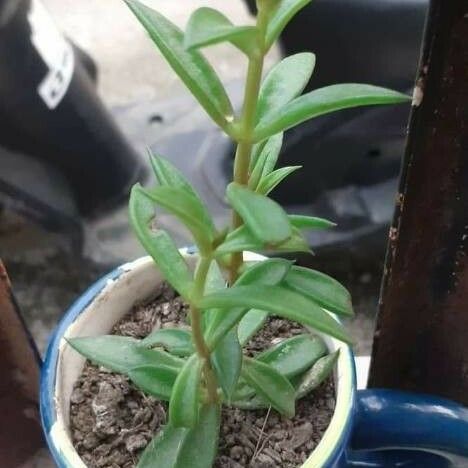
Plant Overview
Commonly known as the Texas Stonecrop or Coastal Sedum, this resilient little succulent is a true survivor of the Rio Grande Valley and the coastal sands of South Texas. Often found forming dense, jewel-like carpets in rocky crevices, it has earned a reputation among collectors for being "tougher than nails." Its dusty, muted colors allow it to blend into the landscape until it erupts with bright, starry blooms.
🔍 How to Identify
- 🍃 The Foliage: Look for thick, fleshy leaves that are slightly concave (trough-shaped), often appearing in shades of olive green, brownish-purple, or greyish-lilac.
- ⭐ The Flowers: In late fall or winter, it produces slender, upright stalks topped with tiny, five-petaled yellow flowers that provide a sharp contrast to the dusky leaves.
- 📐 Growth Pattern: It grows in low-profile rosettes that rarely exceed a few inches in height, though the flower spikes can reach up to a foot tall.
🏡 In Your Garden
- 🏜️ The "Dry Feet" Rule: Because this plant evolved in semi-arid coastal environments, it is highly susceptible to root rot. It thrives in gritty, sandy soil and requires excellent drainage—think of it as a plant that prefers a "drought and drench" cycle over consistent moisture.
- 🌱 Natural Spreader: One of its most fascinating (and sometimes frustrating) traits is how easily it propagates. A single leaf knocked off by a passing animal or a heavy rain can quickly take root and start a brand-new colony, making it an excellent, low-maintenance groundcover for rock gardens.
⚠️ Safety & Toxicity
- ✅ Status: Generally considered non-toxic.
- 🐾 Details: Unlike some other succulent families (like Euphorbia or Kalanchoe), the Texas Stonecrop is not known to be poisonous to cats, dogs, or humans. However, as with any plant not meant for consumption, ingesting large amounts may cause mild stomach upset in curious pets.
✨ Fun Fact
The name Lenophyllum is derived from the Greek words lenos (meaning "trough" or "basin") and phyllon (meaning "leaf"), referring to the distinct hollowed-out, boat-like shape of its succulent leaves!

Detailed Care Instructions
To grow Lenophyllum Texanum, also known as Stonecrop or Texas Silverleaf, follow these steps:
- Choose a suitable location: Lenophyllum Texanum thrives in full sun and well-drained soil. Ensure the location gets at least six hours of direct sunlight each day.
- Prepare the soil: Make sure the soil is well-draining, as the plant is susceptible to rot in overly wet conditions. If the soil is heavy or clayey, amend it with organic matter like compost or sand to improve drainage.
- Planting: Dig a hole that is slightly larger than the plant's root ball. Gently remove the plant from its container and place the root ball into the hole. Backfill the hole with soil, ensuring that the plant is at the same level as it was in the container. Firmly press down the soil around the base of the plant.
- Watering: Water the plant immediately after planting to help settle the soil. Afterward, water regularly to keep the soil slightly moist but not overly saturated. Avoid overhead watering, as the leaves of Lenophyllum Texanum can be prone to fungal diseases.
- Fertilization: Lenophyllum Texanum is not a heavy feeder. You can apply a balanced slow-release fertilizer in spring to provide nutrients for the growing season. Avoid excessive fertilization, as it can lead to leggy growth and reduced flowering.
- Pruning: Prune any dead or diseased branches to maintain the plant's health and appearance. Additionally, you can trim back the plant in early spring to remove old growth and encourage new growth. Trimming also helps promote bushier, more compact growth.
- Propagation: Lenophyllum Texanum can be propagated from stem cuttings or by division. Stem cuttings should be taken in spring or summer and allowed to callus before planting in well-draining soil. To divide the plant, carefully remove it from the ground, separate the root clump into smaller sections, and replant them.
- Pest and disease control: Lenophyllum Texanum is generally resistant to pests and diseases. However, watch out for signs of scale insects or mealybugs. If detected, use an appropriate organic insecticide to control the infestation.
By following these steps, you should be able to successfully grow Lenophyllum Texanum and enjoy its attractive foliage and flowers.

Place in a bright room that is sun drenched almost all day. Or directly in a south-facing window.

Lenophyllum Texanum plant is a succulent plant that requires moderate watering. It is essential to know the moisture requirements of the plant before watering it. One should avoid overwatering, as it may damage the plant's roots and cause root rot. The best way to water this plant is to allow the soil to dry out completely before watering it again. It is best to water it deeply once a week during the growing season, and reduce watering to every 2-3 weeks during the dormant season. It is also crucial to use well-draining soil and a pot with drainage holes, allowing excess water to drain away. In case of hot weather conditions, watering should be increased but still carefully to avoid overwatering.
To fertilize this plant, use a balanced fertilizer with equal amounts of nitrogen, phosphorus, and potassium during the growing season. Apply the fertilizer once a month, being careful not to over-fertilize as this can lead to burnt leaves. Water the plant thoroughly before and after fertilization to avoid root burn. During the dormant season, reduce fertilization to every 2-3 months.
The ideal growing medium for this particular plant would be a well-draining soil that is rich in nutrients. It is recommended to use a mix of sand, perlite, and peat moss in equal proportions to create a loose and airy soil that will allow water to drain freely. The addition of compost or organic fertilizers to the soil will help to provide the necessary nutrients for healthy growth. It is important to avoid using heavy or compacted soils that may retain too much moisture and cause root rot. A pH level between 6.0 and 7.5 is also recommended for optimal growth and development.
To propagate this plant, you will need to take stem cuttings from a mature plant during the spring or summer months. The cutting should be approximately 3-4 inches long and cut just below a leaf node. After removing the lower leaves from the stem, dip the cut end in rooting hormone and plant it in a container filled with well-draining soil. Keep the soil moist but not overly wet and place the container in a location with bright but indirect light. Within a few weeks, the cutting should start to root and new growth will appear. Once the new plant has grown root system and has started to produce new leaves, it can be transplanted into a larger container or directly into the garden bed.
Common pests of the coastal stonecrop include Mealybugs, aphids, thrips. Make a habit of checking your coastal stonecrop frequently for pests so that any infestations can be caught and managed early.








