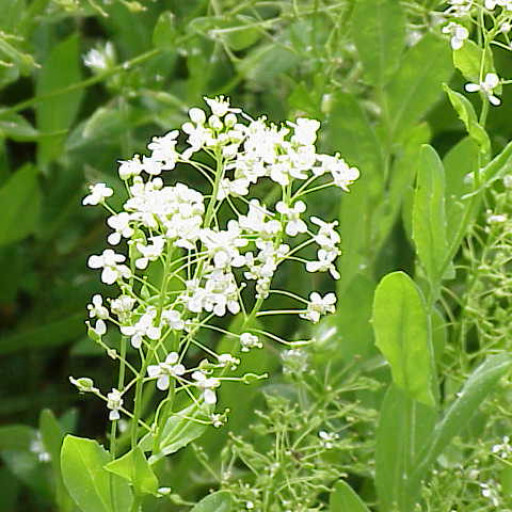
Plant Overview
Known to many as Whitetop or Hoary Cress, Lepidium draba is a deceptive beauty of the mustard family. While it blankets fields in what looks like a soft, white lace, this Eurasian native is a master of survival and expansion. In many parts of the world, it is considered a "noxious weed" because of its incredible ability to crowd out native plants and take over entire landscapes.
🔍 How to Identify
- ☁️ The Bloom: Tiny, white, four-petaled flowers grow in dense, flat-topped clusters, giving the plant a snowy or "hoary" appearance from a distance.
- 🏹 The Leaves: Grayish-green leaves are shaped like arrows or hearts and uniquely "clasp" the stem at the base, meaning they wrap around it without a leaf stalk.
- 🌱 Growth Habit: It typically grows about 1 to 2 feet tall and often appears in large, thick colonies rather than as single, isolated plants.
🏡 In Your Garden
- 🛡️ The Underground Empire: If you find this in your garden, be aware that it spreads primarily through an aggressive, deep-reaching root system. A single plant can send out horizontal roots that produce dozens of new shoots, making it very difficult to "just pull out."
- 🚜 Persistence is Key: Because even a small fragment of root can regenerate into a full plant, tilling the soil often makes the problem worse. It thrives in disturbed soil and is often seen along roadsides or in overgrazed pastures.
⚠️ Safety & Toxicity
- 🐾 Livestock Warning: While not typically "deadly" to humans, it contains glucosinolates which can cause stomach irritation if eaten in large quantities. It is generally avoided by cattle but can be problematic if it gets mixed into harvested hay.
- 🐕 Pet Safety: Keep an eye on curious dogs; while not high-risk, grazing on these tough, peppery leaves can lead to mild digestive upset or vomiting.
✨ Fun Fact
Long before modern spices were easily available, the seeds of Lepidium draba were sometimes used as a substitute for black pepper. This earned the plant the old nickname "Thanet Cress" in parts of England, though its flavor is significantly more bitter than the real thing!

Detailed Care Instructions
| Toxicity | Poisonous |
To grow Lepidium draba, also known as hairy whitetop or hoary cress, you can follow these steps:
- Soil preparation: Lepidium draba prefers well-draining soil. Prepare the planting area by removing any weeds and grasses. Loosen the soil to a depth of about 6 inches and mix in organic compost or well-rotted manure to improve fertility.
- Seed selection and sowing: Purchase Lepidium draba seeds from a reputable source. Sow seeds in early spring or fall when the soil temperature is around 60-70°F (15-21°C). Lightly scatter the seeds over the prepared soil, ensuring they are evenly spaced. Cover the seeds with a thin layer of soil and gently tamp it down.
- Watering: Keep the soil consistently moist but not waterlogged until the seeds germinate. After germination, water the plants regularly, especially during dry periods. Aim to keep the soil evenly moist, but avoid overwatering as this plant can tolerate some drought.
- Sunlight and temperature: Lepidium draba thrives in full sun to partial shade. Choose a location that receives at least 6 hours of direct sunlight per day. This plant is adaptable to a wide range of temperatures and can tolerate both cold winters and hot summers.
- Fertilization: Lepidium draba generally doesn't require heavy fertilization. If your soil lacks nutrients, you can apply a balanced, slow-release fertilizer once or twice a year. Follow the instructions on the fertilizer packaging for application rates.
- Weed control: Lepidium draba is known to be invasive, so regular weeding is necessary to prevent it from spreading unchecked. Hand-pull any weeds that appear near the plant to avoid competition for nutrients and space.
- Pruning and maintenance: Trim back any dead or damaged foliage as needed to maintain the plant's appearance. This will also help prevent diseases and pests.
- Harvesting: If you wish to harvest seeds, allow the plants to flower and produce seed pods. Harvest the seeds when they turn brown and dry. Keep in mind that this plant can be weedy and may be restricted in some areas due to its invasive nature.
Always check with local authorities or extension services to ensure that Lepidium draba is not considered an invasive species in your area before attempting to grow it.

Place in a bright room that is sun drenched almost all day. Or directly in a south-facing window.

Lepidium Draba is a plant that requires regular watering for optimal growth and health. To water this plant, one must ensure that the soil remains moist but not waterlogged. The frequency of watering will depend on various factors such as the climatic condition, humidity levels, and the type of soil. As a general rule, the plant should be watered when the topsoil has dried out.
One can water Lepidium Draba plant either through manual watering with a watering can or through a drip irrigation system. While watering manually, one should ensure to water the soil, avoiding water on the foliage and flowers. Drip irrigation is a more precise and efficient means of watering the plant, which delivers water directly to the roots while minimizing water wastage.
Another crucial consideration is the choice of water used to irrigate Lepidium Draba plant. It is essential to use clean and fresh water, avoiding the use of hard or chlorinated water. Chlorine can harm the microbes present in the soil, leading to nutrient deficiencies in the plant.
Overall, regular and timely watering is essential for the optimal growth and health of Lepidium Draba plant. One must ensure to provide adequate water while avoiding overwatering that can lead to root rot and other diseases.
To fertilize this plant, choose a balanced fertilizer with equal parts nitrogen, phosphorus, and potassium. Apply the fertilizer at half strength every two to three weeks during the growing season, which is typically spring and summer. Avoid over-fertilizing as it can lead to adverse effects on the plant's growth and health. Instead, monitor the plant's appearance and adjust the fertilization schedule as needed. Additionally, water the plant thoroughly before and after fertilizing to help the nutrients reach the roots.
Lepidium Draba plant prefers well-drained soil that is slightly alkaline with a pH level between 7.0 and 8.0. The soil should be rich in organic matter and nutrients, but not too heavy or compacted. Sandy loam or loamy soil is ideal for this plant. It should be moist, but not waterlogged, as excessive water can lead to root rot. It is recommended to add some perlite or sand to the soil mixture to increase drainage. Avoid using soil that is too acidic or too clayey, as it can inhibit the growth and development of the Lepidium Draba plant. Additionally, fertilizer may be added to the soil to promote growth, but it should be used in moderation to prevent burning the roots of the plant.
Propagation of this plant can be done through seed propagation or vegetative propagation. For seed propagation, seeds can be sown directly in the soil or started indoors and transplanted outdoors once they have sprouted and developed a strong root system. For vegetative propagation, stem cuttings or root cuttings can be taken from a mature plant and rooted in a nutrient-rich soil mix. It is important to keep the soil moist and provide adequate sunlight for successful propagation.








