Plant Overview
Known as the Clasping Pepperweed or Shield Cress, this unique member of the mustard family is a master of disguise. It is famous for its "Dr. Jekyll and Mr. Hyde" foliage, where the bottom of the plant looks completely different from the top. Often found in dry, sun-baked plains and roadsides, it has a rugged, pioneer spirit, moving into disturbed soils where other plants might struggle to take root.
🔍 How to Identify
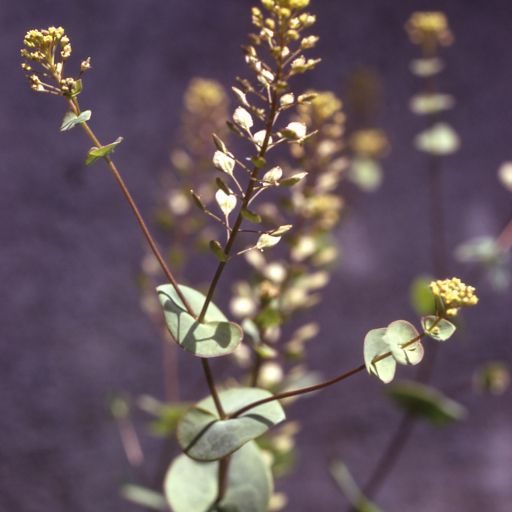
- 🍃 Dual Foliage: The plant features a striking contrast in leaves; the lower leaves are finely divided and feathery (like a fern), while the upper leaves are smooth, heart-shaped, and waxy.
- ⭕ Perfoliate Leaves: The upper leaves are "perfoliate," meaning the base of the leaf completely encircles the stem. This makes the stem look like it is growing directly through the center of a green disc.
- 🌼 Tiny Yellow Blooms: It produces dense, terminal clusters of very small, four-petaled flowers that start as a pale yellow and fade to white as they mature.
🏡 In Your Garden
- 🌱 The Pioneer Spirit: If this plant pops up in your yard, it’s likely telling you something about your soil. It thrives in disturbed, compacted, or nutrient-poor earth, often appearing after construction or heavy tilling.
- ☀️ Drought Specialist: Because of its deep taproot and waxy upper leaves, it is incredibly drought-tolerant. It doesn't need supplemental watering and will happily bake in the summer heat while other garden plants wilt.
⚠️ Safety & Toxicity
- ✅ General Safety: Clasping Pepperweed is generally considered non-toxic to humans and pets. It belongs to the Brassicaceae family, making it a distant cousin to broccoli and kale.
- 🚜 Nitrate Warning: While not inherently poisonous, this plant is known to accumulate nitrates from the soil, especially in agricultural areas. Foraging it for food is discouraged as high nitrate levels can be harmful if consumed in large quantities.
✨ Fun Fact
The botanical name perfoliatum is Latin for "through the leaf," a perfect description of the plant's most famous party trick—the way its stem pierces right through its shield-like upper foliage.

Detailed Care Instructions
To grow Lepidium perfoliatum, also known as Clasping pepperweed, you can follow these steps:
- Planting: Choose a location that receives full sun to partial shade. Lepidium perfoliatum prefers well-draining soil. You can start growing it either from seeds or transplants.
- Seeds: Sow the seeds directly into the soil in early spring or fall, as per your climate. Prepare the soil by removing any weeds or debris and rake it to create a fine texture. Scatter the seeds on the soil surface, then rake lightly to cover them with a thin layer of soil. Water gently to keep the soil moist until germination occurs.
- Transplants: Alternatively, you can start growing Lepidium perfoliatum from nursery-bought transplants. Dig a hole slightly larger than the rootball, place the transplant in the hole, and cover with soil. Water thoroughly after planting.
- Watering: Lepidium perfoliatum requires regular watering, especially during dry periods. However, ensure you don't overwater as it can cause root rot. Keep the soil moist but not waterlogged.
- Fertilizing: Generally, Lepidium perfoliatum doesn't require heavy fertilization. However, you can apply a balanced, slow-release fertilizer once or twice during the growing season to provide essential nutrients. Follow the manufacturer's instructions on the fertilizer packaging.
- Mulching: Apply a layer of organic mulch, such as straw or wood chips, around the base of the plant to help retain moisture, prevent weed growth, and maintain a more stable soil temperature.
- Pruning: Pruning is not typically necessary for Lepidium perfoliatum. However, you can trim back any dead or damaged branches to maintain its shape and appearance.
- Pest and disease control: Lepidium perfoliatum is generally resistant to pests and diseases. However, keep an eye out for common garden pests like aphids, caterpillars, or snails. If you notice any infestation, you can manually remove them or use an appropriate organic pesticide.
- Harvesting: Clasping pepperweed is edible and can be harvested before it flowers to use in salads, stir-fries, or as a garnish. Make sure to positively identify the plant before consumption and wash it thoroughly before usage.
Remember to check your local regulations before growing Lepidium perfoliatum, as it is considered invasive in some areas.

Place in a bright room that is sun drenched almost all day. Or directly in a south-facing window.

To water this particular plant, it is important to first consider the environment in which it is growing. The plant requires consistently moist soil, but it is also important to avoid overwatering, which can lead to root rot.
To accomplish this balance, the plant should be watered deeply but infrequently. This means that a thorough watering should be given when the top inch of soil feels dry, but the plant should not be watered again until the soil has had a chance to dry out slightly.
It is also important to water the plant at the base, avoiding getting the leaves and stems wet, as this can contribute to the development of fungal diseases. Watering in the morning or early in the day is recommended, as this allows the plant to dry out before cooler evening temperatures set in.
Overall, providing consistently moist but well-draining soil and avoiding overwatering is key to successful watering of this plant.
To fertilize this plant, use a balanced fertilizer with an N-P-K ratio of 10-10-10 or 15-15-15. Apply the fertilizer at half strength every two weeks during the growing season, and reduce fertilization during the winter months. Make sure to water the plant thoroughly before and after fertilization to avoid fertilizer burn.
The Lepidium perfoliatum plant thrives best in a well-draining, nutrient-rich soil with a neutral to slightly acidic pH level. It requires soil that is loose, fertile and moist, but not waterlogged. Organic matter such as compost or well-rotted manure can be added to the soil before planting to improve soil quality. Additionally, adding sand to the soil can enhance drainage and prevent waterlogging. The plant prefers soil that is not too heavy or compacted, as this can restrict root growth and hinder nutrient and water uptake. Regular fertilization and adequate watering are also essential for proper growth and development of the plant.
To propagate this plant, first prepare a well-draining soil mixture with equal parts sand, perlite, and peat moss. Take stem cuttings from healthy mature plants, making sure to include at least two nodes on each cutting. Remove the lower leaves and dip the cuttings in rooting hormone powder.
Plant the cuttings in the prepared soil mixture and water them thoroughly. Cover the container with a clear plastic bag to create a humid environment. Place the container in a bright, indirect light location and keep the soil moist but not waterlogged.
After a few weeks, new growth should appear on the cuttings, indicating successful rooting. Remove the plastic bag and gradually acclimate the new plants to normal room conditions by gradually removing the cover for longer periods each day. Once the plants have become accustomed to the normal environment, they can be transplanted into larger containers or directly into the ground.








