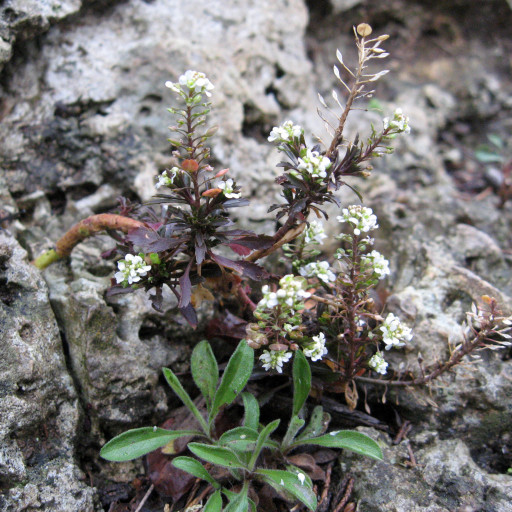
Plant Overview
Often called "Poor Man’s Pepper" or "Bird’s Pepper," Lepidium virginicum is a hardy North American native that thrives where other plants struggle. While many gardeners dismiss it as a mere weed, it has a long history as a wild culinary spice, offering a zesty, radish-like kick. Its delicate, wand-like flower stalks give it a whimsical, airy appearance that belies its tough-as-nails personality.
🔍 How to Identify
- 🌿 Leaf Structure: It begins its life as a flat rosette of lobed leaves on the ground, eventually sending up branched stems with narrow, tooth-edged leaves.
- ⚪ The Flowers: Tiny, four-petaled white flowers cluster at the tips of the stems in a "bottle-brush" arrangement that continuously grows upward.
- 🎈 Seed Pods: Look for the distinctive flat, heart-shaped or circular seed pods (siliques). They look like miniature green sequins with a tiny notch at the top.
🏡 In Your Garden
- 🌱 Soil Pioneer: This plant loves "disturbed" ground. If you’ve recently tilled a bed or have a gravel driveway, Pepperweed is likely to be the first guest to arrive. It actually helps stabilize loose soil with its taproot.
- ☀️ Sun Seeker: It is an extreme sun-lover. While it doesn't need high-quality soil, it does require bright light to produce its signature peppery seeds. If it pops up in your garden, it’s a sign that the area has excellent drainage.
⚠️ Safety & Toxicity
- 🥗 Edibility: The young leaves and green seed pods are edible for humans and taste remarkably like black pepper or horseradish. However, never harvest them from roadsides where they may have absorbed vehicle exhaust or heavy metals.
- 🐾 Pets & Kids: It is generally considered non-toxic, but like many members of the mustard family, eating large quantities can cause mild stomach irritation or "wasabi-like" burning in the mouth for sensitive pets or toddlers.
✨ Fun Fact
The "peppery" bite of this plant comes from glucosinolates—the same chemical compounds found in wasabi and horseradish. This isn't just for flavor; it’s a sophisticated chemical defense system designed to ward off hungry caterpillars!

Detailed Care Instructions
To grow Lepidium Virginicum, which is commonly known as Virginia pepperweed or Virginia peppergrass, follow these steps:
- Select a suitable location: Virginia pepperweed prefers full sun but can tolerate partial shade. Choose an area with well-draining soil.
- Prepare the soil: Loosen the soil using a garden fork or tiller. Remove any weeds, rocks, or debris. Mix in organic matter like compost to improve the soil's fertility and drainage.
- Sow the seeds: Scatter the seeds directly onto the prepared soil. Virginia pepperweed seeds need light to germinate, so do not cover them with soil. Press the seeds lightly into the soil to ensure good contact.
- Watering: Keep the soil consistently moist, but not waterlogged. Water the seeds gently using a fine mist to avoid dislodging them.
- Germination: Virginia pepperweed seeds will usually germinate within 5-10 days. Maintain moisture during this period to support germination.
- Thin the seedlings: Once the seedlings have grown to around 2-3 inches tall, thin them to allow proper spacing. Maintain a spacing of about 6-8 inches between the plants.
- Watering and care: Regularly water the plants to keep the soil slightly moist. Avoid overwatering as it can promote disease and root rot. Mulching around the plants can help conserve moisture and suppress weeds.
- Fertilization: Lepidium Virginicum doesn't require much fertilization. However, if your soil is poor, you can apply a balanced fertilizer once or twice during the growing season.
- Control weeds: Remove any weeds that compete with the Virginia pepperweed plants for nutrients and space. Be careful not to disturb the plants' shallow roots while weeding.
- Harvesting: Virginia pepperweed is an edible plant. Young leaves can be harvested for salads or used as a spice in cooking. Harvesting should be done before the plants flower. When flowers appear, the leaves become tougher and more peppery in taste.
Note: Virginia pepperweed can grow aggressively and become invasive in some areas. It is advisable to check with your local extension office or authorities to ensure it is suitable and not categorized as an invasive species in your region.

Place in a window with dappled sun or a spot in the middle of a room. Or directly in a window facing west or east.

To water this plant, you should thoroughly saturate the soil around the base of the plant, ensuring that water reaches the root zone. It is important to avoid getting water on the leaves as this can encourage fungal growth and disease. Allow the soil to dry slightly between waterings, but do not let it completely dry out as this can lead to wilting and damage to the plant. It is recommended to water this plant in the morning or evening when temperatures are cooler and the sun is less intense.
To fertilize this plant, use a balanced fertilizer with equal amounts of nitrogen, phosphorus, and potassium. Apply the fertilizer every four to six weeks during the growing season, which is typically from spring to fall. Be sure to water the plant before and after fertilizing to avoid burning the roots. Avoid over-fertilizing as it can cause damage to the plant. Also, be sure to read the fertilizer label for specific instructions on applying the product and to ensure that it is appropriate for your plant.
The best type of soil to use with the Lepidium Virginicum plant is a well-draining, loamy soil with a slightly acidic to neutral pH level. It is important to ensure that the soil is not too compacted and has good aeration to promote healthy root growth. Adding organic matter such as compost or leaf litter to the soil can improve soil texture, fertility, and moisture retention. Avoid using heavy clay soils or soils that are too sandy as these do not provide the necessary nutrients and water retention needed for optimal growth.
There are several ways to propagate this plant. One method is through seeds. Collect mature seeds from the plant and sow them in well-draining soil in a container or directly in the ground. Make sure the soil stays moist but not waterlogged.
Another method is through stem cuttings. Take a cutting from a healthy stem, ensuring that it has at least a few leaves. Remove the lower leaves and dip the cut end in rooting hormone. Place the cutting in a well-draining soil mixture and keep it in a warm, bright location. Keep the soil moist but not waterlogged.
Division is also a possible method. Carefully separate the roots of a mature plant into smaller sections, ensuring that each section has a healthy root system. Plant the divisions in well-draining soil and water thoroughly.
Regardless of the propagation method used, it's important to keep the new plants in a warm, bright location and to keep the soil moist but not waterlogged until they establish themselves.
Common pests of the virginia peppergrass include Aphids, larvae, snails. Make a habit of checking your virginia peppergrass frequently for pests so that any infestations can be caught and managed early.








