Plant Overview
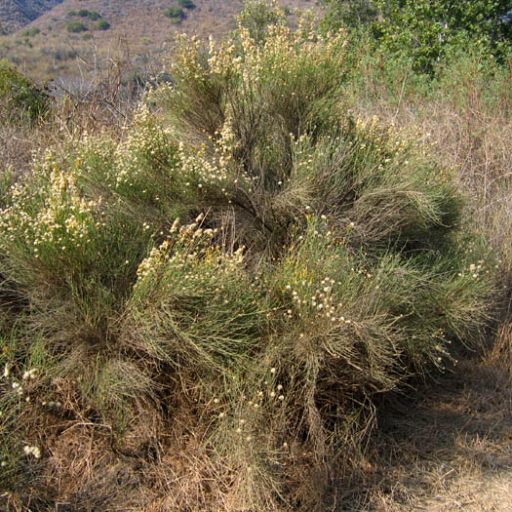
Often called the Scale Broom or California Broamsage, Lepidospartum squamatum is a master of disguise in the arid washes of the American Southwest. This native shrub looks like a bundle of gray, leafless twigs for most of the year, but it is actually a vital "pioneer species" that helps stabilize sandy soils after seasonal floods. Its name comes from the tiny, scale-like leaves that cling to its stems, a clever adaptation designed to prevent water loss in the scorching desert sun.
🔍 How to Identify
- 🌿 The Stems: The plant is dominated by rigid, broom-like branches that are covered in fine, felt-like gray hairs, giving the entire shrub a silvery-green or ghostly appearance.
- 🍃 The "Scales": On mature branches, the leaves are reduced to tiny, triangular scales that lie flat against the stem. Younger shoots may have larger, spoon-shaped leaves that disappear as the plant ages.
- 🌼 The Flowers: In late summer and autumn, the tips of the branches erupt in small, bright yellow flower heads. Unlike daisies, these flowers consist only of "disk florets," looking like fuzzy golden buttons.
🏡 In Your Garden
- 🏜️ Natural Xeriscaping: This is a perfect choice for native plant enthusiasts living in dry climates. It thrives in "wash" conditions—meaning it loves sandy, gravelly soil that drains instantly and doesn't mind the occasional heavy soaking.
- 🌱 Deep Root System: Because it evolved to survive in flood-prone sandy areas, it develops a deep taproot quickly. It is notoriously difficult to transplant once established, so choose its "forever home" in your garden carefully.
- 🦋 Pollinator Magnet: While it may look rugged and dry, its late-season blooms provide a critical nectar source for native bees and butterflies when most other desert plants have already gone dormant.
⚠️ Safety & Toxicity
- ✅ General Safety: Scale Broom is not considered a high-risk toxic plant for humans or common garden pets. It lacks the sharp thorns found on many other desert shrubs.
- 🤧 Respiratory Sensitivity: Like many members of the Aster (sunflower) family, the pollen or the fine hairs on the stems may cause mild irritation or hay fever for sensitive individuals during its blooming season.
✨ Fun Fact
The Scale Broom is a "breathable" plant! Because it has so few leaves, it performs most of its photosynthesis directly through its green stems. This allows the plant to keep creating energy even during extreme droughts when other plants would be forced to drop their leaves and go dormant.

Detailed Care Instructions
To grow Lepidospartum squamatum plant, also known as scale broom or scale shrub, follow these steps:
- Climate and soil conditions: Lepidospartum squamatum is native to regions with mild, Mediterranean climates. It grows well in full sun and well-drained sandy or loamy soil. Ensure that the soil pH is slightly acidic to neutral.
- Propagation: It can be propagated from seeds or cuttings. Seeds should be sown in late winter or early spring. Soak the seeds in water for 24 hours before sowing them in seed trays or pots filled with a well-draining potting mix. Keep the soil consistently moist until the seeds germinate, which may take several weeks. Once the seedlings have grown a few inches tall, transfer them into individual pots.
- Planting: Transplant the seedlings, or plant nursery-bought Lepidospartum squamatum, in the desired spot in your garden or a large container. Make sure there is enough space between plants for proper growth, as they can reach a height of 3-4 feet (1-1.2 meters). Ensure that the soil around the plant is firm, but not compacted.
- Watering: While Lepidospartum squamatum is drought-tolerant once established, it is crucial to provide regular watering during the first year to help it establish a deep root system. Water the plant deeply once or twice a week, allowing the soil to dry out slightly between watering. After the first year, reduce watering frequency, as it prefers drier conditions.
- Pruning: Prune the plant lightly in late winter or early spring to maintain its desired shape. Remove any dead, damaged, or overcrowded branches to allow for better airflow and overall health.
- Fertilization: Lepidospartum squamatum generally does not require much fertilization. If necessary, apply a slow-release, low-nitrogen fertilizer in spring. Avoid excessive fertilization, as it can encourage excessive leaf growth at the expense of blooming.
- Protection: Lepidospartum squamatum is generally resistant to pests and diseases. However, ensure it has good air circulation and avoid overwatering to prevent potential fungal diseases.
- Mulching: Apply organic mulch around the base of the plant to retain moisture, suppress weeds, and provide some insulation for the roots during extreme temperatures.
Remember, it may take a few years for the Lepidospartum squamatum plant to reach its full maturity and start blooming. Patience and proper care are essential for its successful growth.

Place in a bright room that is sun drenched almost all day. Or directly in a south-facing window.

Lepidospartum squamatum plant should be watered deeply and infrequently to avoid overwatering and root rot. One should let the soil dry out completely between watering. The amount and frequency of watering depend on the climate and humidity level. It is best to water in the early morning or evening to avoid evaporation during hot weather. Additionally, one should avoid putting water on the leaves to prevent the risk of fungal diseases.
To fertilize this plant, you should use a balanced fertilizer with equal amounts of nitrogen, phosphorus, and potassium. Apply the fertilizer at a rate of 1/4 to 1/2 pound per 100 square feet of soil. This should be done in the early spring before the plant begins to grow. Be sure to water the plant thoroughly after applying the fertilizer. Do not over-fertilize or you may damage the plant.
Lepidospartum Squamatum plants prefer well-draining soil with a pH of 6.5 to 7.5. The soil should be mostly sandy with some loam and clay. Adding organic matter to the soil can help improve drainage and fertility. It is also important to avoid soils with high levels of salt or alkalinity, as this can harm the plant. In general, a soil mix of 50% sand, 30% loam, and 20% clay, with added organic matter, should be suitable for growing Lepidospartum Squamatum plants.
To propagate this plant, first select a healthy and mature specimen. Take a cutting from the plant, ideally in the spring or summer months. Make sure the cutting is roughly 4-6 inches long and has at least two leaves attached.
Remove the lower set of leaves on the cutting, leaving only the topmost two leaves. Dip the cut end of the stem in rooting hormone powder and plant it in a well-draining soil mixture.
Water the cutting well and cover it with a clear plastic bag or dome to create a humid environment that will aid in root development. Make sure to keep the soil moist but not waterlogged.
Place the cutting in a spot with bright but indirect light. After a few weeks, check for root development by gently tugging on the stem. If there is resistance, roots have formed and the plant has successfully propagated. Remove the plastic cover and transplant the new plant into a larger pot or outside in a well-draining soil with full sun exposure.








