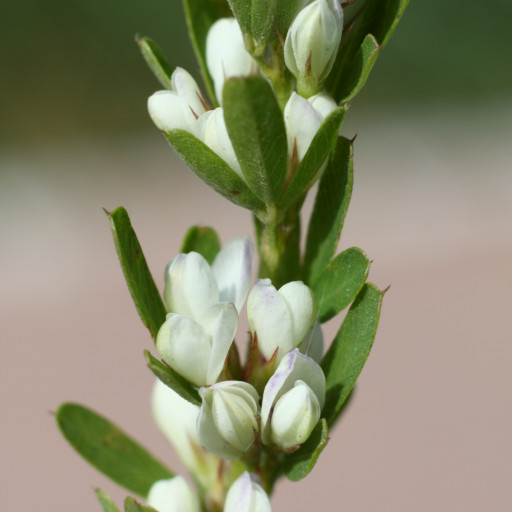
Plant Overview
Known as the "Poor Man’s Alfalfa" or Chinese Bushclover, Lespedeza cuneata is a hardy perennial from East Asia that is a master of survival. While it was originally introduced to many regions to prevent soil erosion and provide forage, its stubborn nature has earned it a reputation as a persistent "invader" that refuses to leave once it feels at home. It is admired by some for its delicate flowers and despised by others for its aggressive growth.
🔍 How to Identify
- 🍃 Wedge-Shaped Leaves: The plant features trifoliate leaves (clusters of three). Each leaflet is narrow and wedge-shaped, often with a tiny, sharp point at the tip that looks like a miniature needle.
- 🌸 Pea-Like Blooms: In late summer, you’ll see clusters of small, creamy-white to pale yellow flowers. If you look closely, the center of the flower usually has a distinct purple or pink "honey guide" to attract pollinators.
- 🌿 Silvery Sheen: The stems are upright, woody, and covered in fine, silvery hairs, giving the entire plant a slightly grayish-green or "frosted" appearance from a distance.
🏡 In Your Garden
- ⛰️ The Ultimate Pioneer: This plant is a nitrogen-fixer, meaning it creates its own fertilizer from the air. This allows it to thrive in "dead" soil, rocky slopes, and clay where nothing else grows. However, this also means it can quickly take over a garden bed if not managed.
- ⛏️ The Taproot Trap: If you find this in your yard and want to move it, do it early! It develops a deep, woody taproot that anchors it firmly into the earth. Once established, pulling it by hand is nearly impossible and often results in the plant snapping and regrowing from the base.
⚠️ Safety & Toxicity
- 🐾 General Safety: Lespedeza cuneata is generally non-toxic to humans, dogs, and cats. It is actually used as high-protein forage for goats and cattle.
- 👅 The Tannin Factor: As the plant matures, it produces high levels of tannins. While not poisonous, these chemicals make the plant taste very bitter and can interfere with protein digestion in some animals if eaten in massive quantities.
✨ Fun Fact
- ⏳ Time Travelers: The seeds of the Sericea Lespedeza are incredibly resilient; they have a "hard coat" that allows them to stay dormant in the soil for over 20 years, waiting for the perfect conditions to finally sprout!

Detailed Care Instructions
| Lighting | Full Sun |
| Hardiness Zones | 5A - 9B |
To grow Lespedeza cuneata, also known as sericea lespedeza, you can follow these steps:
- Choose the right location: Lespedeza cuneata prefers full sun to partial shade. Select an area in your garden that receives at least 6-8 hours of direct sunlight per day.
- Prepare the soil: Lespedeza cuneata prefers well-draining soil with a pH level between 6 and 7. If your soil is heavy clay or lacks nutrients, consider amending it with organic matter such as compost or aged manure.
- Sow the seeds: Lespedeza cuneata can be grown from seeds. It is best to sow the seeds directly into the ground in spring or early summer, after the danger of frost has passed. Prepare the soil by raking it gently, then scatter the seeds evenly. Lightly press the seeds into the soil, ensuring good seed-to-soil contact.
- Water and maintain: Keep the soil consistently moist until the seeds germinate, which usually takes around 7-14 days. Water the plants regularly, especially during dry spells, to promote healthy growth. As the plants establish, they should become more tolerant to drought.
- Mulch: Apply a layer of organic mulch, such as straw or wood chips, around the base of the plants. Mulch helps retain soil moisture, suppress weeds, and regulate soil temperature.
- Pruning: Lespedeza cuneata benefits from pruning to maintain a more compact and bushier form. In late winter or early spring, before new growth emerges, prune the plants by cutting back about one-third of the stems. This will promote new growth and improve overall plant shape.
- Fertilize: Lespedeza cuneata is generally low-maintenance and does not require heavy fertilization. However, if your soil is nutrient-poor, you can apply a balanced slow-release fertilizer in early spring to provide essential nutrients for healthy growth.
- Control weeds: Regularly remove weeds around the Lespedeza cuneata plants to prevent competition for nutrients and water.
- Pests and diseases: Lespedeza cuneata is relatively resistant to pests and diseases. However, keep an eye out for common garden pests like aphids or leafhoppers. If necessary, treat the infestation with an appropriate organic or chemical insecticide.
- Enjoy the blooms: Lespedeza cuneata produces showy pink or purple flowers in late summer or early fall. Enjoy the beautiful blooms and the ecological benefits it provides, such as attracting pollinators and fixing nitrogen in the soil.

Place in a bright room that is sun drenched almost all day. Or directly in a south-facing window.

To water this plant, make sure the soil is dry to the touch before watering. Then, slowly pour water around the base of the plant until the soil is moist but not waterlogged. It is important not to over water this plant as it can lead to root rot. Check the soil regularly to ensure it stays evenly moist. Water more frequently in hot and dry weather. Avoid watering the leaves, as this can promote disease.
To fertilize this plant, use a balanced fertilizer with equal amounts of nitrogen, phosphorus, and potassium, applied in early spring and summer. Apply at a rate of 1/2 cup per plant, and water thoroughly after application to ensure the fertilizer penetrates the soil. Avoid over-fertilizing, as this can lead to excessive growth and decreased flowering.
Lespedeza cuneata is a perennial legume that has a deep root system and thrives in well-draining soils. It prefers soils that are slightly acidic to neutral, with a pH between 6.0 and 7.0. The ideal soil type for Lespedeza cuneata is sandy loam to loamy sand, as it allows for good root penetration and water drainage. The plant can also grow in other soil types, including clay and loam, as long as they are well-draining and have good fertility. It is important to note that Lespedeza cuneata is adapted to a range of soil types and can be grown in both upland and lowland soils. The addition of organic matter, such as compost or well-rotted manure, can benefit the plant's growth and productivity. It is also important to avoid soils that are contaminated with heavy metals, chemicals, or other pollutants that may negatively impact the plant's health and growth.
Lespedeza cuneata can be propagated by using seeds or through cuttings.
To propagate through seeds, collect the ripe seeds from the plant in fall and store them in a cool and dry place until spring. Sow the seeds in well-draining soil in a location with full sun exposure. Cover the seeds with a quarter inch of soil and keep the soil moist until the seeds germinate.
To propagate through cuttings, take stem cuttings from healthy and mature plants in the late fall or early spring. Cut the stem into 6-inch sections and remove the leaves from the bottom half. Dip the cut end of the stem into rooting hormone and plant it in a well-draining potting mix. Keep the soil moist and the cutting in a bright, warm location until new growth appears.
Once the new plants have grown, transplant them to their permanent location in full sun with well-draining soil. It is recommended to space the plants at least 3 feet apart to allow for optimal growth and spreading.








