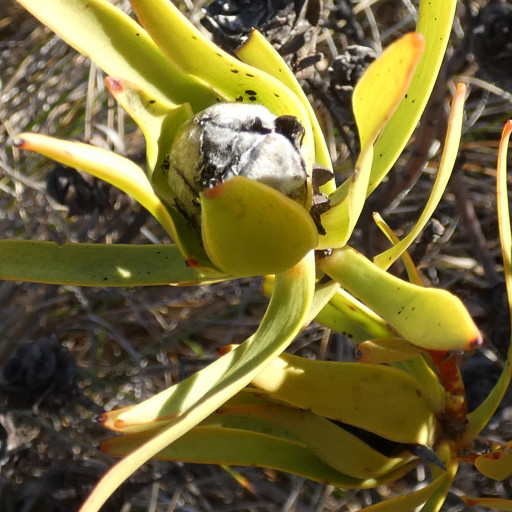
Plant Overview
Often called the Common Sunshine Conebush, this South African native is the golden child of the Cape Floristic Region. It is beloved by florists and gardeners alike for its ability to "glow" as its foliage shifts through a spectrum of yellows, oranges, and deep crimsons. Unlike many of its finicky relatives, this shrub is a rugged survivor, built to endure the harsh winds and fires of the fynbos.
🔍 How to Identify
- 🍃 Willow-like Foliage: It features long, narrow, and leathery leaves that resemble willow leaves (the name Salignum actually means "willow-like").
- 🎨 Vibrant Bracts: The "flowers" are actually modified leaves called bracts. These surround the true, smaller flower heads and provide the plant's intense seasonal color.
- 🪵 Woody Cones: After "blooming," the female plants produce hard, nut-like cones that persist on the branches, protecting the seeds until they are ready to be released.
🏡 In Your Garden
- ⛰️ The Soil Secret: This plant is part of the Protea family and possesses specialized "proteoid" roots. It thrives in nutrient-poor, acidic soil and can be killed by standard fertilizers—especially those high in phosphorus.
- 🔥 Fire Survivor: In the wild, it is a "resprouter." This means if a fire (or a very heavy pruning) cuts it back to the ground, it can regrow from a woody underground base called a lignotuber.
- 🌬️ Airflow is Key: It loves a breezy, open spot. Stagnant air and high humidity are its enemies, often leading to fungal leaf spots if the foliage stays wet for too long.
⚠️ Safety & Toxicity
- ✅ Non-Toxic: Leucadendron salignum is generally considered non-toxic to humans, cats, and dogs.
- 🧤 Pruning Protection: While not poisonous, the stems are very woody and the leaves can be stiff. It is always wise to wear gloves when pruning to avoid scratches or skin irritation from the sap.
✨ Fun Fact
👫 Distinct Genders: Leucadendrons are "dioecious," meaning individual plants are either male or female. The male plants are often more colorful to attract pollinators, while the female plants are the only ones that produce the iconic, long-lasting woody cones!

Detailed Care Instructions
To grow Leucadendron Salignum, also known as the Silvertree, you can follow these steps:
- Obtain seeds or seedlings: You can either purchase seeds or find seedlings at a local nursery or garden center. Make sure to choose healthy, disease-free plants.
- Choose the right location: Leucadendron Salignum prefers a sunny location with well-draining soil. Ensure that the soil pH is slightly acidic to neutral (between 5.5 and 7.0).
- Prepare the soil: Prior to planting, prepare the soil by loosening it and removing any weeds or debris. You can also add compost or organic matter to improve the nutrient content and drainage.
- Plant the seedlings or seeds: If using seedlings, dig a hole that is slightly wider and deeper than the root ball of the seedling. Place the seedling in the hole and backfill with soil, gently firming it down. If using seeds, sow them directly into the prepared soil at the recommended depth (usually around 1/4 inch or 6 mm).
- Water regularly: Water the plant thoroughly after planting and continue watering regularly. Leucadendron Salignum prefers a moderate amount of water, allowing the soil to dry out between watering. Avoid overwatering, as this can cause root rot.
- Apply mulch: Place a layer of mulch around the base of the plant to help retain moisture, suppress weed growth, and insulate the roots.
- Prune when necessary: Prune the plant to maintain its shape and encourage bushier growth. Cut back any dead, damaged, or overcrowded branches. It is best to prune in early spring before new growth appears.
- Fertilize sparingly: Leucadendron Salignum does not require heavy fertilization. Use a slow-release or controlled-release fertilizer with low phosphorus content once a year in spring. Follow the manufacturer's instructions for application rates.
- Protect from frost: If you live in a colder climate, protect the plant from frost by covering it or moving it indoors during extreme cold periods.
- Watch for pests and diseases: Monitor the plant for any signs of pests, such as aphids or spider mites. If necessary, apply appropriate organic or chemical treatments to control them. Also, keep an eye out for any signs of disease, such as fungal infections, and treat accordingly.
With proper care, Leucadendron Salignum should grow well and provide you with beautiful silvery foliage.

Place in a bright room that is sun drenched almost all day. Or directly in a south-facing window.

To properly water this plant, you should consider the soil type and the weather conditions. This plant prefers a well-draining soil that is not waterlogged, so avoid overwatering. During the warmer months, it may require more frequent watering, but still, make sure the soil is not saturated. Allow the soil to dry out slightly before watering again. In cooler months, watering can be reduced. Avoid getting water on the leaves as it may cause damage or fungal infections. It may also benefit from occasional misting to increase humidity, especially in dry environments.
The best time to fertilize the plant is in early spring, before new growth appears. Use a slow-release fertilizer with equal parts nitrogen, phosphorus, and potassium. Spread the fertilizer evenly around the base of the plant, avoiding contact with the leaves or stems. Water the plant thoroughly after fertilization to help distribute the nutrients. Repeat once or twice a year, but avoid fertilizing in the winter months.
Leucadendron Salignum plants thrive in well-draining soil that is rich in nutrients. The soil should be slightly acidic with a pH level between 5.5 and 6.5. It is recommended to use a mixture of sand, peat moss, and perlite to improve drainage and aeration. Additionally, adding organic matter such as compost or leaf mold can enhance the soil's fertility. It is important to avoid using heavy clay soil or soil that retains too much moisture, as this can lead to root rot and other fungal diseases.
To propagate this plant, take 4-6 inch cuttings from healthy, mature branches that have at least two sets of mature leaves. Remove any leaves from the bottom half of the cutting. Dip the cut end in rooting hormone powder and place it in a pot filled with well-draining soil. Keep the soil moist and provide bright, indirect light. Once roots start to form, usually after 4-6 weeks, transplant the cutting to a larger pot or directly into the garden.








