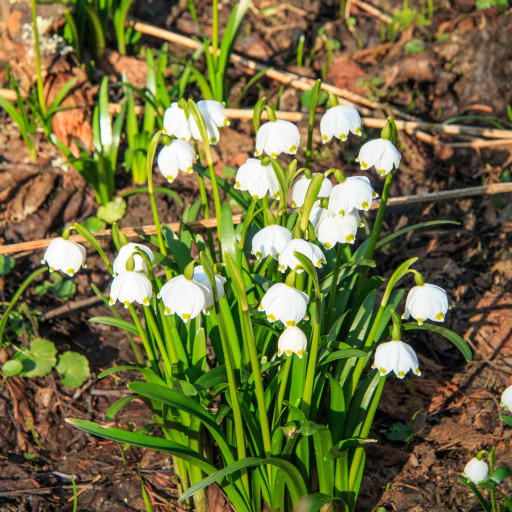
Plant Overview
Known as the Spring Snowflake, this charming woodland herald is often mistaken for its cousin, the Snowdrop. Carrying an air of delicate elegance, it is one of the first signs of life to pierce through the cold soil as winter fades. In European folklore, these nodding bells were often seen as a symbol of hope and purity, appearing even while snow still blankets the ground.
🔍 How to Identify
- 🌸 The Bloom: Six identical, creamy-white tepals (petals) that form a perfect, drooping bell shape.
- 🎨 The "Teardrop": A signature feature—each petal tip is marked with a distinct, small smudge of lime-green or yellowish-gold.
- 🌿 The Foliage: Long, narrow, strap-shaped leaves that are a deep, glossy green, typically growing in lush clumps about 8-12 inches tall.
🏡 In Your Garden
- 💧 Moisture Seeker: Unlike many bulbs that require a dry "baking" period, the Spring Snowflake thrives in damp, cool soil. It is an ideal choice for the edges of garden ponds or low-lying areas that stay moist.
- 🌳 Naturalizing: It loves the "woodland edge" lifestyle. Plant it under deciduous trees; it will soak up the early spring sun and then happily go dormant once the tree canopy provides shade in the summer.
- 🌱 Low Disturbance: This plant prefers to be left alone. It has a sensitive root system and doesn't enjoy being moved once established, but it will slowly spread to form beautiful, snowy carpets over several years.
⚠️ Safety & Toxicity
- 🚫 Toxic Status: Highly toxic if ingested.
- 🐾 Risk Level: The plant contains lycorine and other alkaloids. Keep it away from curious pets and children, as eating any part (especially the bulb) can cause nausea, vomiting, and dizziness.
- 🧤 Skin Sensitivity: While not as irritating as some plants, the sap can cause mild skin irritation for those with sensitive skin; wearing gloves while planting is a wise precaution.
✨ Fun Fact
While people often confuse them with Snowdrops (Galanthus), there is an easy trick to tell them apart: Snowdrops have three long outer petals and three short inner ones. The Spring Snowflake, however, is perfectly symmetrical with six petals of exactly the same length!

Detailed Care Instructions
| Humidity | Dry |
| Lighting | Part Sun |
| Difficulty | Easy |
| Plant Type | Bulb |
| Hibernation | Cold Period |
| Mature Size | Flower Stalks Are 8 To 10 Inches Tall |
| Hardiness Zones | 3-9 |
To grow the Leucojum Vernum plant, also known as the Spring Snowflake, you can follow these steps:
- Choose a suitable location: Leucojum Vernum plants prefer partial shade to full sunlight. They can adapt to a wide range of soil types, but well-draining soil with organic matter is ideal.
- Prepare the soil: Clear the area of weeds and rocks. Loosen the soil to a depth of 8-10 inches and mix organic matter such as compost or well-rotted manure into the soil to improve its fertility and drainage.
- Planting bulbs: Plant the bulbs of Leucojum Vernum in the fall, around September or October. Dig holes about 4-6 inches deep and space them 4-6 inches apart. Place the bulbs with the pointed end facing upwards and cover them with soil.
- Watering: Water the newly planted bulbs thoroughly to settle the soil around them. After that, water sparingly during the fall season and winter, as excessive moisture can cause the bulbs to rot.
- Maintenance: Leucojum Vernum plants are relatively low-maintenance. Once established, they require little watering except during prolonged dry spells. Apply a layer of mulch over the soil to retain moisture and suppress weeds.
- Fertilizing: In early spring, you can apply a balanced fertilizer or a slow-release bulb fertilizer according to the package instructions. This will nourish the bulbs and encourage healthy growth and flowering.
- Blooming period and care: Leucojum Vernum typically blooms in late winter to early spring. Enjoy the delicate white flowers that resemble snowflakes. After blooming, allow the foliage to die back naturally, as it provides energy for the bulbs to store for the next year's growth.
- Propagation: Leucojum Vernum plants can be propagated by dividing the clumps of bulbs every few years. Dig up the clumps after the foliage has died back, separate the bulbs, and replant them in new locations or give them to friends and family.
Remember to check for any specific care instructions for your specific climate and local conditions, as they may vary.

Place in a bright room that is sun drenched almost all day. Or directly in a south-facing window.

To water this plant, you should ensure that the soil around it is moist but not waterlogged. Allow the top inch of soil to dry out before watering again. When watering, slowly saturate the soil around the plant to ensure that the water reaches the roots. Avoid getting water on the leaves as this can promote fungal growth. During the winter months, when the plant is dormant, reduce watering but do not allow the soil to completely dry out.
To fertilize this plant, use a balanced slow-release fertilizer in early spring once the soil has thawed and the plant has begun to emerge. Apply the fertilizer at the base of the plant, being careful not to get any on the leaves or shoots. Water the plant well after fertilizing, and reapply the fertilizer again in the fall just before the plant goes dormant. Avoid over-fertilizing, as this can lead to excessive leaf growth and reduced flowering.
Leucojum Vernum is a perennial plant that requires well-draining soil with a neutral to slightly acidic pH level. The soil should be rich in nutrients and organic matter to support healthy growth and flowering. A mix of loamy soil, sand, and peat moss is ideal for growing Leucojum Vernum. It is important to avoid using heavy, clay soils that do not drain well, as the plant can be prone to rotting and disease in such conditions. It is also important to ensure that the soil is adequately moist without being waterlogged, as overwatering can also lead to disease and rot. Regular fertilization with a balanced fertilizer can help Leucojum Vernum to thrive and produce abundant blooms.
To propagate this particular plant, one can utilize the method of division. This involves digging up an established plant and dividing its root system into several smaller sections, each with at least one healthy shoot. These smaller sections can then be replanted in a new location or container, where they will continue to grow and develop into mature plants. It is important to ensure that each division has enough root material to survive and thrive in its new location, and that the soil and environmental conditions are suitable for the plant type.
Common pests of the spring snowflake include Scale insect, mealybugs, spider mites, fungus gnats, aphids, thrips, whiteflies, snails. Make a habit of checking your spring snowflake frequently for pests so that any infestations can be caught and managed early.








