Plant Overview
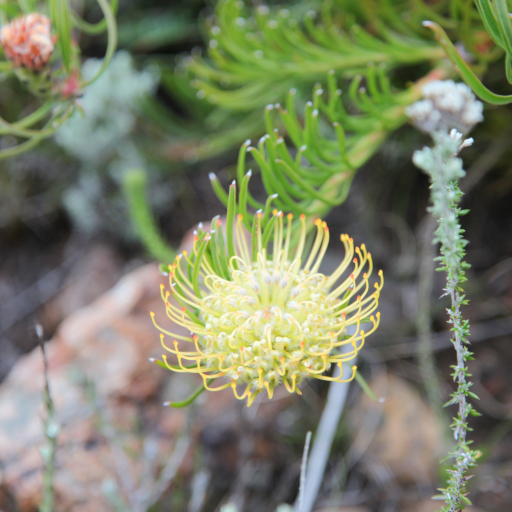
Known as the Needle-leaf Pincushion, Leucospermum lineare is a radiant gem from the fynbos of South Africa. Its common name perfectly captures its striking appearance—bright, sunburst-like flowers that look exactly like pins stuck into a cushion, perched atop delicate, needle-thin foliage. These plants are the "sun-seekers" of the Cape, evolved to thrive in rocky, challenging landscapes where other plants might wither.
🔍 How to Identify
- 📍 The Foliage: Unlike many other Pincushions with broad leaves, this species features very narrow, linear (needle-shaped) leaves that give the shrub a soft, feathery texture from a distance.
- 🌞 The Bloom: The flower heads are usually a brilliant yellow or orange-red. The "pins" (styles) are long and curve slightly upward, creating a spherical, glowing shape.
- 🌿 The Habit: It is typically a low to medium-sized evergreen shrub, often spreading wider than it is tall, making it an excellent ground-covering focal point.
🏡 In Your Garden
- 🏖️ Soil Sensitivity: These plants are specialists in poor, acidic, and sandy soils. They have "proteoid" roots that are highly efficient at scavenging nutrients, so they actually prefer "lean" soil and can be killed by high-phosphorus fertilizers.
- 💨 Air and Sun: They demand full sun and excellent air circulation. Because they are adapted to the breezy Cape coast, they dislike stagnant, humid air, which can lead to fungal issues on the delicate leaves.
- ✂️ Pruning Strategy: Pruning isn't just for shape—it's for health. Cutting back the stems after the flowers fade mimics the natural grazing or fire cycles of the wild, encouraging a flush of new, vigorous growth.
⚠️ Safety & Toxicity
- ✅ Status: Non-toxic and safe.
- 🐾 Pets & Humans: Leucospermum lineare is generally considered safe and non-poisonous for cats, dogs, and children. However, the stiff, needle-like leaves can be sharp, so it’s best placed away from narrow pathways where it might poke passersby.
✨ Fun Fact
- 🐜 Ant Bodyguards: This plant practices "myrmecochory," a fancy word meaning its seeds are dispersed by ants! The seeds have a fleshy attachment called an elaiosome that ants love to eat. They carry the seeds underground to their nests, protecting them from fire and birds until they are ready to sprout.

Detailed Care Instructions
To grow a Leucospermum Lineare plant, also known as the pincushion protea, you can follow these steps:
- Climate and Growing Conditions:
- Leucospermum Lineare plants thrive in Mediterranean climates, so ensure you are in a suitable region.
- They require full sun exposure (at least 6 hours of direct sunlight) and well-drained soil.
- Leucospermum Lineare plants thrive in Mediterranean climates, so ensure you are in a suitable region.
- Propagation:
- The most common method of propagation is from seeds.
- Soak the seeds in warm water for 12-24 hours before sowing.
- Use a well-draining potting mix and sow the seeds 1 inch deep into small pots or trays.
- Maintain a temperature of around 68-77°F (20-25°C) for germination, which usually takes 4-8 weeks.
- The most common method of propagation is from seeds.
- Planting:
- Once the seedlings have grown to a suitable size (about 4-6 inches tall), transplant them to larger pots or directly into the ground.
- Ensure that the planting site has well-draining soil with a pH level between 6-7.
- Once the seedlings have grown to a suitable size (about 4-6 inches tall), transplant them to larger pots or directly into the ground.
- Watering:
- Water the Leucospermum Lineare plant regularly, especially during the growing season. Provide enough water to keep the soil slightly moist but not waterlogged.
- Water the Leucospermum Lineare plant regularly, especially during the growing season. Provide enough water to keep the soil slightly moist but not waterlogged.
- Fertilizing:
- Use a slow-release, balanced fertilizer formulated for flowering plants.
- Apply the fertilizer according to the instructions on the package, usually every 3-4 months during the growing season.
- Use a slow-release, balanced fertilizer formulated for flowering plants.
- Pruning:
- Prune the plant lightly after flowering to maintain its shape and promote healthy growth.
- Remove any dead or diseased branches, and cut back leggy growth.
- Prune the plant lightly after flowering to maintain its shape and promote healthy growth.
- Pests and Diseases:
- Leucospermum Lineare plants are relatively resistant to pests and diseases but can occasionally be susceptible to aphids, spider mites, or fungal diseases.
- Monitor the plants regularly and take appropriate measures if any issues arise.
- Leucospermum Lineare plants are relatively resistant to pests and diseases but can occasionally be susceptible to aphids, spider mites, or fungal diseases.
- Mulching and Protection:
- Apply a layer of mulch around the base of the plant to help retain moisture in the soil and suppress weed growth.
- Protect the plant from strong winds by placing it in a sheltered location or using windbreaks.
Remember to regularly observe and care for your Leucospermum Lineare plant to ensure proper growth and health.
- Apply a layer of mulch around the base of the plant to help retain moisture in the soil and suppress weed growth.

Place in a bright room that is sun drenched almost all day. Or directly in a south-facing window.

To properly water the plant, you should first wait until the top layer of soil has dried out before watering it again. When it is time to water, use a watering can or hose to gently water the soil around the base of the plant, taking care not to splash water onto the leaves or flowers. Water thoroughly until the soil is saturated but not waterlogged. Avoid letting the plant sit in standing water, as this can lead to root rot. During hot and dry periods, the plant may require more frequent watering to prevent it from drying out.
To properly fertilize this plant, apply a slow-release fertilizer in early spring and again in midsummer. Use a fertilizer with a balanced NPK ratio, such as 10-10-10 or 15-15-15. Apply a small amount of the fertilizer to the soil near the base of the plant, avoiding contact with the foliage or stem. Water the plant thoroughly after applying fertilizer to ensure the nutrients are absorbed by the roots. Avoid over-fertilizing, as this can lead to excessive growth and reduced flowering.
The best soil to use for this particular plant is a well-draining soil that is rich in organic matter. It should have a pH level that is slightly acidic, preferably between 5.5 and 6.5. The soil should also be able to retain moisture, but not be too wet or waterlogged as this can lead to root rot. It is recommended to mix in some sand or perlite to the soil to improve drainage and prevent waterlogging. Ideally, the soil should be prepared prior to planting with some compost or aged manure to provide the necessary nutrients for growth.
To propagate this plant, take a stem cutting that is approximately 4-6 inches in length from a healthy parent plant. Make a clean cut using a sharp, sterile knife or scissors just below a leaf node.
Remove the lower leaves from the stem and dip the cut end in rooting hormone to encourage root growth. Plant the cutting in a well-draining potting mix and water thoroughly.
Cover the cutting with a clear plastic bag or dome to create a humid environment and encourage rooting. Place the pot in a bright, warm location, but out of direct sunlight.
Keep the soil moist but not waterlogged and remove any dead or yellowing leaves as necessary. After several weeks, gently tug on the cutting to check for resistance, a sign that it has rooted. Once it has rooted, gradually acclimate it to brighter light and outdoor conditions before transplanting it to its permanent location.
Note: Some additional care may be required in certain regions or seasons due to extreme temperatures or humidity.








