Plant Overview
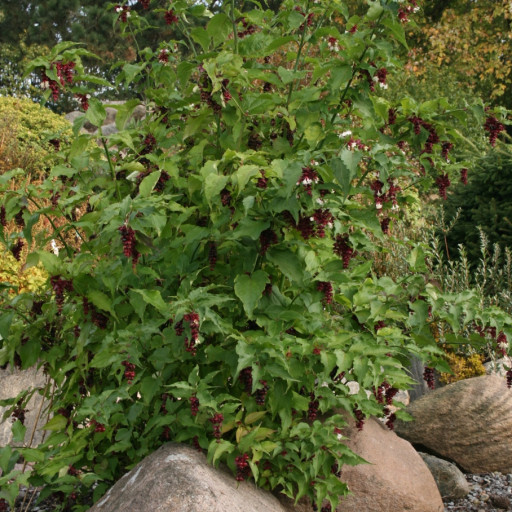
Known commonly as the Pheasant Berry or Himalayan Honeysuckle, this striking deciduous shrub brings a touch of Victorian drama to the modern garden. Native to the Himalayas and southwestern China, it is celebrated for its elegant, dangling flower tassels that look like ornate earrings hanging from bamboo-like stems. It is a favorite for gardeners looking to create a "jungle-style" aesthetic with a plant that is surprisingly hardy and easy to grow.
🔍 How to Identify
- 🎋 Hollow Stems: The plant produces upright, sea-green to bluish stems that are smooth and hollow, bearing a striking resemblance to young bamboo.
- 🏮 Pendulous Tassels: It features drooping spikes of small white flowers surrounded by layers of deep, wine-red or chocolate-purple bracts that remain beautiful even after the flowers fade.
- 🍇 Beaded Berries: As autumn approaches, the flowers turn into round, glossy berries that transition from green to bright red, and finally to a deep, succulent purple-black.
- 🍃 Heart-Shaped Foliage: The leaves are large, pointed, and heart-shaped, growing in opposite pairs along the stems to create a lush, dense canopy.
🏡 In Your Garden
- 🏗️ Structural Resilience: While it is incredibly tough, its hollow stems can be brittle; planting it in a spot sheltered from harsh winds will prevent breakage. It thrives in moist, well-drained soil and is one of the few ornamental shrubs that performs exceptionally well in partial shade.
- 🕊️ The Wildlife Hub: This plant is a magnet for biodiversity. Bees love the nectar-rich flowers, and as the name suggests, pheasants and other garden birds are obsessed with the ripened berries. Be mindful that birds will "plant" the seeds elsewhere, so you may find occasional seedlings popping up in other parts of your yard.
⚠️ Safety & Toxicity
- ✅ Non-Toxic Status: Leycesteria formosa is generally considered non-toxic to humans, cats, and dogs. It is not known to cause serious illness if ingested in small quantities.
- 👅 Bitter Warning: While the berries are technically edible for humans, they are intensely bitter and unpleasant until they are completely ripe (almost mushy). When fully dark, they have a strange, spicy flavor often compared to burnt sugar or bitter toffee.
✨ Fun Fact
In the Victorian era, wealthy landowners planted Leycesteria in massive quantities on their estates specifically to provide "high-class" snacks and cover for pheasants, which is exactly how it earned its most common nickname!

Detailed Care Instructions
| Humidity | High |
| Lighting | Part Sun |
| Difficulty | Medium |
| Hardiness Zones | 7 - 9 |
To successfully grow Leycesteria Formosa (also known as Himalayan honeysuckle or pheasant berry), follow these steps:
- Choose a location: Select a spot in your garden that receives partial shade to full sun. The plant can tolerate a wide range of soil types, but well-draining soil is preferred.
- Planting: Dig a hole twice as wide and deep as the root ball of the plant. Place the Leycesteria Formosa in the hole and backfill with soil, gently firming it around the plant.
- Watering: Water the newly planted shrub thoroughly and regularly during the first few weeks to establish a strong root system. Afterward, provide water during dry spells to keep the soil moist but not waterlogged.
- Mulching: Apply a layer of organic mulch around the base of the plant to retain moisture, suppress weed growth, and keep the root system cool.
- Fertilization: Leycesteria Formosa generally doesn't require much fertilizer. However, you can apply a balanced slow-release fertilizer in spring to provide essential nutrients.
- Pruning: Prune the plant in late winter or early spring to remove dead or damaged branches and maintain its shape. You can also cut back the Leycesteria Formosa to the ground every few years to rejuvenate and encourage fresh growth.
- Pests and diseases: This plant is relatively resistant to pests and diseases. However, aphids and slugs may occasionally attack the leaves. Monitor the plant regularly and take appropriate action if you notice any infestations.
- Propagation: Leycesteria Formosa can be propagated from seeds, cuttings, or by division. Collect ripe berries in the fall, clean them, and sow them in a pot with well-draining soil. Alternatively, take stem cuttings in spring or divide the plant every few years to create new plants.
Keep in mind that Leycesteria Formosa is an invasive species in some areas, so make sure to check with your local agricultural extension office or plant nursery to determine if it is safe and legal to plant in your location.

Place in a bright room that is sun drenched almost all day. Or directly in a south-facing window.

The plant should be watered consistently, but not overly watered, to avoid root rot. It is important to check the soil's moisture level before watering, which can be done by sticking your finger in the soil up to the second knuckle. If the soil is dry at that depth, it is time to water the plant. Ensure that the water is thoroughly distributed throughout the soil, and try not to get water on the plant's leaves or flowers. Overhead watering may lead to fungal diseases. Water Leycesteria Formosa plant in the morning or evening to allow the water to absorb into the soil before the sun dries it out. Depending on the temperature and humidity, the plant may need watering once or twice a week.
To fertilize this plant, use a general purpose fertilizer that is balanced with equal amounts of nitrogen, phosphorus, and potassium. Apply fertilizer in the early spring when new growth appears and again after the first bloom. When applying fertilizer, be sure to follow the manufacturer's instructions and do not over-fertilize, as this can damage the plant. Water the plant well before and after fertilizing to help the fertilizer absorb into the soil.
Leycesteria Formosa prefers a well-draining soil that is rich in organic matter. The ideal soil pH ranges from slightly acidic to neutral. The soil should have good water retention capacity but should not be waterlogged. It is recommended to use a mixture of loam soil, compost, and sand for planting Leycesteria Formosa. The loam soil provides nutrients and good water holding capacity, the compost adds organic matter to the soil, and the sand improves drainage. It is important to regularly fertilize the soil with a balanced fertilizer to promote healthy growth and blooming.
There are several methods to propagate this plant, including:
- Softwood cuttings: Take a stem cutting from a healthy plant in the spring or early summer. The cutting should be about 10cm long with no flowers or buds. Remove the lower leaves and dip the end of the cutting in rooting hormone. Plant the cutting in a pot with a well-draining soil mix, water it well, and cover with a plastic bag to retain moisture. Place the pot in bright, indirect sunlight and keep the soil moist. After a few weeks, the cutting should start to root and new growth should appear.
- Hardwood cuttings: Take a stem cutting from a healthy plant in the autumn or winter when the plant is dormant. Cut a section of older wood about 25cm long and remove any side shoots or leaves. Dip the end of the cutting in rooting hormone and plant it in a deep pot filled with a well-draining potting mix. Water it well and cover the pot with a plastic bag to retain moisture. Place the pot in a cool, bright place and keep the soil moist. It may take several months for the cutting to root.
- Division: Leycesteria Formosa can be divided in the spring or autumn when it is actively growing. Dig up the plant and use a sharp spade to divide it into smaller sections, making sure each section has roots and shoots. Replant the sections in well-prepared soil, water them well, and keep the soil moist until new growth appears.
- Seed propagation: This plant produces small, black berries in the autumn that can be harvested for their seeds. Remove the seeds from the berries and plant them in pots filled with a well-draining potting mix. Keep the pots in a cool, bright place and keep the soil moist. It may take several months for the seeds to germinate and grow into small seedlings.
Common pests of the pheasant-berry include Spider mites, aphids, thrips. Make a habit of checking your pheasant-berry frequently for pests so that any infestations can be caught and managed early.








