Plant Overview
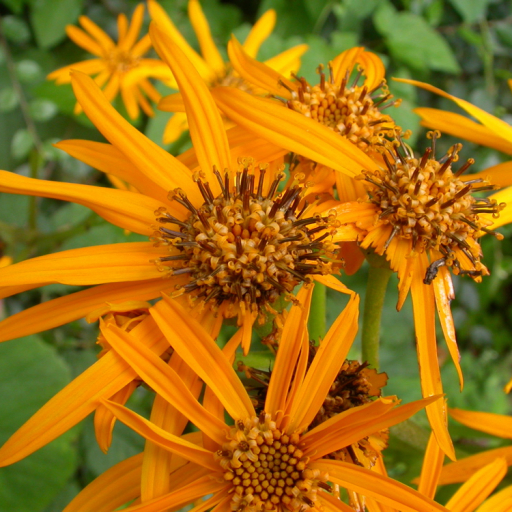
Known as the "Leopard Plant" or "Summer Ragwort," Ligularia dentata is the ultimate drama queen of the shade garden. Native to the damp woodlands of China and Japan, this plant is cherished for its massive, architectural leaves that look like they belong in a prehistoric jungle. It is a favorite for gardeners looking to add bold texture and "fire-orange" color to those tricky, soggy corners of the yard.
🔍 How to Identify
- 🍃 Lush Foliage: Features huge, leathery, kidney-shaped leaves that can grow over a foot wide. Many popular varieties, like 'Britt-Marie Crawford,' have a stunning chocolate-burgundy tint on the undersides.
- 🌼 Golden Sunbursts: In mid-to-late summer, it sends up tall, dark stalks topped with clusters of bright orange-yellow daisy-like flowers.
- 🦷 Toothed Margins: The edges of the leaves are coarsely "dentate" (toothed), which is how the plant earned its specific botanical name.
🏡 In Your Garden
- 💧 The "Thirsty" Indicator: This plant is famous for wilting dramatically the moment it feels dry, acting as a natural moisture alarm for your garden. Don't panic if it looks collapsed on a hot afternoon; a quick drink usually sees it perking back up within the hour.
- 🐌 Slug Magnetism: Because it thrives in the cool, damp shadows that slugs and snails love, its broad leaves are often targeted. Planting it in heavy clay soil is fine, but you'll need to keep an eye out for "Swiss cheese" holes in the foliage.
- ☁️ Sun Sensitivity: It hates the afternoon sun. To keep those dark leaves from scorching or bleaching, find a spot with dappled light or full morning sun only.
⚠️ Safety & Toxicity
- ✅ Generally Safe: Ligularia dentata is not considered toxic to humans, cats, or dogs. It is a much safer alternative for shade gardens than the highly toxic Foxglove.
- 👅 Bitter Defense: While safe, the plant contains bitter alkaloids that act as a natural deterrent. Most pets will find the taste unpleasant and won't attempt to eat enough to cause any stomach upset.
✨ Fun Fact
The name Ligularia comes from the Latin word "ligula," which means "little tongue." This refers to the shape of the long, strap-like petals that circle the center of each flower!

Detailed Care Instructions
| Color | Yellow |
| Soil Ph | (6.0 To 7.5) Slightly Acidic To Slightly Alkaline |
| Humidity | Normal |
| Lighting | Part Sun |
| Toxicity | Poisonous |
| Soil Type | Rich, Medium-Moisture To Wet Soil |
| Bloom Time | Early To Late Summer (Varies Depending On Climate) |
| Difficulty | Easy |
| Plant Type | Herbaceous Perennial |
| Mature Size | 3 To 4 Feet Tall; 2- To 3-Foot Spread |
| Native Area | China, Japan |
| Temperature | 12°C - 30°C |
| Sun Exposure | Part Shade To Full Shade |
| Hardiness Zones | 3 To 8 (Usda) |
To grow a Ligularia Dentata plant, follow these steps:
- Choose a suitable location: Ligularia Dentata plants prefer partial shade to full shade. They need protection from direct sunlight, especially during the hottest part of the day. Additionally, make sure the soil is moist and well-draining.
- Prepare the soil: Ligularia Dentata plants prefer organically rich, moist soil. Before planting, amend the soil by adding compost or well-rotted manure to increase its fertility and water-holding capacity.
- Planting: Dig a hole slightly larger than the root ball of the Ligularia Dentata plant. Place the plant in the hole, making sure the crown (where the stem meets the roots) is level with or slightly above the soil surface. Gently backfill the hole with soil and firm it around the plant.
- Watering: After planting, water the Ligularia Dentata thoroughly to ensure the roots are well-hydrated. Throughout the growing season, keep the soil consistently moist but not waterlogged. Mulching the soil around the plant can help retain moisture.
- Feeding: In the spring, apply a balanced, slow-release fertilizer or a compost-based organic fertilizer to provide nutrients for the Ligularia Dentata plant.
- Maintenance: Remove any weeds or competing vegetation around the plant to reduce competition for water and nutrients. Regularly check for pests or diseases and address any issues promptly. If the plant becomes too large or crowded, consider dividing it every few years to maintain its vigor.
- Winter care: Ligularia Dentata is typically hardy in USDA zones 4-8. In colder regions, provide winter protection by applying a layer of mulch around the plant before the first frost. This will help insulate the roots and prevent them from heaving out of the ground during freeze-thaw cycles.
By following these steps and providing the appropriate care, you can successfully grow a Ligularia Dentata plant.

Place in a bright room that is sun drenched almost all day. Or directly in a south-facing window.

To properly water this plant, first check the soil to ensure it has dried out slightly before watering again. When watering, use a watering can to slowly pour water at the base of the plant, making sure not to get the leaves or stem wet as this can lead to fungal diseases. Water deeply but infrequently, allowing the soil to dry out partially between waterings. Ensure that the plant is not sitting in standing water as this can lead to root rot.
To fertilize this plant, begin by carefully tilling the soil around the base of the plant. Next, apply a slow-release, balanced fertilizer according to the manufacturer's instructions. Be sure to choose a fertilizer with a low nitrogen content, as this plant prefers a moderate level of nitrogen. Water deeply after applying the fertilizer, and be sure not to apply too much, as this can burn the plant's roots. Finally, top dress the soil with a layer of organic compost to help retain moisture and improve the soil's fertility.
Ligularia Dentata plant requires a well-draining soil that is rich in organic matter. The soil should be slightly acidic with a pH range of 5.5 to 6.5. A mixture of sand, loam, and peat moss is ideal for this plant. The soil should also be moist, but not waterlogged, as excess moisture can lead to root rot. It is important to avoid using heavy clay soils for this plant, as they can lead to poor drainage and inhibit healthy root growth. Adding compost or other organic materials can also help improve soil quality and provide important nutrients for the plant.
Propagation of the plant species with large, dark green foliage and tall flower spikes can be accomplished through a number of techniques. One of the simplest methods of propagation is stem cuttings. A cutting should be taken in the spring or summer by removing a 3-6 inch section from the stem of the parent plant. This cutting should be treated with a rooting hormone and inserted into a moist, well-draining soil mix. It is important to keep the soil consistently moist and to provide the cutting with adequate light levels.
Another method of propagation is division. Mature plants can be divided into smaller sections, each of which will grow into an individual plant. To divide a plant, the root system should be dug up and the plant should be gently pulled apart into sections. Each section should contain several stems and a portion of the root system. These sections should be replanted into moist, well-draining soil with good drainage.
Finally, the seeds produced by this plant can be collected and sown in a similar fashion to many other flowering plants. The seeds should be collected when the seed pods have dried and turned brown and should be sowed in a well-draining soil that is kept moist but not saturated. The seeds should be covered with a light layer of soil and kept in a warm, bright location until they germinate.
Common pests of the leopardplant include Larvae, snails. Make a habit of checking your leopardplant frequently for pests so that any infestations can be caught and managed early.








