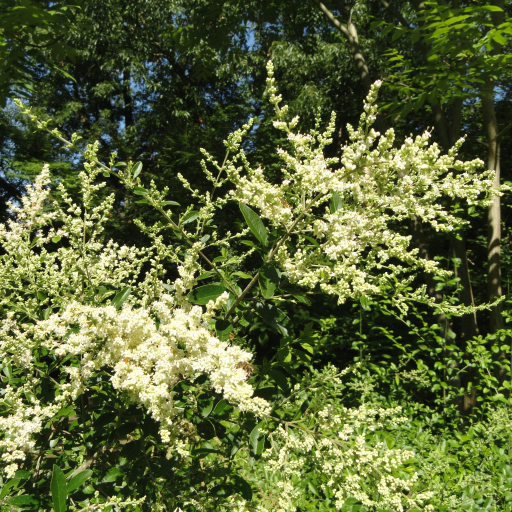
Plant Overview
Often called the Quihou Privet, this elegant shrub is the "late bloomer" of the privet family. While most of its relatives finish their show in the spring, the Quihoui waits until the peak of summer to burst into long, fragrant plumes of white flowers. Native to China, it offers a more graceful, airy silhouette compared to the rigid, boxy hedges people typically associate with privets.
🔍 How to Identify
- 🍃 Small & Waxy: The leaves are notably small, dark green, and leathery. They grow in opposite pairs along the stem and often have a "waxypurple" tint in certain lights.
- 🌸 Slender Panicles: It produces long, narrow clusters of tiny white flowers that can reach up to 8 inches in length, creating a "shaggy" or lace-like appearance.
- 🪵 Arching Habit: Unlike the upright Common Privet, this species has branches that naturally arch and spread, giving it a soft, fountain-like shape.
🏡 In Your Garden
- 🦋 Summer Nectar: Because it blooms in July and August, it serves as a critical late-season food source for butterflies and bees when other floral sources have dried up.
- ✂️ Pruning Flexibility: This plant flowers on "new wood" (growth from the current year). This means you can prune it heavily in late winter to maintain its shape without worrying about cutting off the summer flower buds.
- 🧱 Urban Survivor: It is incredibly tough and thrives in poor soil, drought conditions, and even urban pollution, making it an excellent choice for a "set-it-and-forget-it" privacy screen.
⚠️ Safety & Toxicity
- 🚫 Toxic if Ingested: Like all Ligustrum species, the leaves and the dark purple berries contain terpenoid glycosides that are harmful to humans and animals.
- 🐾 Pet & Child Warning: Ingestion of the berries can lead to stomach upset, vomiting, and lethargy. It is best to keep this plant away from areas where small children or curious pets play unsupervised.
✨ Fun Fact
The Quihou Privet is so resilient that it is often used in the art of Bonsai. Its small leaves and ability to withstand aggressive pruning make it a favorite for enthusiasts looking to create miniature, ancient-looking trees.

Detailed Care Instructions
To grow Ligustrum Quihoui plant, follow these steps:
- Location: Choose a spot with full to partial sun exposure. Ligustrum Quihoui prefers well-drained soil and can tolerate various soil types.
- Planting: Dig a hole that is twice as wide and deep as the plant's root ball. Place the plant in the hole at the same depth it was previously growing. Backfill the hole with soil, firming it gently around the roots.
- Watering: Water the plant thoroughly after planting and keep the soil consistently moist but not waterlogged. During the growing season, water deeply once or twice a week, allowing the soil to dry out slightly between waterings.
- Fertilizer: Fertilize the plant during the growing season, typically from spring to early fall. Use a balanced, slow-release fertilizer or a liquid fertilizer according to the package instructions.
- Pruning: Ligustrum Quihoui tolerates pruning well and can be shaped and maintained as desired. Prune to maintain the desired shape and remove any dead, diseased, or overcrowded branches.
- Pest and disease control: Vigilantly monitor the plant for any signs of pests, such as aphids or scale insects, and promptly treat them using appropriate insecticides or horticultural oils. Similarly, address any diseases, such as powdery mildew, with appropriate treatments.
- Mulching: Apply a layer of organic mulch around the base of the plant to help conserve moisture, suppress weed growth, and maintain a more consistent soil temperature.
- Winter care: Ligustrum Quihoui is generally hardy, but it may require protection in cold climates. Consider applying a thick layer of mulch around the base in late fall to insulate the roots from freezing temperatures.
By following these guidelines, your Ligustrum Quihoui plant should grow and thrive. Remember to adapt the care according to your specific climate and growing conditions.

Place in a bright room that is sun drenched almost all day. Or directly in a south-facing window.

To properly water this type of plant, it is important to consider the soil conditions and climate. The soil should be well-draining and moist, but not waterlogged. Water should be applied directly to the soil and not to the leaves or flowers to avoid fungal growth. The frequency of watering will vary depending on the weather and soil conditions, but a general rule is to water deeply once a week during the growing season and reduce frequency during the dormant season. It is important to monitor the plant's soil moisture level to prevent over or under watering. Watering should be adjusted accordingly during periods of heavy rainfall or drought.
To fertilize this plant, begin by selecting a balanced fertilizer with equal amounts of nitrogen, phosphorus, and potassium. Apply the fertilizer according to the manufacturer's instructions, typically by scattering it around the base of the plant and gently working it into the topsoil. Be sure to water the plant thoroughly after fertilizing to facilitate nutrient uptake. For optimal results, fertilize the plant during the growing season, typically from spring to early fall. Avoid fertilizing during the winter months when the plant is dormant.
The recommended soil for Ligustrum Quihoui plant is one that is moisture-retentive and well-draining. It should be rich in organic matter, with a pH range of 6.0-7.5. A sandy loam soil is ideal for optimum growth and health. Adding perlite or vermiculite to the soil mix can improve aeration and drainage. It is important to avoid using heavy or compacted soils, as they can inhibit root growth and cause waterlogging. Additionally, it is recommended to amend the soil with a balanced fertilizer during planting and as needed throughout the growing season.
To propagate this plant, you will first need to take stem cuttings from a mature, healthy plant. Select a stem that is at least 4-6 inches long and has several leaves attached. Using a sharp, clean pair of scissors or pruning shears, make a clean cut just above a leaf node.
Remove any leaves from the lower half of the stem, leaving only 2-3 leaves at the top. Dip the cut end of the stem in rooting hormone powder, tapping off any excess. Plant the stem in a pot filled with well-draining soil, making sure that the leaf nodes are buried.
Water the soil well, then cover the pot with a plastic bag to create a humid environment. Place the pot in a bright, indirect light location and keep the soil moist but not waterlogged. Check the pot regularly for signs of growth and remove the plastic bag once roots have formed.
Once the roots are established, you can transplant the new plant into a larger pot or into the ground. Keep the new plant well-watered but avoid overwatering, as this can lead to root rot. With proper care, your propagated plant should grow into a healthy, mature plant with time.








