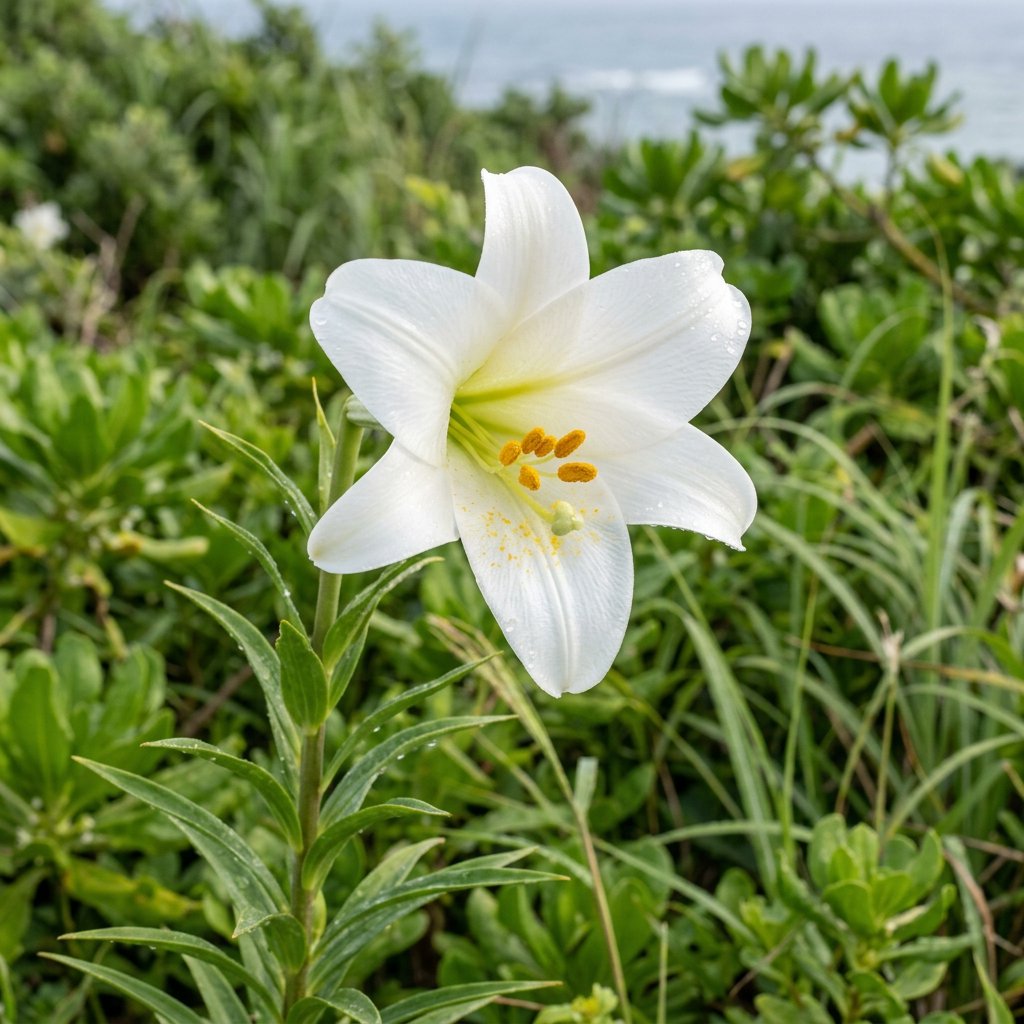
Plant Overview
Known globally as the "Easter Lily," this elegant perennial is the quintessential symbol of spring, purity, and rebirth. While it originated on the subtropical Ryukyu Islands of Japan, it has become a staple of windowsills and garden borders worldwide. Its dramatic, snowy-white appearance often marks the official transition from winter's slumber to the vibrancy of the new season.
🔍 How to Identify
- 🎺 Trumpet Blooms: Features large, outward-facing, funnel-shaped flowers that are pure white, often reaching up to 7 inches in length.
- 🍃 Spiral Foliage: Numerous narrow, lance-shaped, dark green leaves grow in a dense spiral pattern along the entire length of the sturdy, upright stem.
- 👃 Head-Turning Scent: Produces an intensely sweet, classic floral perfume that is strongest in the evening to attract pollinators.
🏡 In Your Garden
- ☀️ Cool Feet, Hot Head: These lilies thrive when their "heads are in the sun and feet are in the shade." In the garden, this means planting them in a sunny spot but using mulch or low-growing groundcover to keep the soil temperature cool around the bulb.
- ⏳ The Second Act: Most people treat these as disposable holiday plants, but they are hardy! If you plant your gift pot outdoors after the flowers fade, the lily will often revert to its natural blooming cycle, appearing in mid-summer rather than early spring.
⚠️ Safety & Toxicity
- 🐱 Fatal for Felines: ULTRA-TOXIC. Every part of this plant—the petals, leaves, pollen, and even the water in the vase—is deadly to cats. Ingestion of even a tiny amount can cause rapid, irreversible kidney failure.
- 👶 General Irritant: For humans and dogs, the plant is less dangerous but can still cause mouth irritation, drooling, and digestive upset if swallowed. The heavy pollen can also be a significant trigger for hay fever sufferers.
✨ Fun Fact
- 🌎 The Bulb Capital: Despite its global popularity, nearly 95% of all Easter Lily bulbs produced for the North American market are grown in a tiny, specialized coastal region on the Oregon-California border known as the "Easter Lily Capital of the World."

Detailed Care Instructions
| Color | White |
| Soil Ph | 5.5 To 6.5 |
| Humidity | Normal |
| Lighting | Full Sun |
| Toxicity | Poisonous |
| Soil Type | Sandy Loam Soil, Rich In Humus |
| Bloom Time | June And July (Earlier, If Forced For Easter Blooming) |
| Difficulty | Medium |
| Plant Type | Perennial Bulb |
| Hibernation | Cold Period |
| Mature Size | 24 To 36 Inches Tall |
| Native Area | Southern Islands Of Japan |
| Temperature | 15°C - 18°C |
| Sun Exposure | Full Sun |
| Hardiness Zones | 4-8 |
To grow Lilium Longiflorum plants, follow these steps:
- Obtain a Lilium Longiflorum bulb or plant from a reputable nursery or garden center. Choose a healthy bulb or plant that is firm and plump.
- Select a suitable location for planting. Lilium Longiflorum thrives in full sunlight or partial shade. The soil should be well-draining, rich in organic matter, and slightly acidic to neutral in pH.
- Prepare the soil by loosening it to a depth of around 12 inches (30 cm). Remove any weeds or debris and incorporate organic matter like compost or well-rotted manure.
- Dig a hole that is about 6-8 inches (15-20 cm) deep, spacing each hole about 12-18 inches (30-45 cm) apart. If planting multiple bulbs, space them accordingly.
- Place the Lilium Longiflorum bulb in the hole, with the pointed end facing upwards. The top of the bulb should be around 4-6 inches (10-15 cm) below the soil surface. Gently backfill the hole with soil, firming it around the bulb to ensure good contact.
- Water the newly planted bulb thoroughly to settle the soil and provide initial moisture.
- Keep the soil consistently moist but not waterlogged throughout the growing season. Water deeply whenever the top inch (2.5 cm) of soil becomes dry.
- Apply a balanced fertilizer, such as a slow-release granular fertilizer, following the package instructions. Apply it when new shoots emerge in spring and repeat every 4-6 weeks until late summer.
- Mulch around the base of the plant with a layer of organic mulch, like shredded bark or straw, to conserve moisture, suppress weeds, and regulate soil temperature.
- Protect the plants from extreme weather conditions. In colder climates, provide winter protection by adding a layer of mulch or straw over the planting area.
- Remove any faded flowers or seed heads promptly to encourage the plant to put more energy into producing new blooms.
- In autumn, as the leaves turn yellow and die back, gently cut them off at soil level. This allows the bulb to focus on storing energy for next year's growth.
By following these steps, you can successfully grow Lilium Longiflorum plants and enjoy their beautiful, fragrant flowers.

Place in a window with dappled sun or a spot in the middle of a room. Or directly in a window facing west or east.

To water this plant, you should ensure that the soil is evenly moist but not waterlogged. The frequency of watering depends on the temperature and humidity of the environment, as well as the size of the pot and the amount of light it receives. It's important to avoid allowing the soil to completely dry out, as this can damage the roots and prevent the plant from flowering. It's also important to water the plant from the base, rather than from above, to prevent moisture from accumulating on the leaves and causing disease. You may need to adjust the frequency of watering based on changes in the environment, such as a change in temperature or humidity.
Apply a balanced fertilizer with equal amounts of nitrogen, phosphorus, and potassium every two weeks while the plant is actively growing. Use a slow-release fertilizer for best results. Water the plant thoroughly after fertilizing to help the nutrients penetrate the soil. Avoid over-fertilizing as it can damage the plant and lead to excessive foliage growth at the expense of flowers.
The ideal soil for this plant should be a well-draining loamy soil that is rich in organic matter. It should have a pH of around 5.5 to 6.5 and should be slightly acidic. The soil should be able to retain moisture but should not be waterlogged as it can cause root rot. It is also important to ensure that the soil is free from any pests or diseases that may harm the plant. Adequate fertilization is necessary to promote the growth and development of the lilium longiflorum plant.
Lilium Longiflorum plants can be propagated through various methods such as bulb scaling, seed germination, and stem cuttings.
For bulb scaling, select a healthy mature bulb and gently remove any attached foliage to expose the bulblets. With a disinfected sharp knife, cut away the bulblets and plant them in well-draining soil in a separate container. Provide adequate moisture and wait for the bulblets to establish themselves before transplanting them.
For seed germination, collect mature seeds from the parent plant and soak them in lukewarm water overnight. Sow the seeds in a seed-starting tray or pot filled with a well-draining soil mix. Keep the soil moist and place the container in a warm, bright spot. Once the seedlings have established themselves, transplant them into larger containers or outdoors.
For stem cuttings, select healthy stems with mature leaves. Using a sharp, disinfected knife, cut the stem at an angle just below a node. Remove the lower leaves and dip the cut end into rooting hormone. Plant the cutting in a well-draining soil mix and keep it moist. Place the container in a bright spot but avoid direct sunlight. Once the cutting has rooted, transplant it into a larger container or outdoors.
Regardless of the propagation method, it is crucial to provide adequate moisture and nutrient requirements to ensure successful growth.
Common pests of the easter lily include Spider mites, aphids, thrips, larvae. Make a habit of checking your easter lily frequently for pests so that any infestations can be caught and managed early.








