Plant Overview
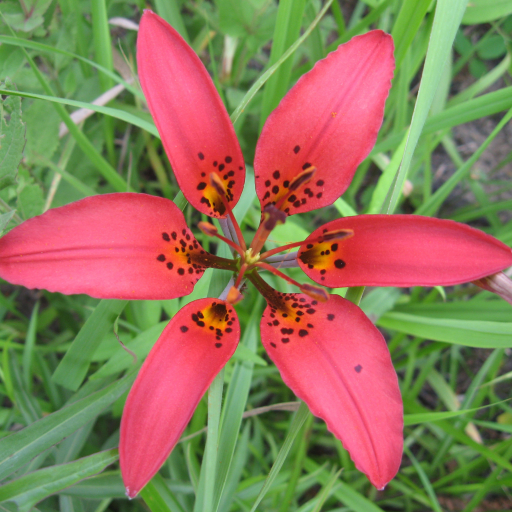
Often called the Wood Lily or Prairie Lily, Lilium philadelphicum is like a flicker of flame captured in the forest understory. This North American native is famous for its vibrant, upward-facing blooms that look like glowing embers against the green brush. Unlike many garden lilies that "nod" or hang their heads, the Wood Lily stares straight at the sky, welcoming pollinators with a bold, open cup.
🔍 How to Identify
- 🌸 The Upward Bloom: Look for large, star-shaped flowers that face directly upward. The petals are usually a fiery orange to deep scarlet, fading to yellow at the base.
- 🐆 Leopard Spots: The inner throat of each petal is splattered with distinct, dark purple or maroon spots, acting as a "landing strip" for butterflies.
- 🍃 Whorled Foliage: While the upper leaves might be scattered, the middle leaves are usually arranged in "whorls"—neat circles of 3 to 11 leaves radiating from a single point on the stem.
🏡 In Your Garden
- 🪵 The "Look but Don't Move" Rule: This lily is notoriously difficult to transplant because it grows from a delicate, scaly bulb that hates being disturbed. If you want it in your garden, it is best started from seed or nursery-grown pots rather than being moved from the wild.
- 💧 Drainage is Non-Negotiable: In nature, it thrives in sandy or rocky soils. If its "feet" stay wet for too long, the bulb will rot quickly. It prefers acidic, well-drained spots where it can enjoy dappled sunlight—mimicking the edge of a woodland.
⚠️ Safety & Toxicity
- 🐈 Cat Alert: Like most true lilies, this plant is highly toxic to cats. Ingesting even a small amount of pollen or a single leaf can cause life-threatening kidney failure in felines.
- 👶 Human/Dog Safety: While not considered deadly to humans or dogs, eating the plant can cause nausea, vomiting, or lethargy. It is best treated as an ornamental "eye-candy" plant only.
✨ Fun Fact
💡 The Wood Lily is a "fire-follower." In the wild, it often blooms most spectacularly in the years following a forest or prairie fire, as the ash provides nutrients and the cleared canopy allows more sunlight to reach the forest floor.

Detailed Care Instructions
Growing Lilium philadelphicum, commonly known as the wood lily or prairie lily, can be done by following these steps:
- Choose a suitable location: Lilium philadelphicum prefers sunny to partially shaded locations. It can tolerate a wide range of soil types but prefers well-draining soil.
- Prepare the soil: Work the soil by removing any rocks, weeds, or debris. Till in organic matter such as compost to improve soil fertility and drainage.
- Planting: Dig a hole about 6-8 inches deep. Place the bulb in the hole with the pointed side facing upwards. Ensure that the bulb is covered with soil, leaving only the tip exposed.
- Spacing: Space the bulbs about 6-8 inches apart to allow for proper growth and airflow.
- Watering: Provide regular watering to keep the soil moist but not waterlogged. During dry periods or hot summers, additional watering may be necessary.
- Mulching: Apply a layer of organic mulch around the plants to retain moisture, suppress weeds, and regulate soil temperature.
- Fertilizing: Apply a balanced, slow-release fertilizer in spring when new growth appears. Follow the package instructions for proper application rates.
- Staking: If necessary, stake tall varieties to provide support and prevent them from falling over in strong winds.
- Pruning: After flowering, remove any dead or faded flowers. Allow the foliage to die back naturally, as it provides nourishment to the bulb for the next season's growth.
- Winter care: Lilium philadelphicum is hardy in USDA zones 3-8. In colder regions, apply a layer of mulch or leaves over the plant's base in late fall to protect it from freezing temperatures.
- Propagation: Lilium philadelphicum can be propagated by seed or bulb scaling. Seed propagation is a longer process, while bulb scaling involves dividing the bulb and replanting the sections.
Patience is key when growing Lilium philadelphicum as it can take a few years for the plant to establish and bloom reliably. With proper care and patience, you can enjoy the beautiful flowers of this native lily species.

Place in a bright room that is sun drenched almost all day. Or directly in a south-facing window.

To properly water this plant, it is important to take note of the soil moisture levels. Ideally, the soil should be evenly moist but not waterlogged. This means waiting until the top inch of soil is dry before watering again. When watering, gently pour water onto the soil near the base of the plant until it begins to drain out of the bottom of the pot or onto the ground. Avoid getting water on the leaves of the plant, as this can lead to mold or mildew. During hot and dry periods, the plant may require more frequent watering to maintain healthy growth.
- Choose a well-draining soil with a slightly acidic pH level.
- Prepare the soil by loosening it up to a depth of 6 inches.
- Apply a slow-release fertilizer with a balanced N-P-K ratio (such as 10-10-10) at a rate of 1 tablespoon per square foot.
- Water the area well after applying the fertilizer to avoid burning the roots.
- Repeat the fertilizer application every 4-6 weeks during the growing season (spring and summer) until the plant matures.
- Avoid getting the fertilizer on the leaves or blooms as this can cause damage.
- Mulch the area to retain soil moisture and prevent weed growth.
- In fall, apply a low-nitrogen fertilizer (such as 5-10-10) to encourage root growth and overwintering.
- Always follow the manufacturer's instructions when applying fertilizer, as over-fertilization can harm the plant.
The ideal soil to use with this plant species is a well-draining, acidic soil that is rich in organic matter. It should have a pH level of around 5.5 to 6.5. The soil should also be kept consistently moist, but not waterlogged, as the plant does not tolerate drought well. It is important to avoid using soils that are heavy and compacted, as this can impede root growth and lead to root rot. Additionally, adding mulch to the soil surface can help maintain moisture levels and regulate soil temperature.
To propagate this plant, you will need to collect mature seeds from the plant once they have ripened. These seeds can then be planted in a well-draining soil mix, and kept moist until they germinate. Alternatively, you can divide mature bulbs in the fall, taking care to separate and replant individual offsets. Once replanted, the newly propagated bulbs should be regularly watered and fertilized to encourage healthy growth.
Common pests of the wood lily include Spider mites, aphids, thrips, larvae. Make a habit of checking your wood lily frequently for pests so that any infestations can be caught and managed early.








