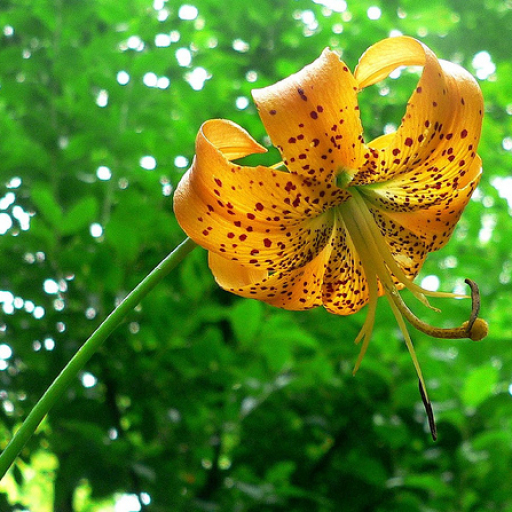
Plant Overview
Often called the "Turk’s Cap Lily" because its petals curl back into the shape of a regal turban, this plant is the undisputed giant of the North American meadow. Standing tall above surrounding wildflowers, it transforms damp fields into a sea of nodding, fiery lanterns during the height of summer. It is a favorite of swallowtail butterflies and hummingbirds, who are easily drawn to its dramatic, hanging displays.
🔍 How to Identify
- 🌸 The Flower: Features pendulous, nodding blooms with petals that sweep dramatically backward, revealing a bright orange-to-red face heavily speckled with dark maroon spots.
- ⭐ The Green Star: A key identifying mark is the distinct green "star" pattern at the center of the flower’s throat, which distinguishes it from the similar-looking Michigan Lily.
- 🌿 Whorled Leaves: The smooth, lance-shaped leaves are arranged in elegant circular groups (whorls) at intervals along the towering, sturdy central stalk.
🏡 In Your Garden
- 💧 Moisture Lover: Native to wet meadows and marshes, this lily thrives in soil that stays consistently moist. It is an excellent candidate for rain gardens or low-lying areas of the yard where other plants might "drown."
- 🌞 Cool Roots: While the flowers love to reach for the sun, the bulb prefers to keep its "feet" cool and shaded. Planting low-growing perennials or applying a thick layer of mulch around the base helps mimic its natural forest-edge habitat.
- 🦌 Deer Protection: Be warned that deer consider these blooms a gourmet snack. If you live in an area with high deer pressure, you may need a cage or repellent to see the plant reach its full, spectacular height.
⚠️ Safety & Toxicity
- 🐱 Fatal for Cats: This is a "True Lily," meaning every part of the plant—from the petals to the pollen—is extremely toxic to cats. Ingesting even a tiny amount can lead to rapid kidney failure.
- 👶 Human Safety: While the bulbs were historically used as a food source by some Native American tribes after extensive preparation, the raw plant can cause stomach upset in humans and dogs. It is best kept as a "look but don't touch" ornamental.
✨ Fun Fact
A single, mature stalk of the Turk’s Cap Lily is a true botanical overachiever; in ideal conditions, it can grow over 8 feet tall and produce as many as 40 individual flower heads on a single stem!

Detailed Care Instructions
To grow Lilium superbum, also known as the Turk's Cap Lily, follow these steps:
- Choose a suitable planting location: Turk's Cap Lilies prefer full to partial sun, well-draining soil, and shelter from strong winds.
- Prepare the soil: Amend the soil with organic matter, such as compost or aged manure, to improve its fertility and drainage. You can also add a slow-release balanced fertilizer.
- Plant the bulbs: Dig holes that are around 6-8 inches deep and spaced about 12-18 inches apart. Place the bulbs in the holes, with the pointed side facing up. Cover the bulbs with soil and gently pat it down.
- Water thoroughly: After planting, water the bulbs deeply to help them settle in and encourage root growth. Keep the soil consistently moist but not waterlogged throughout the growing season.
- Mulch the soil: Apply a layer of organic mulch, such as straw or wood chips, around the base of the plants. This will help conserve moisture, suppress weeds, and regulate soil temperature.
- Provide support: Lilium superbum can grow quite tall, so it's beneficial to stake or support the plants to prevent them from toppling over in strong winds. Use bamboo stakes or other sturdy supports and tie the stems gently to them with soft twine.
- Fertilize regularly: Feed the plants with a balanced fertilizer every 4-6 weeks during the growing season to promote healthy growth and blooming. Follow the instructions on the fertilizer packaging for application rates.
- Monitor for pests and diseases: Keep an eye out for common lily pests like aphids, mites, and lily beetles. Remove any affected leaves or insects manually or use organic pest control methods if necessary. Also, be vigilant for diseases like botrytis (gray mold) and promptly remove any infected plant parts.
- Deadhead spent flowers: Once the flowers fade, remove them by cutting the stem back to the main stalk. This will divert the plant's energy towards bulb development rather than seed production.
- Prepare for winter dormancy: In areas with cold winters, Turk's Cap Lilies will naturally go dormant. Before winter arrives, cut down the stems to ground level, remove any debris from around the plants, and apply a layer of mulch to protect the bulbs from frost.
With proper care and attention, your Lilium superbum plants should grow and produce beautiful Turk's Cap Lily flowers.

Place in a bright room that is sun drenched almost all day. Or directly in a south-facing window.

To water this particular plant, ensure that the soil is completely dry before watering it thoroughly. Use a watering can or hose with a soft spray nozzle to evenly distribute water on the soil. Avoid watering the leaves, and instead, aim for the root zone. Allow any excess water to drain off and make sure that the pot or container has sufficient drainage holes. Water the plant when the top 1-2 inches of soil feels dry to the touch.
To fertilize this plant, use a balanced fertilizer with equal amounts of nitrogen, phosphorus, and potassium. Apply the fertilizer in early spring before new growth emerges. Use a granular or slow-release fertilizer and follow the manufacturer's instructions for application rates. Water the plant after fertilization to help the nutrients penetrate the soil. Avoid over-fertilizing as this can burn the roots and damage the plant.
The recommended soil type for planting Lilium Superbum is a well-draining sandy loam soil with a pH range of 5.5-6.5. The soil should be rich in organic matter and should have good water-retaining capacity. Avoid using heavy clay soils as they can retain too much water and become waterlogged, which can lead to root rot. It is also important to ensure that the soil is not compacted as it can restrict root growth and therefore, plant growth. Adding a layer of organic mulch around the plant can help retain moisture and suppress weeds.
To propagate this plant, first select a healthy adult specimen that has several healthy stems. Carefully remove the stems from the plant, taking care not to damage the roots or main stem. Cut each stem into sections, each containing a node or bud.
Next, prepare a pot or container with well-draining soil and moisten the soil with water. Place the stem cuttings into the soil, making sure to bury each node or bud at least one inch deep. Water the soil thoroughly and cover the pot or container with a plastic bag to create a humid environment.
Place the pot or container in a bright location out of direct sunlight and wait for the stem cuttings to develop roots and new growth. This typically takes several weeks to a few months. Once the new growth is established, remove the plastic bag and continue caring for the new plants as you would care for mature plant specimens.








