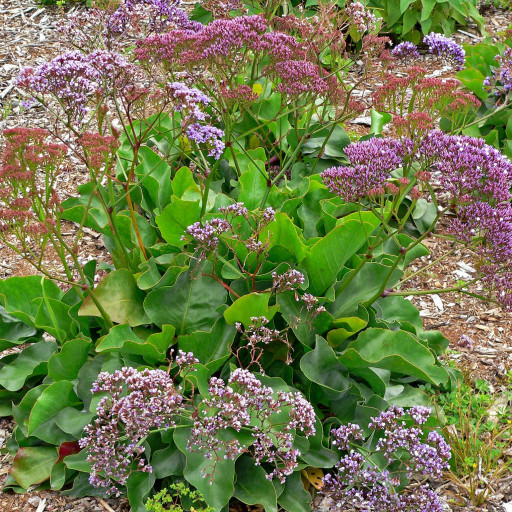
Plant Overview
Known as the Sea Lavender or Perez’s Sea Lavender, this Canary Island native is a coastal superstar. It is famous for its massive, cloud-like clusters of purple flowers that look just as vibrant dried in a vase as they do swaying in a garden breeze. Often found clinging to rocky cliffs in its homeland, it has become a staple for drought-tolerant landscaping across the globe.
🔍 How to Identify
- 🌸 The Blooms: Large, dome-shaped clusters (panicles) featuring tiny, papery deep-purple structures (calyxes) with even smaller white star-shaped flowers peeking out from the center.
- 🍃 The Foliage: Thick, leathery, dark-green leaves that grow in a "basal rosette" (forming a circular clump at ground level). The leaves are broad and shaped somewhat like a paddle or a large spoon.
- 📐 Growth Habit: It forms a sturdy mound of foliage, with stiff, leafless flower stalks rising 1 to 3 feet high, creating a "floating" purple haze effect.
🏡 In Your Garden
- 🌊 Coastal Resilience: This plant is a true "beach bum." It is exceptionally salt-tolerant and thrives in salty air and wind, making it the perfect choice for seaside gardens where other plants might wither.
- 💧 Drainage is Critical: Originating from rocky environments, it demands excellent drainage. It prefers sandy or gritty soil and will quickly succumb to root rot if left in heavy, waterlogged clay.
- ☀️ Drought Nuance: While it is highly water-wise once established, its large leaves can occasionally wilt in extreme afternoon heat. It appreciates a "deep soak" once a week rather than frequent, shallow sprinkles.
⚠️ Safety & Toxicity
- ✅ Safe Status: Limonium perezii is generally considered non-toxic to humans, cats, and dogs. It is a "worry-free" addition to family-friendly yards.
- 🧤 Mechanical Irritation: While not chemically toxic, the dried flower stalks and the edges of older leaves can become quite stiff and scratchy. Sensitive gardeners may prefer wearing gloves when pruning or harvesting for floral arrangements.
✨ Fun Fact
The vibrant purple parts you see aren't actually the flower petals! They are "calyxes"—tough, papery protective layers. Because these calyxes are so sturdy and hold their color indefinitely, they are known as "everlasting flowers" and are a favorite in the dried floral industry.

Detailed Care Instructions
To successfully grow Limonium perezii, also known as sea lavender or statice, follow these steps:
- Choose a suitable location: Limonium perezii prefers full sun to partial shade and well-draining soil. It can tolerate dry and salty conditions, making it ideal for coastal gardens. Make sure the location offers protection from strong winds.
- Prepare the soil: This plant thrives in alkaline soil with a pH between 7 and 8.5. If your soil is acidic, add dolomite lime to raise the pH level. Ensure the soil is fertile and well-drained by incorporating organic matter like compost.
- Planting: Dig a hole slightly bigger than the plant's root ball and place the Limonium perezii in it. Position it at the same depth as it was in the nursery container. Gently backfill the hole with soil, firming it around the roots.
- Watering: Initially, water the plant deeply to help establish its root system. Afterward, allow the top 1-2 inches of soil to dry out before watering again. Sea lavender is drought-tolerant, so be careful not to overwater, as it may lead to root rot.
- Fertilizing: Limonium perezii does not require heavy feeding. However, you can apply a balanced, slow-release fertilizer in early spring to promote healthy growth. Follow the instructions on the packaging for the recommended dosage.
- Pruning: Trim back any dead or fading flowers regularly to encourage continuous blooming. In late winter or early spring, cut the entire plant back to about 2 inches above the ground to promote new growth.
- Pest and disease control: Limonium perezii is generally pest and disease-resistant. However, you should monitor for aphids, snails, slugs, or powdery mildew. If any issues arise, use appropriate organic or chemical controls recommended for the specific problem.
- Propagation: You can propagate Limonium perezii by dividing established clumps in early spring or by taking stem cuttings in summer. Ensure the new plants have well-drained soil with proper watering until they establish.
By following these guidelines, you should be able to grow a healthy and vibrant Limonium perezii plant in your garden or container.

Place in a bright room that is sun drenched almost all day. Or directly in a south-facing window.

To water this plant, you should first make sure the soil is dry to the touch. If the soil feels damp, wait to water until it has dried out. When watering, use room temperature water and water from the base of the plant rather than the top. Avoid getting water on the leaves as this can cause damage. Allow excess water to drain away and don't let the plant sit in water as it can lead to root rot. In general, this plant prefers well-draining soil and should not be overwatered.
To fertilize this plant, use a slow-release fertilizer with high phosphorus content. Apply the fertilizer in the early spring or late autumn. Mix the fertilizer into the soil around the plant's base, and water the area thoroughly. Avoid over-fertilizing as it may harm the plant.
Limonium Perezii plant prefers a well-draining soil that is moist but not waterlogged. The soil should have a neutral to slightly alkaline pH level. It also prefers a soil that is rich in organic matter, such as compost or peat moss. It's important to avoid soil that is too heavy or compact, as this can lead to root rot. Choosing a soil mix that contains perlite or vermiculite can help with drainage and prevent soil compaction. Regular fertilization with a low-nitrogen fertilizer can also help keep the plant healthy and encourage flowering.
To propagate this plant, start by obtaining healthy stem cuttings from mature plants. Choose stems that are at least 4-6 inches long with multiple leaves.
Next, remove the bottom leaves and dip the end of the cutting in rooting hormone powder. This will encourage root growth.
Plant the cutting in a small pot filled with a well-draining soil mix. Water the cutting thoroughly and keep the soil moist while it establishes roots.
Place the pot in a bright, indirect light and keep it out of direct sunlight. It's important to keep the cutting in a warm environment with temperatures between 65-80°F for best results.
After a few weeks, you should see new growth and roots starting to form. Once the cutting has established a healthy root system, it can be transferred to a larger pot or planted in the ground.








