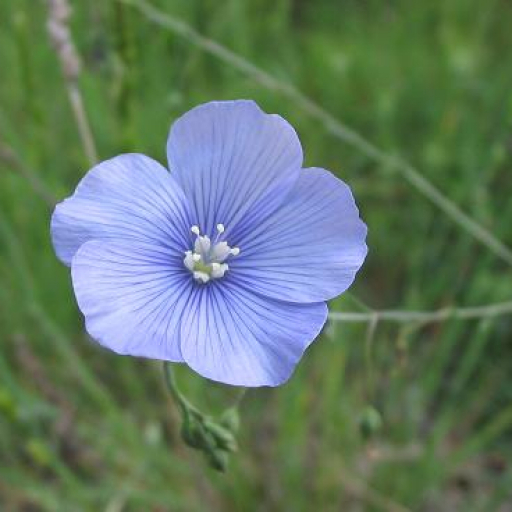
Plant Overview
Often called the "Heavenly Blue Flax," this Mediterranean native is celebrated for its ethereal, silk-like blossoms that capture the color of a clear summer sky. Named after the ancient French city of Narbonne, it brings a wild, meadow-like charm to rock gardens and sunny borders. It is a resilient perennial that manages to look delicate while being remarkably tough against heat and drought.
🔍 How to Identify
- 💙 The Flowers: Large, five-petaled blooms in a striking azure blue, often featuring a white "eye" or delicate darker veins radiating from the center.
- 🌿 The Foliage: Slender, needle-like leaves that are a soft grayish-green. They wrap around the stems in an alternating pattern, giving the plant an airy, textured look.
- 🌬️ Growth Habit: It forms upright, fountain-like clumps. The stems are wiry and flexible, allowing the plant to sway gracefully even in a light breeze.
🏡 In Your Garden
- 🏜️ The Taproot Rule: This plant develops a long, sturdy taproot to find water deep underground. Because of this, it absolutely hates being moved. Choose its "forever home" carefully, as transplanting often leads to shock.
- ☀️ Sun Worshiper: The flowers are heliotropic, meaning they follow the sun. They typically pop open at dawn and may drop their petals by late afternoon, but don't worry—a fresh batch of buds will open every single morning throughout the summer.
- 🪨 Soil Nuance: It thrives in "lean" soil. If your soil is too rich or heavily fertilized, the plant may grow too tall and "flop" over. It prefers sandy or gravelly spots where water drains away quickly.
⚠️ Safety & Toxicity
- 🟢 General Status: Non-toxic to touch and generally safe for home landscapes.
- 🐾 Ingestion Warning: While not considered high-risk, the seeds of the Linum genus contain small amounts of cyanogenic glycosides. It is best to discourage pets or small children from snacking on the seed pods to avoid any potential stomach upset.
✨ Fun Fact
Unlike its cousin, the common flax used to make linen fabric, Linum narbonense was bred almost entirely for its beauty. Its flowers are nearly twice the size of industrial flax, earning it the Royal Horticultural Society's Award of Garden Merit.

Detailed Care Instructions
To grow Linum narbonense, also known as blue flax, you can follow these steps:
- Choose a suitable location: Blue flax prefers full sun but can tolerate a little shade. Ensure the area has well-draining soil.
- Prepare the soil: Loosen the soil and remove any weeds or debris. Add compost or well-rotted manure to improve soil fertility and drainage.
- Sow the seeds: You can sow the seeds directly into the ground in early spring or early fall. Alternatively, you can start the seeds indoors about 6-8 weeks before the last frost date and transplant them outdoors when the weather has warmed up.
- Sow the seeds thinly: Scatter the seeds evenly over the area, ensuring they are about 1/4 inch deep. Blue flax seeds do not need to be covered with soil, just press them gently into the soil.
- Water regularly: Keep the soil evenly moist until the seeds germinate, which usually takes about 2-3 weeks. Once the plants are established, they are drought-tolerant and only require watering during prolonged dry spells.
- Thin out the seedlings (if necessary): If the plants become overcrowded, thin them out to allow proper air circulation and prevent disease. Space the seedlings about 6-12 inches apart.
- Provide support (optional): Blue flax can sometimes benefit from staking or support if you want to keep the stems upright.
- Mulch around the plants: Apply a layer of organic mulch, such as straw or wood chips, around the base of the plants. This will help retain moisture, suppress weed growth, and protect the roots from temperature extremes.
- Deadhead spent flowers: Blue flax produces attractive blue flowers that last for only one day. Deadhead the faded flowers regularly to encourage continuous blooming and prevent self-seeding.
- Dividing and propagation: Every few years, you can divide mature blue flax plants in early spring or late fall to propagate more plants.
Remember to check the specific requirements of your Linum narbonense variety, as some may have slightly different growing needs.

Place in a bright room that is sun drenched almost all day. Or directly in a south-facing window.

Linum Narbonense is a plant that requires regular watering to thrive. To give it proper hydration, you should pay attention to the soil and weather conditions.
When watering Linum Narbonense, you should ensure that the soil is evenly moist, but not waterlogged. Overwatering can lead to root rot, which can harm and even kill the plant. To avoid this, it's best to water deeply and infrequently, allowing the soil to dry out between watering sessions.
It's also important to note that Linum Narbonense doesn't like standing water. Therefore, ensure that the pot has adequate drainage holes to allow excess water to escape.
Moreover, the watering frequency depends on several factors such as the type of soil, the plant's size, and the environment. During the summer months, when temperatures are high, the plant will require more frequent watering. On the other hand, in cooler temperatures, the plant will require less frequent watering.
In summary, watering Linum Narbonense requires keeping the soil moist but well-drained to prevent root rot. Depending on the environment and plant's size, the frequency of watering may differ.
To fertilize this plant, use a balanced, all-purpose fertilizer with equal amounts of nitrogen, phosphorus, and potassium. Apply the fertilizer every four to six weeks during the growing season, which is typically spring and summer. It is important to follow the instructions on the fertilizer package and not over-fertilize, as this can damage the plant. Water the plant well after fertilizing to ensure the nutrients are absorbed properly.
Linum Narbonense is a type of plant that thrives best in well-draining soils that are rich in organic matter. The soil should be moderately acidic to neutral and should have a pH range of 6.0 to 7.5. It is also important to ensure that the soil is moist but not waterlogged, as the plant can be sensitive to overwatering.
To create ideal soil for Linum Narbonense, organic matter such as compost and aged manure can be added to the soil to improve its structure and provide essential nutrients. The soil can also be amended with sand or perlite to ensure adequate drainage.
Additionally, it is recommended to avoid using heavy clay soils as they tend to hold excessive amounts of water and can lead to root rot. It is also important to maintain adequate levels of soil fertility through regular fertilization using a balanced fertilizer.
- Gather some healthy stems from the Linum Narbonense plant that you want to propagate.
- Prepare a pot with some well-draining soil mixture, which is a combination of equal parts of sand, peat, and perlite.
- Remove any leaves from the bottom two-thirds of the stem and dip the cut end into rooting hormone powder.
- Make a hole in the soil mixture and place the stem cutting into it, pressing the soil firmly around the stem to hold it in place.
- Water the cutting and cover the pot with a plastic bag to create a humid environment.
- Keep the pot in a warm, bright place with indirect sunlight and make sure the soil is moist but not waterlogged.
- Check the cutting regularly and mist the leaves with water if they look dry.
- After about 2-3 weeks, you should see new growth on the stem, indicating that the cutting has rooted.
- Remove the plastic bag and gradually acclimate the new plant to normal indoor or outdoor conditions.
- Once the plant has established itself, it can be transplanted into a larger pot or directly into the garden soil.








