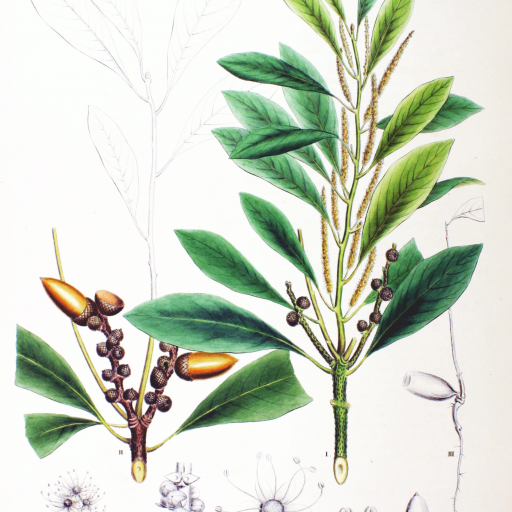
Plant Overview
Known as the Japanese Stone Oak, this elegant evergreen bridges the visual gap between a holly and a traditional oak. Native to the warm-temperate forests of Japan and China, it is prized for its polished, leathery leaves that stay vibrant all year round. In its native lands, it is often seen as a symbol of endurance, standing tall through both summer heat and winter chills.
🔍 How to Identify
- 🍃 Glossy Foliage: The leaves are thick, leathery, and elliptic, featuring a deep green "polished" topside and a paler, sometimes slightly glaucous (waxy) underside.
- 🌰 Unique Acorns: It produces small, nut-like acorns held in shallow, woody cups that are distinctively hard—hence the name "Stone Oak."
- 🌳 Smooth Bark: Unlike the deeply furrowed bark of many European or American oaks, the trunk of this tree remains relatively smooth and gray even as it matures.
🏡 In Your Garden
- 🧱 Urban Warrior: This tree is exceptionally tolerant of urban pollution and smog, making it a premier choice for city privacy screens or street-side planting.
- ⏳ Slow and Steady: Because it has a slow growth habit, it is an excellent "set and forget" structural plant that won't outgrow its designated space too quickly or require constant pruning.
⚠️ Safety & Toxicity
- 🐾 Pet Watch: Like most oaks, the acorns contain tannins. While not deadly, they can cause digestive upset, vomiting, or lethargy if your dog or cat decides to use them as a snack.
- 👶 Low Risk: It is generally safe for humans and lacks thorns or irritating saps, though the fallen acorns can occasionally be a tripping hazard on paved walkways.
✨ Fun Fact
The name Lithocarpus is derived from the Greek words lithos (stone) and karpos (fruit). This refers to the incredibly hard, bone-like shell of the acorn, which is much tougher than the shell of a common oak nut!

Detailed Care Instructions
To grow Lithocarpus glaber, also known as the Japanese evergreen oak, you can follow these steps:
- Obtain seeds or saplings: You can purchase Lithocarpus glaber seeds or saplings from plant nurseries or online sellers. Alternatively, you can collect seeds from existing trees, but keep in mind that it may take longer for the tree to grow from seed.
- Choose a suitable location: Lithocarpus glaber prefers well-draining soil with a slightly acidic to neutral pH. Select a sunny or partially shaded spot in your garden with enough space for the tree to grow.
- Prepare the soil: Before planting, prepare the soil by loosening it and removing any weeds or rocks. If the soil is heavy, add organic matter like compost or peat moss to improve drainage.
- Plant the sapling or seed: If you have a sapling, dig a hole twice as wide and deep as the root ball, gently place the sapling in the hole, and back-fill with soil. If you are growing from seeds, sow them about 1 inch deep in pots or directly into the ground.
- Provide regular watering: Water the newly planted Lithocarpus glaber thoroughly and keep the soil slightly moist but not waterlogged. Watering deeply once or twice a week should be sufficient, adjusting the frequency depending on the weather conditions.
- Mulch the base: Apply a layer of organic mulch around the base of the tree to help retain moisture, control weeds, and regulate soil temperature. Keep the mulch a few inches away from the trunk to prevent rot.
- Prune, if necessary: Lithocarpus glaber generally doesn't require heavy pruning. However, you can trim away any dead or damaged branches and shape the tree as desired during the dormant season.
- Protect from extreme weather: Provide protection from frost or extreme heat when young plants are more susceptible. You can use frost cloths or shade cloth to shield the tree from harsh weather conditions.
- Fertilize sparingly: Lithocarpus glaber doesn't typically need much fertilizer, especially in nutrient-rich soils. However, you can use a slow-release balanced fertilizer in early spring if the growth is sluggish or if a soil test indicates any nutrient deficiencies.
- Monitor and care for pests or diseases: Regularly inspect the tree for signs of pests or diseases, like scale insects or leaf spot. If any issues arise, treat them with appropriate methods such as insecticides or fungicides.
Remember, Lithocarpus glaber is a slow-growing tree, so be patient. Consistent care and suitable conditions will help the tree thrive and grow into a beautiful specimen over time.

Place in a bright room that is sun drenched almost all day. Or directly in a south-facing window.

Lithocarpus Glaber is a type of vegetation that requires a certain amount of water in order to thrive. When watering this plant, it is important to take several factors into consideration such as the type of soil it is planted in, the climate it is growing in, and the amount of sunlight it receives.
In general, Lithocarpus Glaber plants prefer well-draining soil that does not retain water for extended periods of time. This means that when watering, it is important to ensure that the soil is moist but not excessively wet.
The frequency of watering will vary depending on the climate. In hot and dry conditions, Lithocarpus Glaber may require more frequent watering to prevent it from drying out. Conversely, in cooler and more humid conditions, the plant may require less watering.
When watering Lithocarpus Glaber, it is best to do so in the morning or evening when the sun is not as strong. This will prevent the water from evaporating before it can reach the plant's roots.
It is also important to water the plant evenly, ensuring that the water is distributed throughout the root system. This can be achieved by watering slowly and deeply, rather than quickly and superficially.
Finally, it is important to avoid overwatering Lithocarpus Glaber. This can lead to root rot and other problems that can harm the plant. As a general rule, it is better to err on the side of underwatering rather than overwatering.
The Lithocarpus Glaber plant should be fertilized with a balanced, slow-release fertilizer every spring and summer. Apply the fertilizer around the base of the plant, avoiding contact with the foliage or stem. Water the plant thoroughly after fertilizing. Avoid over-fertilizing, as this can cause damage to the roots.
Lithocarpus Glaber plant should be planted in soil that is well-draining and aerated. It should have a pH level of around 5.5 to 6.5. The soil should be rich in organic matter and nutrients, but not overly fertile. Clay soils should be avoided as they can hold too much water and lead to root rot. A mixture of sandy loam and fine gravel can provide adequate drainage. It is also important to maintain soil moisture levels without overwatering, as Lithocarpus Glaber plants do not tolerate waterlogged conditions. Lightly fertilizing the soil once a year can provide additional nutrients for healthy growth.
To propagate Lithocarpus Glaber, take a cutting from a mature, healthy plant. The cutting should be about 6-8 inches long, with at least one node. Remove the lower leaves from the cutting, leaving only 2-3 near the top. Dip the cut end of the cutting into rooting hormone, then plant it in a well-draining soil mixture. Water the cutting thoroughly and place it in a well-lit area, but out of direct sunlight. Keep the soil moist but not waterlogged and mist the cutting regularly. After a few weeks, roots should begin to grow and the cutting can be transplanted into a larger container or into the ground.








