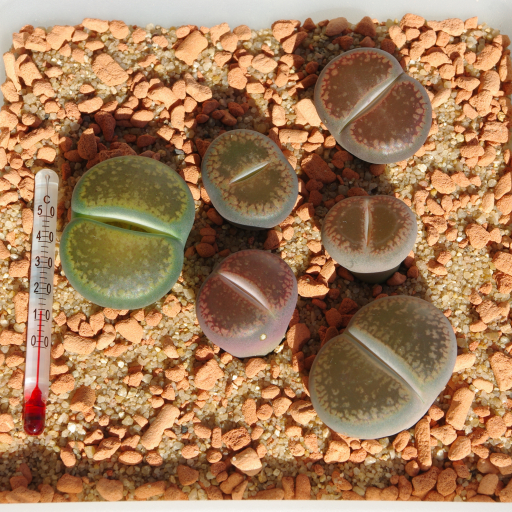
Plant Overview
Often called "Living Stones" or "Pebble Plants," Lithops aucampiae is nature’s master of disguise. These tiny succulents evolved to look exactly like the reddish-brown stones of their native South African home to avoid being eaten by thirsty animals. Named after Juanita Aucamp, who discovered this variety in the early 20th century, they are the perfect "pet" for the minimalist gardener.
🔍 How to Identify
- 🪨 The Split Top: The plant consists of two incredibly thick, fleshy leaves fused together with a deep slit (fissure) across the top, resembling a hoof or a small brain.
- 🎨 Intricate Patterns: The flat upper surface features "islands" of reddish-brown or chocolate color surrounded by darker, mesh-like lines that help it blend into ironstone soil.
- 🌼 Autumn Blooms: In late fall, a surprisingly large, bright yellow daisy-like flower emerges from the center slit, often appearing much larger than the plant itself.
🏡 In Your Garden
- 🏜️ The Art of Neglect: This plant thrives on "tough love." Its biggest enemy is a generous gardener; because it stores massive amounts of water in its leaves, overwatering causes the plant to literally burst or rot from the inside out.
- 🔄 The Great Exchange: Once a year, the plant undergoes a "skin-shedding" phase. New leaves grow from the center and "eat" the old ones, absorbing all their moisture. You must stop watering entirely during this process to let the old leaves dry into papery husks.
- 🪴 Deep Roots: Despite their small size, they have a long taproot. They prefer a deep, sandy pot rather than a shallow saucer to allow their root system to stretch out.
⚠️ Safety & Toxicity
- ✅ Safe Status: Lithops aucampiae is non-toxic to humans, cats, and dogs. They are one of the safest succulents to keep on a low coffee table or shelf.
- 🛑 Choking Hazard: Because of their small, stone-like appearance and firm texture, they could be a choking hazard for very small children or curious pets who might mistake them for a pebble.
✨ Fun Fact
- 🔦 Biological Windows: The dark, patterned areas on the top of the leaves are actually "fenestrae" or windows. Because these plants often grow partially buried in the sand to stay cool, these translucent windows allow sunlight to filter down into the center of the plant body for photosynthesis!

Detailed Care Instructions
To grow Lithops aucampiae, also known as "Living Stones," follow these steps:
- Provide adequate light: Lithops need plenty of bright, indirect sunlight. Place them near a south or east-facing window. If you don't have enough natural light, you can use artificial grow lights.
- Choose proper soil: Lithops prefer well-draining soil to avoid rotting. Use a mix of cactus or succulent soil and perlite or coarse sand to ensure good drainage.
- Water sparingly: Lithops are adapted to survive in arid conditions, so they require minimal watering. Allow the soil to dry out completely between waterings. During the active growth period (spring and autumn), water sparingly and reduce watering during the dormant period (summer and winter).
- Avoid overwatering: Excessive moisture can cause root rot. Water from the bottom by placing the pot in a shallow tray of water for a short period, allowing the soil to absorb water through the drainage holes. Pour off any excess water.
- Provide proper temperatures: Lithops thrive in temperatures between 60-80°F (15-27°C) during the growing season. During the winter dormancy period, they can tolerate cooler temperatures down to 45°F (7°C).
- Fertilize sparingly: Lithops don't require much fertilization. Use a diluted, balanced succulent or cactus fertilizer during the active growth period following the producer's instructions. Avoid fertilizing during the dormant period.
- Handle with care: Lithops have delicate leaves that are easily damaged. Avoid touching or moving the plants to prevent injury.
- Repot occasionally: As Lithops grow, they may need to be repotted. Do this during the active growth period, using a slightly larger pot filled with fresh succulent soil mixture.
- Be patient: Lithops are slow-growing plants that can take several years to reach maturity and produce flowers. Be patient and enjoy their unique beauty as they develop and grow.
Remember, growing Lithops can be challenging due to their specific requirements. However, with the right conditions, patience, and proper care, you can successfully cultivate these fascinating plants.

Place in a bright room that is sun drenched almost all day. Or directly in a south-facing window.

Lithops aucampiae plants should be watered sparingly, only when the soil is completely dry. To water, gently pour water around the base of the plant, being careful not to get water on the leaves. Allow the water to fully soak into the soil, but avoid overwatering as this can lead to rot. It is important to mimic their natural desert environment by providing well-draining soil and allowing the plant to dry out between waterings. During the winter months, it is best to refrain from watering altogether, as the plant goes dormant during this time. Proper watering is crucial for the health and survival of Lithops aucampiae plants.
To fertilize this type of plant, you should use a balanced, water-soluble fertilizer that is low in nitrogen. Mix the fertilizer at half strength and apply once every month during the growing season (spring and summer). Be sure to avoid fertilizing during the dormant season (fall and winter).
Lithops aucampiae plants prefer a well-draining soil mix such as a mixture of sand, perlite, and rocky soil with a low organic content. The soil should have a pH level of around 6.0-7.5 which is slightly acidic to neutral. It is important to make sure that the soil is not too clay-like or heavy, as this can lead to waterlogged roots and rotting of the plant. Additionally, Lithops aucampiae plants prefer a well-aerated soil that allows for good circulation of air and water. It is advisable to use a terracotta or clay pot with adequate drainage holes to prevent water from collecting at the bottom.
Propagation of this plant is best done through division or separating the plant's offsets. The offsets are small plants that grow adjacent to the parent plant and can be removed once they have developed their own root system. Carefully remove these offsets from the parent plant during the growing season with a sharp, sterile knife.
It is important to allow the cuttings to dry out and callous over for several days before replanting them in a well-draining soil mix. To ensure successful propagation, keep the newly propagated plants in a warm, dry location and avoid watering for several weeks to avoid rot.
Once the new plants have established roots, they can be watered regularly and gradually acclimated to more sunlight. It is crucial to note that Lithops Aucampiae plants are slow-growing and require minimal watering, so be mindful of overwatering.








