Plant Overview
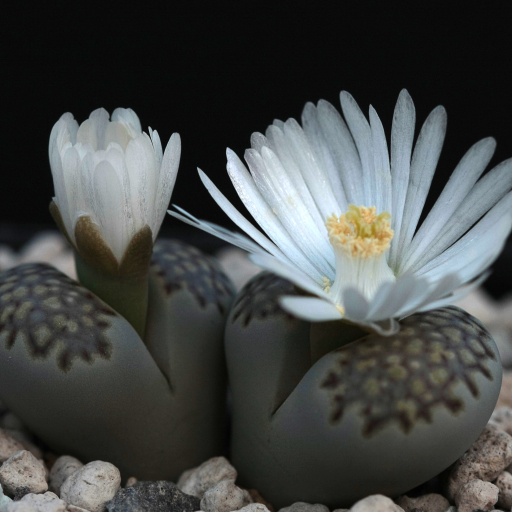
Known as the "Living Stone," Lithops julii is a master of disguise from the arid regions of southern Africa. These tiny succulents have evolved to look exactly like the pebbles surrounding them to avoid being eaten by thirsty animals. Often called the "Stitched Living Stone" due to the delicate, vein-like markings on its surface, this plant is a favorite for collectors who appreciate the strange and the beautiful.
🔍 How to Identify
- 🎨 The Surface: Features a pair of fused, fleshy leaves with a flat or slightly convex top. The coloration is typically a creamy grey or pearly white, decorated with intricate reddish-brown lines or "islands" that look like fine embroidery.
- 🕳️ The Fissure: A deep slit runs across the center of the plant, dividing the two leaves. This is where the new set of leaves—and eventually the flower—will emerge.
- 🌼 The Bloom: In autumn, a surprisingly large, daisy-like white flower emerges from the central slit, often smelling faintly sweet and opening only in the bright afternoon sun.
🏡 In Your Garden
- ⏳ The Shedding Cycle: One of the most critical things to understand is its "molting" phase. Every year, the plant grows a new pair of leaves from the inside, which slowly absorb the moisture from the old outer pair. You must stop watering entirely during this time; the old leaves act as a water reservoir for the new ones.
- ☀️ Light & Lithology: This plant craves bright, direct light but hates "wet feet." It has a long taproot that likes to go deep, so a slightly taller pot with extremely gritty, well-draining soil (mostly pumice or coarse sand) is essential to prevent rot.
⚠️ Safety & Toxicity
- ✅ Status: Non-toxic and safe.
- 🐾 Details: Lithops julii is considered non-toxic to cats, dogs, and humans. However, because they are so small and slow-growing, the plant is much more at risk from a curious pet than the pet is from the plant!
✨ Fun Fact
The name Lithops comes from the Ancient Greek words "lithos" (stone) and "ops" (face). In their natural habitat, they are so well-camouflaged that even expert botanists sometimes struggle to find them unless they are in bloom!

Detailed Care Instructions
To grow Lithops julii plants successfully, follow these steps:
- Choose a well-draining soil mix: Lithops julii plants require a sandy, well-draining soil mix. Use a combination of equal parts potting soil, sand, and perlite or pumice. This will provide the right environment for the plant's roots.
- Provide proper lighting: Lithops julii plants need bright, indirect sunlight. Place the plant near a window where it can receive 4-6 hours of indirect sunlight daily. Avoid direct sunlight, as it can scorch the plant.
- Water carefully: Lithops julii is a succulent plant adapted to survive in arid conditions. Allow the soil to dry out completely between waterings. Only water when the soil is dry to the touch, and never let the plant sit in standing water, as it can rot the roots.
- Maintain a suitable temperature: Lithops julii plants prefer temperatures between 70-85°F (21-29°C) during the growing season. During the winter, when they are dormant, temperatures can drop to 50-60°F (10-16°C).
- Provide ventilation: Good air circulation is crucial for Lithops julii plants. Make sure the plant is not placed in an area with stagnant air, as it can lead to fungal diseases.
- Fertilize sparingly: Lithops julii plants do not require frequent fertilization. Use a diluted succulent fertilizer once or twice a year, in spring and summer, following the instructions on the fertilizer packaging.
- Repotting: Lithops julii plants grow slowly and do not require regular repotting. Only repot when the plant has outgrown its current pot, and make sure to use the same well-draining soil mix mentioned earlier.
- Be patient: Lithops julii plants are slow-growing, and it may take several years for them to reach their full potential. Be patient and enjoy watching them gradually develop and produce beautiful flowers.
Remember to research and understand the specific needs of your Lithops julii plants to ensure their successful growth.
Lithops Julii plants are succulent plants that require minimal watering. It is essential to water them only when the soil is entirely dry to the touch. Overwatering the plant may lead to root rot, which can eventually kill the plant.
To water Lithops Julii plants, first, wait until the soil is entirely dry, which can take up to a couple of weeks. After that, water the plant deeply, making sure that the water reaches the roots. Ensure that the water is well-drained to prevent waterlogging.
In the winter months, watering the plant may not be necessary as they become dormant and require little to no water. Moreover, Lithops Julii plants grow in rocky and arid environments, and they are accustomed to drought and can survive in extreme conditions.
To help retain moisture levels in the soil and protect the Lithops Julii plants in their natural habitats, in the wild, the plants are often found growing in soil covered in a layer of pebbles or rocks. You can mimic this by adding pebbles or rocks on top of your plant's soil, which can help prevent evaporation, reduce water loss, and provide better drainage to the soil.
In summary, water Lithops Julii plants only when the soil is entirely dry, and ensure that the water is well-drained. Additionally, mimic their natural habitat by adding a layer of pebbles or rocks on top of the soil to help retain moisture levels.
To fertilize this plant, use a diluted liquid fertilizer specifically designed for succulents. Apply the fertilizer every two weeks during the growing season (spring and summer) and reduce frequency to once a month during fall and winter. Do not fertilize during dormant periods. Water the plant before fertilizing to avoid damage to the roots. Only fertilize healthy plants to avoid over-fertilization.
Lithops Julii plants prefer to grow in well-draining soil that is low in organic matter. They require soil that is slightly acidic to neutral in pH, with a pH range between 6.0 and 7.0.
The soil mix should be composed of coarse sand, perlite, and gravel. This will ensure proper drainage and prevent moisture buildup around the plants' roots, which can cause root rot.
It is recommended to use a soil mix that is specifically formulated for succulent plants, as these mixes have the ideal drainage and nutrient levels for Lithops Julii. These mixes often contain materials such as pumice, coir, and volcanic rock, which help to aerate the soil and improve drainage.
Overall, it is important to choose a soil mix that is well-draining and low in organic matter to ensure healthy growth and prevent issues such as root rot in Lithops Julii plants.
To propagate this particular plant, one can take a small offset from the parent plant and pot it in a well-draining, sandy soil mix. The offset should be carefully removed from the parent plant with a clean, sharp knife and allowed to dry in a cool, dry place for a few days. Once the offset has calloused over, it can be planted into the soil mix and watered lightly. The new plant should be kept out of direct sunlight and watered sparingly until it has established roots and new growth. Over-watering at this stage can lead to rotting or fungal infections, so it is important to keep the soil mix on the drier side until the plant is established.








