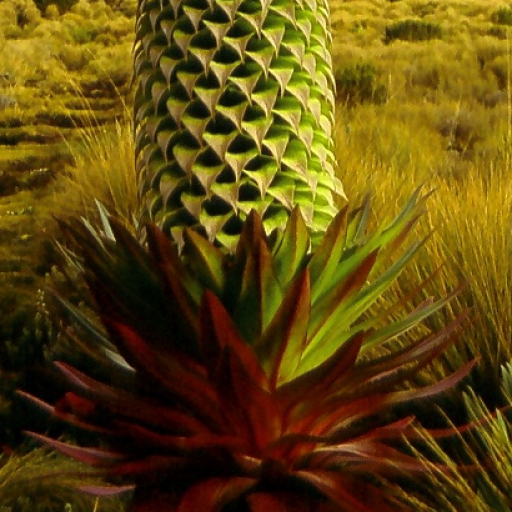
Plant Overview
Often called the "Giant Lobelia of Kilimanjaro," this high-altitude survivor looks like something straight out of a science fiction novel. Growing in the thin air of East Africa’s volcanic peaks, it has evolved incredible "alien" technology to survive freezing nights and scorching days. It is most famous for its "ice-cabbage" appearance, acting as a living thermal flask for the mountain's unique wildlife.
🔍 How to Identify
- 🥬 The Rosette: It features a massive, tight rosette of thick, tongue-shaped leaves that resemble a giant succulent cabbage sitting on the ground.
- 🗼 The Flower Tower: When it blooms, it sends up a colossal, furry spike (inflorescence) that can reach several feet in height, hiding small blue or purple flowers between protective bracts.
- 💧 The Water Reservoirs: Between its leaves, you will find deep pools of clear fluid and mucus that the plant uses as a liquid "blanket" to protect its core.
🏡 Habitat & Ecology
- 🏔️ The Antifreeze Trick: This plant is a master of thermal engineering; at night, the water in its leaf rosettes freezes into a "cap" of ice. This process releases latent heat, keeping the vital heart of the plant safely above freezing while the world around it turns to frost.
- 🐦 Sunbird Sanctuary: It plays a crucial role in its ecosystem by providing a high-calorie "energy drink" of nectar for iridescent Malachite Sunbirds, which act as its primary pollinators in the alpine desert.
⚠️ Safety & Toxicity
- 🟢 General Safety: Lobelia deckenii is not known to be toxic to humans or animals, though it is certainly not a food crop.
- 🚫 Environmental Protection: Because it is a highly specialized species restricted to specific mountain zones, it is extremely sensitive to climate change. It is a protected species in its native habitat and should never be disturbed or removed from the wild.
✨ Fun Fact
The fluid inside the leaf rosettes is so clear that hikers often call it the "Gin and Tonic" plant. However, you shouldn't drink it—it’s full of plant mucus and drowned insects that the plant uses for extra nutrients!

Detailed Care Instructions
To grow Lobelia Deckenii, also known as Kenyan Lobelia, follow these steps:
- Obtain seeds or plantlets: You can either collect seeds directly from mature Lobelia Deckenii plants or purchase them from a reputable nursery or online supplier.
- Prepare the soil: Lobelia Deckenii thrives in well-draining, fertile soil. Prepare the planting area by removing any weeds or debris and loosening the soil with a garden fork or tiller. Add organic matter such as compost or aged manure to enhance soil fertility.
- Sow the seeds or plant the plantlets: If you have seeds, sow them directly into the prepared soil. Make sure to space them apart adequately, following the spacing instructions on the seed packet. If you have plantlets, dig a hole slightly bigger than the root ball and place the plantlet in the hole. Gently pat the soil around the roots to secure the plantlet.
- Water thoroughly: After planting, water the Lobelia Deckenii thoroughly to help establish the plant. Keep the soil consistently moist but avoid overwatering. Watering needs may vary depending on climate and soil conditions, so monitor the moisture levels regularly.
- Provide proper sunlight: Lobelia Deckenii requires full sun to partial shade. Choose a location that receives at least 4-6 hours of direct sunlight per day. If growing in hot climates, provide some shade during the hottest part of the day to prevent scorching.
- Support the plants: Lobelia Deckenii can benefit from some support as it grows. Use stakes or a trellis to provide support for the plants' upright growth and prevent them from sprawling or bending.
- Fertilize regularly: Lobelia Deckenii benefits from regular feeding during the growing season. Use a balanced, water-soluble fertilizer or a slow-release fertilizer according to package instructions. Apply the fertilizer every 4-6 weeks to promote healthy growth and abundant flowering.
- Monitor pests and diseases: Keep an eye out for common pests, such as aphids or snails, and take appropriate measures to control them if necessary. Additionally, ensure good air circulation around the plants to prevent diseases like powdery mildew.
- Regular pruning: To maintain a compact and bushy growth habit, regularly pinch back the growing tips of Lobelia Deckenii. This encourages branching and more flowering.
- Enjoy the blooms: Lobelia Deckenii typically blooms in spring and summer, producing vibrant blue or purple flowers. Admire the beautiful blooms and consider deadheading (removing spent flowers) to promote continuous flowering.
Remember to follow any specific care instructions provided with the seeds or plantlets you obtain, as regional variations and cultivar-specific requirements may exist.

Place in a bright room that is sun drenched almost all day. Or directly in a south-facing window.

Watering Lobelia Deckenii plant requires regular monitoring of the soil moisture level. It is important to provide enough water to keep the soil evenly moist but not waterlogged. It is recommended to water the plant deeply at least once a week and more frequently during hot and dry weather conditions. Be careful not to let water stand around the base of the plant, as it can cause root rot. Apply water directly to the soil, avoiding the foliage, and ensure that excess water drains out of the pot. Avoid overwatering or allowing the soil to dry out completely as it can impact the plant's growth and health. Use well-draining soil mix, and avoid using hard tap water as the high mineral content can affect the plant's growth.
To fertilize this plant, use a balanced, water-soluble fertilizer with equal parts nitrogen, phosphorus, and potassium. Apply the fertilizer once every two weeks during the growing season, from spring to summer. Mix the fertilizer with water according to the manufacturer's instructions, and apply it around the base of the plant. Avoid getting fertilizer on the leaves or flowers. Water the plant thoroughly after fertilizing.
Lobelia Deckenii is a plant that requires fertile, well-drained soil with good moisture retention. The soil should have a pH level of 5.5 to 6.5 and should be rich in organic matter. This plant prefers soil that is slightly acidic, so it is important to avoid soils that are too alkaline.
The best soil for Lobelia Deckenii is a mixture of loam and organic matter. Loam is a soil type that consists of a balanced mixture of sand, clay, and silt, which provides good drainage and aeration. Organic matter can be added in the form of compost, leaf mold, or well-rotted manure, which will improve soil structure and provide essential nutrients.
To ensure optimal growth, the soil should be kept evenly moist but not waterlogged. This can be achieved by watering the plant regularly, but allowing the soil to dry out slightly between watering. Mulching around the base of the plant can also help to retain moisture in the soil.
It is important to avoid using heavy, compacted soils or soils that are prone to waterlogging as this can cause root rot and other problems. Similarly, soils that are too sandy or lacking in nutrients may not provide adequate support for the plant.
To propagate this plant, one can start by selecting a healthy and well-established mother plant. Then, take stem cuttings that are about 4-6 inches in length and contain a few nodes. Remove any leaves from the bottom half of the stem to prevent moisture loss. Dip the cut end into rooting hormone powder and plant it in a moist, well-draining potting mix. Place the pot in a warm and bright location but avoid direct sunlight. Water the cutting regularly, but be careful not to overwater as this can lead to rotting. After a few weeks, the cutting should start forming root and new growth. Once it has established a strong root system, it can be transplanted into a larger pot or directly into the garden.








