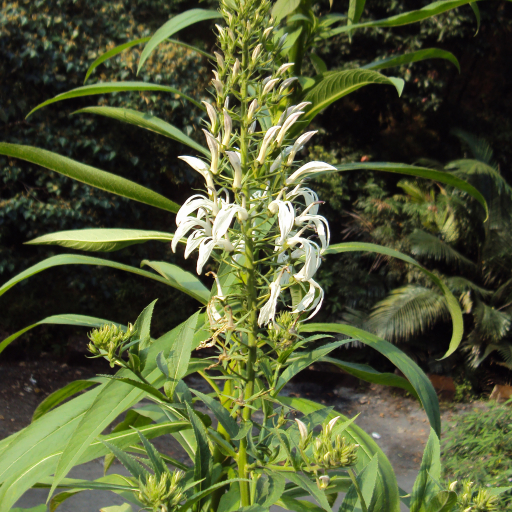
Plant Overview
Often called the "Wild Tobacco" or "Great Lobelia," Lobelia nicotianifolia is a towering, statuesque beauty native to the high-altitude hills of India and Sri Lanka. While it shares a name and a visual likeness with common tobacco, it actually belongs to the Bellflower family. In its natural habitat, it stands like a floral sentinel along forest edges, producing dramatic spires of blossoms that can reach heights of nearly ten feet.
🔍 How to Identify
- 🍃 The Foliage: The leaves are long, narrow, and lance-shaped with finely serrated edges. They look remarkably similar to real tobacco leaves, often growing in a dense, lush rosette at the base before the flowering stem shoots upward.
- 🌸 The Bloom Spike: It produces a massive, terminal raceme (a long spike) of white to pale lilac flowers. Each flower has a distinct "lobed" appearance, typical of the Lobelia genus, resembling a tiny bird with outstretched wings.
- 🥛 The Latex: If a leaf or stem is broken, the plant exudes a thick, milky white sap (latex). This is a primary identifying feature but should be handled with extreme caution.
🏡 In Your Garden
- ☁️ Atmospheric Needs: This plant is a child of the mist. It craves high humidity and cool temperatures, making it difficult to grow in dry, flat lowland gardens. It performs best in "cloud forest" conditions.
- 🌱 The Life Cycle: It is often biennial or short-lived perennial. It spends its first year building a strong root system and a leafy base, saving all its energy for one spectacular, "monocarpic" flowering event before eventually going to seed.
- 🐝 Pollinator Hub: In a garden or wild setting, these giant spikes act as a beacon for large bees and butterflies, who are among the few insects strong enough to navigate the tubular flowers.
⚠️ Safety & Toxicity
- 🚫 High Toxicity: Warning. This plant is highly poisonous if ingested. It contains potent alkaloids, specifically lobeline, which can cause severe vomiting, tremors, and respiratory failure.
- 🧤 Skin Irritant: The milky sap can cause "contact dermatitis" or painful skin rashes. Always wear gloves if you are pruning or clearing this plant, and ensure it is kept well away from areas where pets or children play.
✨ Fun Fact
Despite its toxicity, Lobelia nicotianifolia has a history in pharmacology. The compound "lobeline" extracted from the plant was historically used as a "nicotine substitute" in anti-smoking lozenges because it affects the brain's receptors in a similar way to tobacco—without being addictive!

Detailed Care Instructions

Place in a bright room that is sun drenched almost all day. Or directly in a south-facing window.

Water-loving plants flourish in wet or sloppy soil and near ponds. The extensive root system enables these plants to absorb plenty of water. The surface of the soil should be kept moist at all times. Place your pot in a container filled with water to guarantee that plants get enough water. If the ground becomes dry, it is recommended that you water it well. Plants in smaller pots will need to be watered more frequently. Water the soil in which the plant is standing thoroughly using a watering can.








