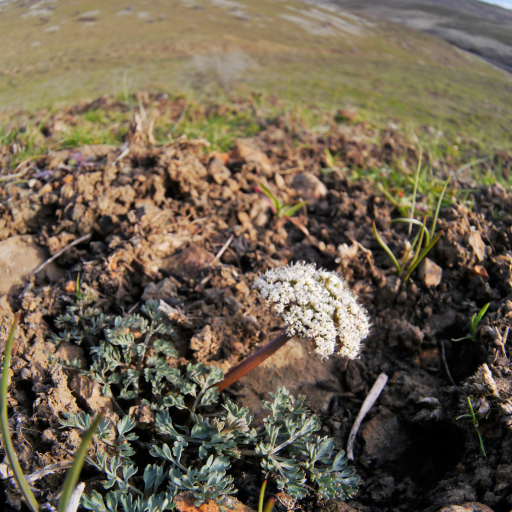
Plant Overview
Commonly known as Canby’s Biscuitroot or Canby’s Desert Parsley, this resilient perennial is a survivor of the rugged American Northwest. Long before it was a favorite for native wildflower enthusiasts, it was a vital "grocery store" for Indigenous peoples, who harvested its starchy roots to grind into flour for cakes—hence the name "Biscuitroot." In the early spring, it emerges from rocky, volcanic soils like a tiny, lacy puff of life against a grey landscape.
🔍 How to Identify
- 🌿 Lacy Foliage: The leaves are finely divided and feathery, resembling parsley or carrot greens, often hugging the ground in a low, grayish-green rosette.
- 🌸 Umbel Flowers: It produces small, flat-topped clusters (umbels) of tiny white flowers. Look closely, and you’ll see distinctive dark purple or black "dots," which are actually the pollen-bearing anthers.
- 🥔 The "Biscuit" Root: Underground, the plant develops a thick, corky, and starchy taproot that acts as a nutrient reservoir for surviving harsh droughts.
🏡 In Your Garden
- 🌋 Volcanic Origins: This plant is a "lithophyte" at heart, meaning it thrives in rocky, shallow, or volcanic soils. If you're planting it, ensure your soil has impeccable drainage; it hates "wet feet" and will rot in heavy clay.
- ☀️ Sun Worshipper: Canby’s Biscuitroot evolved for the wide-open sagebrush steppe. It requires full sun to bloom and is incredibly drought-tolerant once established, making it a perfect candidate for a xeriscape or rock garden.
⚠️ Safety & Toxicity
- 🟢 Edible History: Historically, the roots are edible and were a staple food for many tribes. However, foragers must exercise extreme caution.
- 🚫 Deadly Lookalikes: This plant belongs to the Apiaceae (Carrot) family, which includes the Deadly Water Hemlock. Never consume wild plants unless you are 100% certain of the ID, as a mistake in this family can be fatal.
- 🐾 Pet Safety: While not specifically listed as highly toxic to pets, many plants in this family can cause mild stomach upset or skin sensitivity (phototoxicity) if handled or ingested in large amounts.
✨ Fun Fact
Native Americans often called this plant "Chucklusa." They would peel the roots and eat them raw—tasting somewhat like a cross between a parsnip and a celery stalk—or dry them to make a travel-ready "biscuit" that could last for months!

Detailed Care Instructions

Place in a bright room that is sun drenched almost all day. Or directly in a south-facing window.

Some plants require more regular watering than others, which should be done every few days. It's critical to maintain the soil moist all of the time. The water requirements of the same plant placed in pots with varying sizes will differ. Because the water in the smaller pot evaporates faster than the water in the larger pot, it will require more watering. Regardless of pot size, the surface should constantly be maintained moist.








