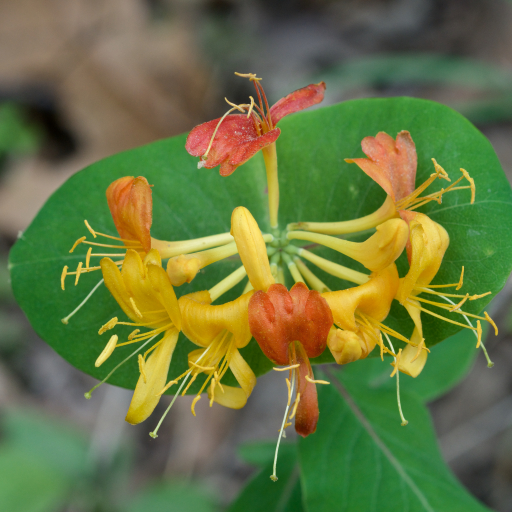
Plant Overview
Often called the Yellow Honeysuckle, this native North American beauty is a favorite for those looking to add a splash of vertical sunshine to their landscape. Unlike its aggressive, invasive cousins, this vine is a polite garden guest that offers a heavy, sweet perfume and striking clusters of golden-orange blooms that seem to glow against its blue-green foliage.
🔍 How to Identify
- 🌼 Golden Blooms: Features clusters of trumpet-shaped flowers that emerge a bright primrose yellow and deepen to a rich orange-gold as they age.
- 🍃 Fused Leaves: The most distinct feature is the "perfoliate" upper leaves; the pair of leaves directly below the flower cluster are fused together at the base, making it look like the stem is piercing through a single circular leaf.
- 🍇 Autumn Fruit: After the blossoms fade, the plant produces clusters of small, translucent red berries that persist into the cooler months.
🏡 In Your Garden
- 🧗 Support Needs: Because this is a twining vine rather than a "clinging" one, it lacks suction-cup roots. It requires a trellis, arbor, or chain-link fence to wrap itself around as it grows.
- 🦋 Pollinator Paradise: The long, tubular flowers are perfectly evolved for the long tongues of hummingbirds and sphinx moths, making your garden a hub for local wildlife.
- 🌱 Root Protection: It prefers "cool feet and a warm head," meaning it thrives when the roots are shaded by mulch or low-growing perennials while the vines reach upward into the sun.
⚠️ Safety & Toxicity
- 🚫 Mildly Toxic: While the nectar is sweet and harmless, the red berries and the foliage contain saponins which are toxic if ingested in large quantities.
- 🐾 Pet & Child Safety: Keep an eye on curious toddlers and pets; eating the berries can cause stomach upset, nausea, or lethargy. It is generally not considered "deadly," but it is definitely not edible.
✨ Fun Fact
The Lonicera flava was a favorite of early American botanists and was frequently planted in "Moonlight Gardens" because its bright yellow flowers remain highly visible and fragrant long after the sun goes down, guiding nocturnal pollinators to their feast.

Detailed Care Instructions
To grow Lonicera Flava (Yellow Honeysuckle) plants, follow these steps:
- Choose the right location: Lonicera Flava thrives in full sun to partial shade. Select a location that receives at least 6 hours of direct sunlight each day. Ensure the soil is well-drained, as excess moisture can lead to root rot.
- Prepare the soil: Lonicera Flava prefers moist and fertile soil. Before planting, amend the soil with compost or well-rotted manure to improve its fertility and drainage.
- Planting: Dig a hole slightly larger than the plant's root ball. Place the plant in the hole, ensuring that the soil level is the same as the nursery container. Fill the hole with soil and press it gently around the base of the plant.
- Watering: After planting, thoroughly water the plant to establish its roots. Water regularly, especially during hot and dry periods, ensuring the soil remains evenly moist. However, avoid overwatering, as it can lead to root rot.
- Mulching: Apply a layer of organic mulch, such as wood chips or bark, around the base of the plant. Mulching helps retain moisture, suppress weeds, and regulate soil temperature.
- Pruning: Lonicera Flava generally requires minimal pruning. However, you can prune it lightly in early spring to shape the plant or remove any dead or damaged branches.
- Fertilizing: Apply a balanced, slow-release fertilizer in spring to provide nutrients for healthy growth. Follow the instructions provided by the specific fertilizer. Avoid excessive fertilizer application, as it can negatively impact the plant's health.
- Supporting the vine: Since Lonicera Flava is a vining plant, it may require support to climb. Install a trellis, fence, or any other vertical structure for the plant to twine around and grow upward.
- Pests and diseases: Monitor your plant regularly for common pests like aphids, spider mites, or powdery mildew. If necessary, treat the infestation using organic or chemical control methods.
- Propagation: Lonicera Flava can be propagated via seeds or cuttings. Gathering seeds from the berries once they ripen, or taking softwood cuttings in early summer, are common methods of propagation.
Remember to research and comply with any local regulations regarding the cultivation of Lonicera Flava, as it may be invasive in some regions.
Lonicera Flava is a plant that requires regular watering to thrive. To water this plant, you should first ensure that the soil is moist but not saturated. You can test the soil moisture by inserting your finger into the top inch of soil. If the soil feels dry, you can water the plant.
When watering Lonicera Flava, you should aim to water deeply but infrequently. This means providing enough water to thoroughly saturate the soil, but allowing time for the soil to dry out slightly before watering again. This helps encourage the plant to develop a deep root system, which can help it better withstand drought conditions.
When watering Lonicera Flava, it's important to avoid getting the foliage wet. This can increase the risk of fungal diseases developing on the plant. Instead, water the base of the plant, taking care to avoid wetting the leaves.
Overall, Lonicera Flava is a relatively easy plant to care for, and regular watering is a key part of ensuring that it remains healthy and thriving.
To fertilize this plant, use a balanced, slow-release fertilizer in the spring before new growth appears. Apply it evenly around the root zone and water it in well. Avoid over-fertilizing as it may lead to excessive vegetative growth at the expense of flowers and fruit. Additionally, monitor the soil pH and adjust if necessary to maintain optimal nutrient uptake.
When selecting soil for Lonicera Flava plant, it is important to consider the plant's natural habitat and requirements. This species grows best in well-draining soil that is slightly acidic and rich in organic matter. Therefore, it is recommended to use a mixture of sandy loam soil and peat moss or compost in a ratio of 2:1.
The soil should be aerated and loose to allow good water drainage and root growth. Additionally, it is important to avoid soil that is too alkaline or compacted, as this can lead to poor growth and plant health. A pH level of around 6 to 6.5 is optimal for this species.
Before planting, it is recommended to amend the soil with a slow-release fertilizer to provide the plant with necessary nutrients. It is also important to ensure that the plant is watered regularly, but not excessively, as over-watering can lead to root rot and other issues. Adequate drainage is key to preventing these problems.
Overall, Lonicera Flava plant thrives in soil that is well-draining, slightly acidic, and rich in organic matter. Proper soil selection and care are essential to promoting healthy growth and optimal plant health.
The process of propagating this plant can be done through stem cuttings. Firstly, select a healthy stem from the parent plant that is not too young or old. It should have healthy leaves and a soft yet firm stem. Cut the stem carefully with a sharp and clean knife. Make sure the cut is at a slant. Then, remove the leaves from the bottom of the stem to leave about 1 inch of bare stem. Dip the cut end of the stem into rooting hormone powder and plant it in a moist potting soil mixture. Water the soil well after planting and keep the soil moist, but not waterlogged. Place the newly planted cutting in a shaded area and keep an eye on it for the next few weeks. With some patience and care, it should start growing roots and leaves within a month or two.








