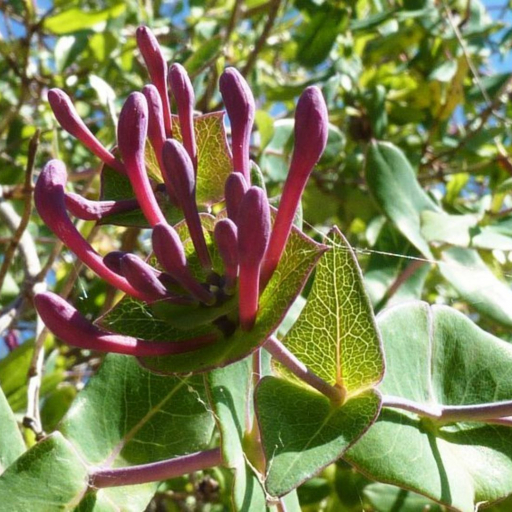
Plant Overview
Known affectionately as the Minorcan Honeysuckle, this Mediterranean beauty is a master of the vertical climb. Unlike some of its more aggressive cousins, Lonicera implexa brings a refined, evergreen elegance to sun-drenched gardens, filling the evening air with a sweet, heady perfume that has inspired garden lovers for centuries.
🔍 How to Identify
- 🍃 Fused Foliage: The upper leaves are highly distinctive; they grow together at the base, completely encircling the stem to form a solid green saucer (perfoliate) right beneath the flowers.
- 🌸 Bicolor Blooms: The tubular flowers appear in dense clusters, showing off a delicate pink-purple exterior that opens to reveal a creamy white or pale yellow interior.
- 🍇 Autumn Jewels: As the flowers fade in late summer, they are replaced by small, glossy red-to-orange berries that sit nestled in the "cup" of the fused leaves.
🏡 In Your Garden
- 🧗 Natural Climber: This is a "twining" vine. It doesn't use tendrils like a grape; instead, the entire woody stem wraps itself around supports. It is ideal for rustic wooden trellises, pergolas, or chain-link fences where it can create a living screen.
- ☀️ Mediterranean Resilience: Native to rocky coastal areas, it is remarkably drought-tolerant once established. It thrives best with its "feet in the shade and head in the sun," meaning it appreciates mulch to keep the roots cool while the vines reach for the light.
- 🦋 Pollinator Magnet: The long, tubular flowers are specifically designed for long-tongued visitors. In the evenings, you may spot Hawkmoths hovering like hummingbirds to drink the rich nectar.
⚠️ Safety & Toxicity
- 🚫 Toxic Berries: While the nectar of the flower is legendary for its sweetness, the berries are strictly not edible. They contain saponins that can cause significant digestive distress if swallowed.
- 🐾 Pets & Children: Because the berries are bright and attractive, keep this plant away from areas where small children or curious pets play. Ingestion can lead to vomiting, diarrhea, and lethargy.
✨ Fun Fact
The species name implexa comes from the Latin word for "interwoven" or "entangled." This refers to the plant’s habit of twisting its stems so tightly around itself and its neighbors that it creates a dense, impenetrable thicket in the wild.

Detailed Care Instructions
To grow Lonicera implexa, also known as the Evergreen Honeysuckle or Spanish Honeysuckle, you can follow these steps:
- Choose a suitable location: Select a spot in your garden that receives partial shade to full sun. The soil should be well-draining and fertile.
- Prepare the soil: Loosen the soil by removing any weeds, rocks, or debris. Add organic matter such as compost or well-rotted manure to improve the soil's fertility and drainage.
- Planting: Dig a hole that is slightly larger than the root ball of the plant. Place the Lonicera implexa in the hole at the same level it was growing in its container. Backfill the hole with soil and gently firm it around the roots.
- Watering: Water the plant thoroughly after planting to settle the soil. Provide regular watering to keep the soil evenly moist but not soggy. Depending on the weather and soil conditions, you may need to water once or twice a week.
- Mulching: Apply a layer of organic mulch, such as wood chips or shredded bark, around the base of the plant. Mulching helps to retain moisture, suppress weeds, and maintain a more even soil temperature.
- Pruning: Trim the plant in late winter or early spring before the new growth begins. Remove any dead, damaged, or overgrown branches to maintain a neat and tidy appearance. Pruning also encourages vigorous new growth.
- Fertilizing: Lonicera implexa generally does not require heavy fertilization. However, you can apply a balanced slow-release fertilizer in early spring to promote healthy growth. Follow the instructions on the fertilizer packaging for dosage and application guidelines.
- Support: Provide a trellis, fence, or sturdy support structure for the vine to climb. Lonicera implexa is a vigorous climber and will benefit from having something to latch onto.
- Monitor for pests and diseases: Regularly check the plant for any signs of pests or diseases, such as aphids or powdery mildew. Treat any issues promptly with appropriate organic or chemical controls.
- Propagation: Lonicera implexa can be propagated through stem cuttings. Take cuttings in late spring or early summer and root them in a well-draining soil mix.
Remember to adapt these instructions based on your specific climate and growing conditions. Following these steps should help you successfully grow Lonicera implexa and enjoy its beautiful flowers and fragrance.

Place in a bright room that is sun drenched almost all day. Or directly in a south-facing window.

The best way to water Lonicera Implexa plant is to test the soil moisture level using a moisture meter or by sticking your finger into the soil up to the second knuckle. If the soil feels dry, it is time to water the plant. Slowly pour water into the soil around the base of the plant until the water starts to come out of the drainage holes in the bottom of the pot or container. Be careful not to overwater the plant as this can cause root rot. Water the Lonicera Implexa plant on a regular basis, typically once a week, adjusting the frequency depending on the season and weather conditions. Always check the soil moisture level before watering to ensure it is not too wet or too dry.
To fertilize this plant, you should apply a balanced fertilizer with equal amounts of nitrogen, phosphorus, and potassium in the spring and summer. Avoid fertilizing in the fall and winter when the plant is dormant. Follow the instructions on the fertilizer package for the appropriate amount to apply and water thoroughly afterward.
For growing Lonicera Implexa, it is recommended to use well-draining loamy soil that is rich in organic matter. The soil should have a neutral to slightly acidic pH level between 6.0 and 7.0.
The soil should be moist but not waterlogged and should be kept slightly damp at all times. The plant prefers soil that is moderately fertile and well-aerated to ensure vigorous growth.
It is also important to choose a location that receives full to partial sunlight, as the plant requires ample light to grow and thrive. Adequate spacing and proper soil preparation are necessary with any plant to ensure that it develops healthy roots and reaches its full potential.
There are several methods to propagate Lonicera Implexa plant. One of the most common ways is to propagate through cuttings. For this, select healthy stems with several leaf nodes. Cut the stem at an angle, and remove the leaves from the bottom two nodes. Dip the cut end in rooting hormone powder and plant it in a well-draining soil mix. Keep the soil moist but not waterlogged and provide indirect sunlight. After a few weeks, the cutting will develop roots, and new leaves will emerge.
Another way to propagate Lonicera Implexa is through layering. Select a healthy stem with low-lying branches that can be bent down to touch the soil. Make a small cut on the stem where it touches the soil to encourage rooting. Cover the cut with soil and keep it moist. After a few weeks, the stem will develop roots, and a new plant will emerge.
Finally, Lonicera Implexa can also be propagated through seeds. Collect seeds from mature berries and plant them in a well-draining soil mix. Keep the soil moist and provide indirect sunlight. After a few weeks, the seeds will germinate, and new seedlings will emerge. It's important to note that propagating through seeds can take a long time and may not result in plants that are identical to the parent plant.








