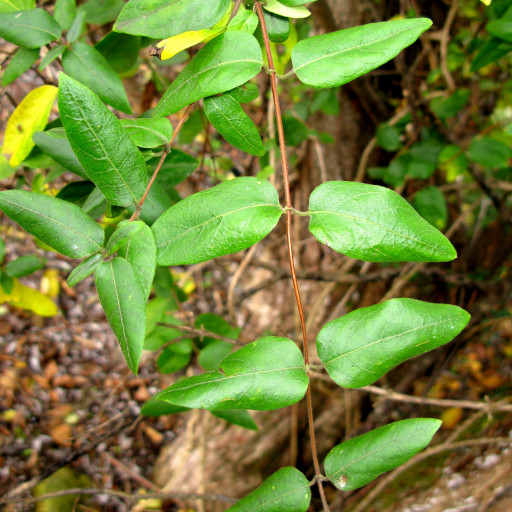
Plant Overview
Known as the "Gold-and-Silver Flower" in East Asia, Japanese Honeysuckle is famous for its intoxicating, honey-sweet fragrance that can fill an entire neighborhood on a warm summer evening. While beloved for its beautiful blooms and ability to quickly cover fences, it is a vigorous climber that often walks the fine line between a garden favorite and an unstoppable invader. In many parts of the world, it is cherished for its nostalgic scent but feared for its ability to "choke" out native forests.
🔍 How to Identify
- 🌼 The Two-Tone Bloom: The flowers are tubular and grow in pairs. They emerge a pure, snowy white and gradually fade to a deep golden yellow as they are pollinated, giving the vine its "gold and silver" nickname.
- 🍃 Opposite Leaves: Look for simple, oval-shaped leaves that grow in pairs directly across from one another along the woody, reddish-brown stems.
- 🔮 Dark Berries: In late summer and autumn, the flowers are replaced by small, glossy black berries (unlike the red berries found on many native honeysuckle species).
🏡 In Your Garden
- ✂️ Vigorous Growth: This plant is a "weaver." It doesn't have tendrils; instead, it wraps its entire stem around supports. Because it grows so fast, it requires aggressive pruning to prevent it from becoming a tangled, heavy mess that can collapse weak trellises.
- 🦋 Pollinator Magnet: If you want to see nature in action, plant this near a window. It is a primary food source for hummingbirds during the day and hawk moths at twilight, who are drawn in by the intensified evening scent.
⚠️ Safety & Toxicity
- 🤢 Mildly Toxic: While children often enjoy sucking the tiny drop of sweet nectar from the base of the flower, the berries and leaves are toxic if ingested. They can cause nausea, vomiting, and diarrhea.
- 🐾 Pet Warning: Keep an eye on curious dogs or cats; the berries are not safe for pets and can cause significant digestive distress.
- 🌳 Ecological Alert: In North America, this plant is considered highly invasive. It can girdle young trees and block sunlight from the forest floor, so it is often better kept in a large container rather than planted directly in the ground.
✨ Fun Fact
In Traditional Chinese Medicine, the flowers (known as Jin Yin Hua) have been used for centuries to create cooling teas intended to treat "inner heat" and respiratory ailments. One of the most common childhood memories for people across the globe is plucking a single bloom, pulling the stamen through the bottom, and tasting that one perfect, sugary drop of nectar.

Detailed Care Instructions
| Color | White, Maturing To Yellow |
| Soil Ph | 5.5 To 8 |
| Invasive | Weed |
| Lighting | Full Sun |
| Soil Type | Prefers Average Soil That Is Well Drained |
| Bloom Time | Late Spring To Fall |
| Plant Type | Perennial Flowering Vine |
| Mature Size | 15 To 30 Feet In Length, With A Spread Of 3 To 6 Feet. |
| Native Area | Eastern Asia Including China, Japan, And Korea |
| Sun Exposure | Full Sun To Part Shade |
| Hardiness Zones | 4 To 9 |
To grow Lonicera japonica, also known as Japanese honeysuckle, you can follow these steps:
- Choose the right location: Lonicera japonica thrives in full sun to partial shade. Make sure it has at least six hours of direct sunlight each day.
- Prepare the soil: The plant prefers well-draining soil. Amend the soil with organic matter like compost or well-rotted manure to improve fertility and drainage.
- Planting: Dig a hole that is slightly larger and deeper than the root ball of the plant. Place the plant in the hole and backfill with soil, gently firming it around the roots. Leave a small basin around the plant to retain water.
- Watering: Water the plant thoroughly after planting and provide regular watering until it becomes established. Ensure the soil is moist but not waterlogged. After establishment, water the plant deeply once a week or when the top inch of soil dries out.
- Mulching: Apply a layer of organic mulch around the base of the plant to help retain moisture, suppress weeds, and regulate soil temperature.
- Pruning: Lonicera japonica can benefit from regular pruning to control its growth and shape. Prune in late winter or early spring before new growth appears. Remove any dead, damaged, or overcrowded branches. It's important to note that Japanese honeysuckle can become invasive, so ensure you regularly remove any new sprouts or runners that may appear outside of the desired planting area.
- Fertilizing: Feed the plant with a balanced, slow-release fertilizer in early spring and again in midsummer. Follow the instructions on the fertilizer packaging for application rates.
- Support: If you want Lonicera japonica to climb, provide a trellis or other support structure for it to grow on. This will encourage upward growth and prevent it from sprawling over the ground.
- Monitor for pests and diseases: Keep an eye out for common pests like aphids, whiteflies, and mites. Treat any infestations promptly with organic or chemical insecticides. Also, watch for signs of diseases like powdery mildew or leaf spot and take appropriate measures to control them.
- Propagation: Lonicera japonica can be propagated from cuttings or by layering. Take semi-hardwood cuttings in late summer or early fall and root them in a well-draining soil mixture. Alternatively, bend a low-hanging stem to the ground, secure it in a small hole, and cover with soil. The stem will develop roots, and you can separate it from the parent plant once rooted.
Remember to consult local regulations and guidelines, as Lonicera japonica can be considered invasive in some areas.

Place in a window with dappled sun or a spot in the middle of a room. Or directly in a window facing west or east.

To water this plant, you should first check the soil moisture by sticking your finger in the soil. If it feels dry up to your second knuckle, it's time to water. Use a watering can or a hose with a gentle sprayer attachment to water the plant slowly and thoroughly, making sure the soil is evenly saturated. Avoid getting water on the leaves, as this can encourage fungal growth. Water the plant only when the top inch of soil is dry to the touch, as overwatering can lead to root rot. Additionally, if your plant is in a pot, make sure it has proper drainage holes to prevent water from sitting in the soil.
To fertilize this plant, use a balanced slow-release fertilizer in the early spring before new growth appears. Apply the fertilizer according to the manufacturer's instructions, being careful not to over-fertilize. Water the plant thoroughly after fertilizing. Repeat the process every 6-8 weeks throughout the growing season. Do not fertilize in the fall or winter.
The Lonicera Japonica plant prefers well-drained soil that is rich in organic matter. It should be slightly acidic with a pH level between 6.0 and 7.5. The soil should also be moist but not waterlogged and should retain enough moisture to keep the plant healthy. Adequate drainage is important for this plant since it can be prone to root rot in overly wet conditions. The ideal soil type for this plant would be a loamy soil mix that contains equal parts of sand, silt, and clay. Adding compost or other organic matter can also help improve soil quality and fertility. Additionally, the plant prefers full sun exposure but can tolerate some shade, so it's important to find an appropriate spot for the plant based on its light needs.
Lonicera japonica can be propagated by taking softwood cuttings from the parent plant. The process involves selecting a healthy stem that is still relatively young and flexible, but not overly soft. Using clean, sharp pruning shears, cut a section of the stem about 4-6 inches in length, making sure to include several nodes (where the leaves grow out from the stem). Remove the lower leaves from the stem, leaving 2-3 pairs of leaves at the top.
Prepare a planting container or tray with well-draining potting soil, and moisten the soil with water. Dip the cut end of the stem in rooting hormone powder, and gently insert it into the soil, pressing the soil around the stem to hold it in place. Water the soil gently and place a clear plastic bag or a humidity dome over the container to create a mini greenhouse environment. Place the container in a bright but indirect light location, and keep the soil moist, but not too wet.
Check the cuttings regularly for signs of new growth and root development. Once roots have formed and new leaves appear, remove the covering and gradually acclimate the plant to brighter light and lower humidity. When the new plant is well-established, transplant it into a larger container or into the ground, and enjoy your new Lonicera japonica plant!
Common pests of the honeysuckle include Spider mites, aphids, larvae. Make a habit of checking your honeysuckle frequently for pests so that any infestations can be caught and managed early.








