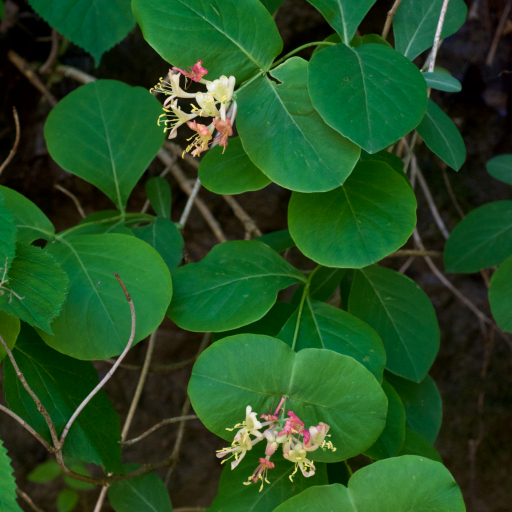
Plant Overview
Affectionately known as the Grape Honeysuckle, this North American native is a showstopper for those who love architectural foliage. Its most famous variety, "Kintzley's Ghost," earned its name from the ethereal, silvery-blue disks that seem to float along its stems, creating a hauntingly beautiful aesthetic in the moonlight. Unlike many invasive honeysuckles, this species is a well-behaved guest that adds a touch of vintage charm to any garden.
🔍 How to Identify
- 🍃 The Floating Disks: The most striking feature is the "perfoliate" leaves; the uppermost pairs fuse together to form a solid, waxy, circular disk that looks like a saucer through which the stem grows.
- 🌼 Golden Trumpets: In late spring, clusters of pale yellow, unscented tubular flowers erupt directly from the center of the fused leaf disks.
- 🍇 Waxy Foliage: The leaves have a distinct glaucous (waxy) coating, giving the entire plant a dusty, blue-green or "grape-like" hue that stands out against typical green garden plants.
🏡 In Your Garden
- 🧗 The Twining Habit: This is a woody vine that climbs by wrapping its stems around a support. Because it doesn't have "suckers" or "tendrils," it requires a sturdy trellis, fence, or arbor to guide its upward journey.
- 🌞 Cool Feet, Sunny Head: To keep it happy, plant it in a spot where the roots stay cool and shaded, but the top growth can reach for the sun. This prevents the "legginess" that often plagues older vines.
⚠️ Safety & Toxicity
- 🚫 Mildly Toxic: While the flowers are beautiful, the plant is not meant for consumption.
- 🐾 Pets & Children: The bright red berries that appear in autumn are toxic. If ingested by dogs, cats, or small children, they can cause significant stomach upset, vomiting, or diarrhea. It is best planted in areas where curious toddlers or pets won't be tempted by the "forbidden fruit."
✨ Fun Fact
The popular 'Kintzley's Ghost' cultivar was a "lost" plant for nearly a century! It was discovered by William Kintzley in the 1880s, but it wasn't formally introduced to the public until a plant expert found a specimen growing in a 100-year-old garden in Colorado in the early 2000s.

Detailed Care Instructions
To grow Lonicera reticulata, also known as honeysuckle vine or honeysuckle plant, follow these steps:
- Choose a suitable location: Honeysuckle plants prefer full sun to partial shade. The soil should be well-draining and rich in organic matter. Make sure there is enough space for the vine to grow and climb.
- Prepare the soil: Before planting, loosen the soil with a garden fork or tiller. Incorporate compost or organic matter to improve nutrient content and drainage.
- Planting method: Dig a planting hole that is twice the width and depth of the root ball. Place the plant carefully in the hole, ensuring that it is at the same depth as it was in the container or nursery pot. Backfill the hole with soil, firmly press down to eliminate air pockets, and water thoroughly.
- Watering: Honeysuckle plants require regular watering, especially during dry periods. Keep the soil evenly moist but not waterlogged. Mulching around the plant can help retain moisture and reduce weed growth.
- Fertilizing: Apply a balanced, slow-release fertilizer in early spring to provide essential nutrients for growth. Follow the instructions on the fertilizer packaging for application rates.
- Pruning: Prune honeysuckle vines in late winter or early spring to remove dead or damaged branches and to shape the plant. Regular pruning helps promote flowering and prevents the vine from becoming overly dense.
- Support structure: Provide a trellis, arbor, or fence for the honeysuckle vine to climb and spread. Secure the vine to the support structure initially, and it will naturally twine around and attach itself.
- Pests and diseases: Honeysuckle plants can be susceptible to aphids, whiteflies, and powdery mildew. Monitor the plant regularly and take appropriate measures if pests or diseases are observed. Using organic insecticides or horticultural oils can help control infestations.
- Propagation: Honeysuckle plants can be propagated from cuttings or by layering. Softwood cuttings taken in spring or semiripe cuttings taken in summer can be rooted in a well-draining medium.
Remember, different honeysuckle varieties may have specific care requirements, so be sure to research the specific needs of the Lonicera reticulata variety you are growing.

Place in a bright room that is sun drenched almost all day. Or directly in a south-facing window.

To water this plant, first check the soil moisture level by sticking your finger about 1-2 inches into the soil. If the top layer feels dry to the touch, it is time to water. Use a watering can or hose with a gentle nozzle to water the soil around the base of the plant, avoiding getting water on the leaves. Water until the soil is moist but not waterlogged. Allow the soil to dry out slightly before watering again. It is also important to note that this plant prefers well-draining soil and may be susceptible to root rot if overwatered.
For optimal growth and flowering, it is recommended to fertilize this plant in the early spring before new growth begins. Use a balanced, slow-release fertilizer with equal parts of nitrogen, phosphorus, and potassium. Apply the fertilizer according to the manufacturer's instructions, being careful not to over-fertilize. Water the plant after fertilizing to help incorporate the nutrients into the soil. Repeat the fertilization process once every 6-8 weeks throughout the growing season.
Lonicera Reticulata plant requires a well-draining soil that is rich in nutrients. The soil should be slightly acidic with a pH between 5.5 and 7.5. It prefers loamy or sandy soil with good drainage. To improve drainage, you can add perlite or sand to the soil. The plant also prefers soil that is moist but not waterlogged. It is important not to let the soil dry out completely, but at the same time, the plant is susceptible to root rot if the soil is too wet for an extended period. Adding organic matter like compost or well-rotted manure to the soil will help improve soil fertility and texture. Avoid using heavy clay soils or soils that are prone to waterlogging.
To propagate this plant, take semi-hardwood cuttings in late summer or early autumn from healthy, vigorous shoots. Cut the stem into 4-6 inch sections, making sure at least two nodes are present on each section. Remove the lower leaves and dip the bottom end in rooting hormone powder. Plant the cuttings in a pot with well-draining soil and keep them moist, but not waterlogged. Place the pot in a bright, shaded area with high humidity. After several weeks, roots should begin to form. Once the cuttings have developed a strong root system, they can be transplanted into their permanent location in the garden.








