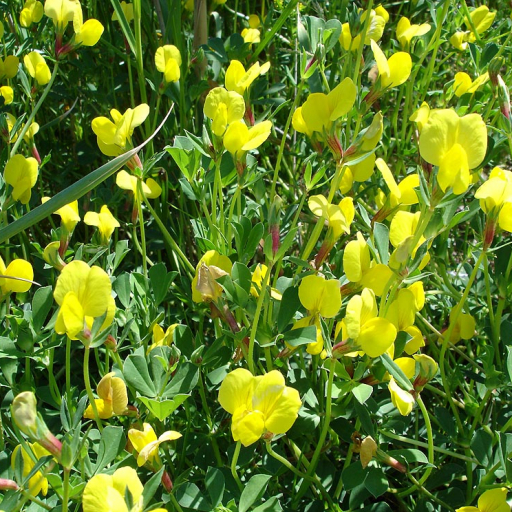
Plant Overview
Known affectionately as "Dragon’s Teeth," Lotus maritimus is a resilient and charming member of the pea family that feels right at home in rugged coastal landscapes. While its pale, buttery flowers look delicate, this plant is a tough-as-nails survivor often found clinging to limestone cliffs or damp meadows across Europe. Its most famous nickname comes from its curious, four-angled seed pods that look like the serrated teeth of a mythical beast.
🔍 How to Identify
- 🟡 The Blooms: Features solitary, pea-like flowers that are a soft creamy yellow, occasionally tinged with a hint of red or orange as they age.
- 🍃 The Foliage: The leaves are a dusty, blue-green hue and are slightly "hairy" to the touch, usually growing in groups of three (trifoliate) like a clover.
- 🦷 The "Teeth": Look closely at the seed pods; they are distinctly square-shaped with four longitudinal "wings" or ridges, which is its most defining characteristic.
🏡 In Your Garden
- 🪨 Limestone Lover: This plant is a "calcicole," meaning it thrives in lime-rich, alkaline soils. If your garden soil is acidic, it may struggle to establish its deep root system.
- 🌊 Coastal Warrior: Because it is highly tolerant of salt spray and wind, it is an excellent choice for seaside rock gardens where other plants might wither.
- 🌱 Nitrogen Fixer: Like its cousins in the legume family, it works behind the scenes to improve your soil by "fixing" nitrogen, essentially fertilizing the earth as it grows.
⚠️ Safety & Toxicity
- ✅ Status: Generally non-toxic and safe for garden use.
- 🐾 Pet Safety: There are no widespread reports of toxicity to dogs or cats. However, as with many legumes, consuming large quantities of the seed pods can lead to minor digestive upset in curious pets.
- 🧤 Skin Care: It is not known to cause irritation, making it a "friendly" plant to handle during weeding or pruning.
✨ Fun Fact
The name Tetragonolobus (its former scientific genus) literally translates to "four-angled pod." In ancient folklore, the "Dragon's Teeth" pods were sometimes carried as charms to provide the bearer with the resilience of the sea and the strength of a dragon.

Detailed Care Instructions
| Humidity | Normal |
| Lighting | Full Sun |
| Difficulty | Medium |
| Hardiness Zones | 5 - 8 |

Place in a bright room that is sun drenched almost all day. Or directly in a south-facing window.

Some plants require more regular watering than others, which should be done every few days. It's critical to maintain the soil moist all of the time. The water requirements of the same plant placed in pots with varying sizes will differ. Because the water in the smaller pot evaporates faster than the water in the larger pot, it will require more watering. Regardless of pot size, the surface should constantly be maintained moist.
The relative humidity levels between 30 and 50 percent are ideal for these plants. They exhibit unpleasant symptoms when the moisture content in the environment is unfavorable. Avoid letting the air temperature rise too high or low and use a humidifier, whenever possible. Misting is also beneficial, although frequent watering is also necessary. The optimal relative humidity will promote plant growth.








