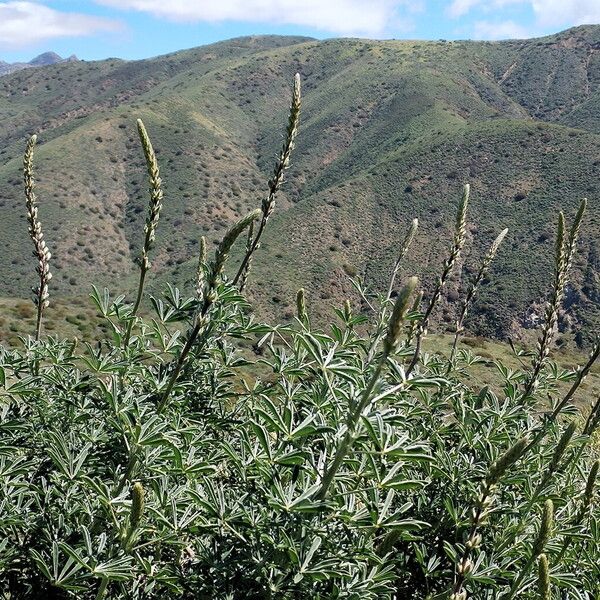
Plant Overview
Often called the Longleaf Bush Lupine, this California native is a standout among its cousins for its impressive, woody stature and silvery sheen. While many lupines are delicate wildflowers, this variety grows into a robust shrub that acts as a structural anchor in coastal and scrubland landscapes. It is a pioneer species, often being the first to "heal" the land after a fire or landslide by stabilizing the soil.
🔍 How to Identify
- 🌿 The Foliage: Features long, narrow leaflets arranged in a star-like (palmate) pattern. The leaves often have a fine, silky hair that gives the plant a shimmering, silvery-green appearance.
- 🪻 The Blooms: Tall, upright spikes (racemes) crowded with pea-like flowers. They are typically a rich violet or lavender-blue, often with a small yellow or white "banner" spot that changes color once pollinated.
- 🪵 The Structure: Unlike smaller lupines, this is a "shrubby" plant. It develops a thick, woody base and can reach heights of 3 to 5 feet, making it look more like a bush than a garden flower.
🏡 In Your Garden
- 💧 The Taproot Rule: This plant develops a deep, sensitive taproot very quickly. It hates being moved once planted, so choose its "forever home" carefully to avoid transplant shock.
- 🧪 Soil Magician: As a member of the pea family, it works with specialized soil bacteria to "fix" nitrogen. It literally pulls fertilizer out of the air and puts it into the ground, making it a great neighbor for nutrient-hungry plants.
- ☀️ Drainage is Key: It thrives in "lean," sandy soil. If kept in heavy clay or overwatered, the roots are highly susceptible to fungal rot.
⚠️ Safety & Toxicity
- 🚫 Toxic Status: High. All parts of the plant, especially the seeds and young pods, contain bitter alkaloids (like lupanine).
- 🐾 Pet & Human Risk: Ingestion can cause "lupinosis," leading to breathing issues, lethargy, or digestive upset in humans, dogs, and livestock. It is best treated as an ornamental plant only—keep it away from curious toddlers and grazing pets.
✨ Fun Fact
Lupines were named after the Latin word lupus (wolf) because ancient people mistakenly believed the plants "wolfed down" all the nutrients in the soil. In reality, they do the exact opposite by adding nitrogen back into the earth!

Detailed Care Instructions

Place in a bright room that is sun drenched almost all day. Or directly in a south-facing window.

Some plants require more regular watering than others, which should be done every few days. It's critical to maintain the soil moist all of the time. The water requirements of the same plant placed in pots with varying sizes will differ. Because the water in the smaller pot evaporates faster than the water in the larger pot, it will require more watering. Regardless of pot size, the surface should constantly be maintained moist.







