Plant Overview
Often called the Pale Wolfberry or Rabbit Thorn, this resilient desert dweller is a hallmark of the American Southwest and Northern Mexico. It is a plant of beautiful contrasts, offering delicate, bell-shaped blooms tucked amidst a protective tangle of thorny, silver-washed branches. In the wild, it serves as a crucial oasis, providing both a sugary snack for birds and a fortress for small desert creatures.
🔍 How to Identify
- 🌿 Pale Foliage: The leaves are a distinct grayish-green or "glaucous" hue. They are narrow, fleshy, and spoon-shaped, designed to hold onto every drop of moisture in the arid heat.
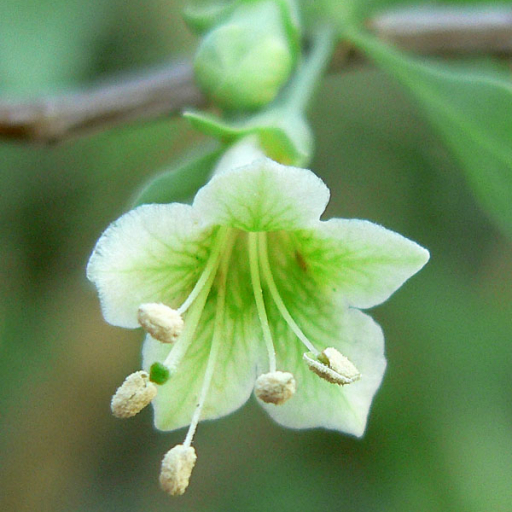
- 🔔 Elongated Blooms: Look for pendulous, funnel-shaped flowers. They are unusually long for the genus and vary in color from a creamy, pale green to a soft, smoky lavender.
- 🔴 Shiny Berries: After blooming, the plant produces round, bright red or reddish-orange berries. These look like tiny, translucent tomatoes and are the plant's most striking feature in late summer.
🏡 In Your Garden
- 🌵 Drought Champion: This is a "set it and forget it" plant for xeriscaping. It thrives in poor, alkaline, or rocky soil and actually prefers a bit of neglect over being pampered with too much water or rich fertilizer.
- 🐦 Wildlife Magnet: If you want a bird-friendly yard, this is a top-tier choice. Hummingbirds are drawn to the nectar-rich tubes of the flowers, while songbirds rely on the berries for hydration and energy.
- 🛡️ Natural Privacy: Because of its dense, sprawling growth habit and sharp thorns, it makes an excellent "security hedge" or living fence that provides privacy while offering safe nesting sites for desert birds.
⚠️ Safety & Toxicity
- 🐾 Nightshade Family: As a member of the Solanaceae (Nightshade) family, the leaves and stems contain alkaloids. While not typically lethal, they can cause digestive upset in curious pets or livestock if eaten in large quantities.
- 🫐 Fruit Ripeness: The berries are traditionally considered edible for humans when fully ripe (deep red and slightly soft). However, unripe green berries should be avoided as they can be bitter and potentially toxic.
- 🧤 Physical Hazard: The "Thorn" in Rabbit Thorn is no joke. The branches are tipped with sharp spines that can easily pierce skin, so always wear heavy-duty gloves when pruning or transplanting.
✨ Fun Fact
The Pale Wolfberry is a very close relative of the famous Himalayan Goji Berry (Lycium barbarum). While the Goji berry gets all the marketing fame, the Pale Wolfberry has been a vital "superfood" for the Zuni and Hopi people for centuries, who traditionally ate the berries fresh, dried, or cooked into a sauce.

Detailed Care Instructions
To grow Lycium pallidum (commonly known as pale wolfberry or pale desert-thorn), you can follow these steps:
- Climate and Location: Lycium pallidum is native to semi-arid regions of North and Central America. It prefers full sun and well-draining soil. Make sure your growing conditions match these requirements.
- Propagation: You can grow Lycium pallidum from seeds or stem cuttings. However, using seeds is the most common method. Obtain fresh seeds from a reputable supplier.
- Seed Treatment: Soak the seeds in water overnight for better germination rates. This step is not necessary but can increase the chances of successful germination.
- Germination: Sow the seeds in a seed-starting tray or small pots filled with well-draining soil. Plant them at a depth of ¼ inch (0.6 cm). Maintain soil moisture during the germination period.
- Transplanting: Once the seedlings reach 2-3 inches (5-7.5 cm) in height, transplant them into larger containers or directly into the ground. Make sure to space them 3-4 feet (0.9-1.2 meters) apart since Lycium pallidum can spread and form thickets.
- Watering and Care: Lycium pallidum is drought-tolerant, but regular watering is essential during its establishment period. Afterward, water deeply but infrequently to simulate its natural arid habitat.
- Pruning: If necessary, you can prune Lycium pallidum to maintain its shape or control its size. Prune it in late winter or early spring before new growth begins.
- Fertilizing: Lycium pallidum generally doesn't require frequent fertilization. If desired, you can apply a balanced, slow-release fertilizer in spring.
- Pest and Disease Management: Lycium pallidum is relatively resistant to pests and diseases. However, occasional problems with aphids or powdery mildew may occur. Monitor your plants regularly and take appropriate actions such as handpicking the pests or using insecticidal soap as needed.
- Harvesting and Use: Lycium pallidum produces small, edible berries that can be harvested once they turn orange or red. The berries are rich in antioxidants. Enjoy them fresh or dry them for later consumption.
Remember to consult local gardening resources or experts for specific advice tailored to your region's conditions.

To water this plant, ensure that the soil is dry to the touch before watering. Use room temperature, filtered water, and water thoroughly until it runs out of the drainage holes at the bottom of the pot. Allow the soil to drain completely before returning the plant to its saucer. Avoid letting the plant sit in standing water, as this can lead to root rot. Water less frequently during the winter months when the plant is not actively growing.
To fertilize the Lycium Pallidum plant, apply a slow-release fertilizer high in nitrogen in early spring. Then, feed the plant with a balanced fertilizer every four to six weeks during the growing season. Avoid over-fertilizing as it can harm the plant. Always read the instructions on the fertilizer package and follow the recommended application rate.
The ideal soil for Lycium pallidum should have good drainage capabilities and be slightly alkaline, with a pH level of around 7.5 to 8.5. The soil should be a well-draining sandy loam, rich in organic matter and nutrients. The plant prefers a soil that is relatively low in nitrogen, but high in potassium and phosphorus. The soil should also be kept moist but not waterlogged to avoid root rot. Additionally, it is important to avoid using soils that are heavily clay-based or have a high salt content, as these can be detrimental to the Lycium pallidum plant's growth and health.
To propagate this particular plant, you would need to first select healthy stem cuttings from the existing plant. Cut these stems at an angle just below the node, which is where leaves grow from. Be sure to use sharp, clean scissors or pruning shears.
Next, remove the leaves from the bottom half of each cutting, leaving just a few leaves at the top. This will help prevent excess water loss and encourage root growth.
Dip the cut end of each stem into rooting hormone powder, which will help stimulate root growth. Then, plant the cuttings in a well-draining soil mix, making sure the cuttings are positioned vertically and deep enough to support themselves.
Once planted, keep the soil slightly moist and cover the cuttings with a plastic bag or dome to create a high humidity environment. This will encourage the development of new roots. Place the cuttings in a warm, bright location, but out of direct sunlight.
After several weeks, carefully check for root growth by gently tugging on the cuttings. If they resist being pulled out of the soil, they have developed roots and can be transplanted into their own individual pots or planted directly in the ground.








