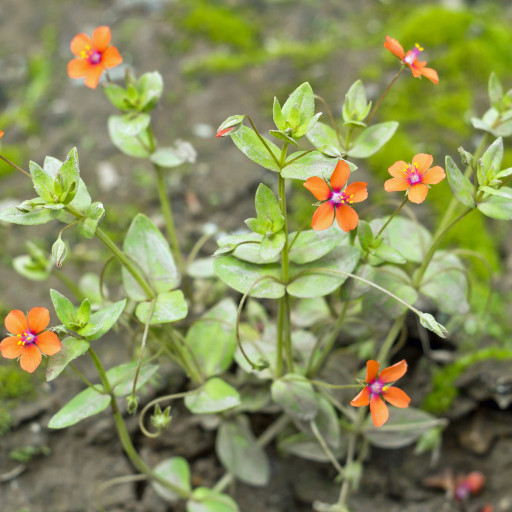
Plant Overview
Commonly known as the Scarlet Pimpernel or the "Poor Man's Weather-glass," Lysimachia arvensis is a charming, low-growing wildflower famous for its uncanny ability to predict the weather. Long before modern forecasting, farmers watched these tiny blooms; if they remained closed in the morning, rain was surely on the way. This plant also gained literary fame as the secret emblem of the elusive hero in Baroness Orczy’s classic novel, The Scarlet Pimpernel.
🔍 How to Identify
- 🌸 The Flowers: Tiny, five-petaled blossoms that are most famously a vivid salmon-orange or "scarlet," though rare blue variations exist. Each flower has a distinct purple-pink ring at its center.
- 🍃 The Foliage: Small, oval-shaped leaves that grow in opposite pairs along the stem. If you flip a leaf over, you’ll often see minute black or brown glands (dots) on the underside.
- 🌿 Growth Habit: This is a "prostrate" plant, meaning it prefers to creep along the ground rather than grow tall, creating a delicate green mat punctuated by bright dots of color.
- 📏 The Stem: The stems are noticeably square-shaped when felt between the fingers, a common trait in several ground-covering species.
🏡 In Your Garden
- ☀️ Sun Worshiper: This plant is an absolute sun-lover. The flowers will only open when the sun is shining directly on them; they tuck themselves away tightly at dusk or when the sky turns gray.
- 🌱 Soil & Resilience: It thrives in disturbed soil, often appearing in garden borders, gravel paths, or fallow fields. While some consider it a "weed," it is actually a beneficial addition to wilder garden areas as it doesn't compete heavily with larger plants.
- 💧 Drought Tolerance: Because of its Mediterranean origins, it is remarkably hardy and can handle dry spells much better than plusher, thirstier bedding plants.
⚠️ Safety & Toxicity
- 🐾 Toxic to Pets: Lysimachia arvensis contains saponins and bitter substances that are toxic to horses, dogs, and cats. Ingestion can lead to stomach upset or more serious respiratory issues in small animals.
- 👶 Human Caution: It is not edible. Touching the plant can occasionally cause mild skin irritation (dermatitis) in sensitive individuals, so it’s best to wear gloves if you are weeding a large patch.
- 🌾 Livestock Risk: It is historically known to be poisonous to sheep and cattle if it dominates their grazing pasture.
✨ Fun Fact
The Scarlet Pimpernel is one of the few plants capable of "nictinasty," a Greek-derived term for the movement of plants in response to the onset of darkness. Its sensitivity to humidity is so precise that it often closes its petals hours before a storm actually hits!

Detailed Care Instructions
To grow Lysimachia arvensis, also known as corn moneywort or yellow pimpernel, follow these steps:
- Choose a suitable location: Lysimachia arvensis prefers full sun to partial shade. Ensure the soil is well-drained, moderately fertile, and slightly acidic.
- Prepare the soil: Remove any weeds or debris from the planting area. If the soil is heavy clay or compacted, amend it with organic matter such as compost or well-aged manure to improve drainage and fertility.
- Planting: Lysimachia arvensis can be propagated through seeds or by division. For seeds, sow them directly into the prepared soil in spring or autumn, and lightly cover them with a thin layer of soil. For division, dig up mature plants and separate them into smaller sections with roots attached, then replant the divisions.
- Watering: Keep the soil consistently moist but not waterlogged. Water the plants regularly, especially during dry periods. Mulching around the plants can help retain soil moisture.
- Fertilizing: Apply a balanced, slow-release organic fertilizer in early spring to provide nutrients throughout the growing season. Avoid excessive use of nitrogen-rich fertilizers, as this may result in excessive leaf growth but few flowers.
- Maintenance: Lysimachia arvensis tends to spread rapidly and can become invasive. Regularly remove any unwanted spreading shoots to control its growth. When the plants are well established, they are generally low-maintenance and require minimal care.
- Pest and disease control: Lysimachia arvensis is generally not prone to serious pest or disease problems. However, occasional issues such as aphids or powdery mildew may occur. Monitor the plants regularly and apply appropriate organic pest control methods if necessary.
- Propagation: Lysimachia arvensis can be easily propagated through division or stem cuttings. Division is typically done in spring or autumn, while stem cuttings can be taken during the growing season. Plant the divisions or cuttings in suitable potting soil or directly in the garden, following the same steps as for planting the seeds.
By following these guidelines, you should be able to successfully grow and maintain Lysimachia arvensis in your garden.

Place in a bright room that is sun drenched almost all day. Or directly in a south-facing window.

To properly water this plant, it is important to first check the soil moisture in the pot or surrounding ground. This can be done by sticking your finger about an inch or two into the soil and feeling if it is dry or moist. If the soil is dry, it is time to water.
When watering, it is important to avoid getting water on the leaves or stems of the plant, as this can lead to disease and damage. Instead, water around the base of the plant, allowing the water to soak into the soil.
The frequency of watering will depend on the specific conditions, such as the type of soil and amount of sunlight. As a general guideline, it is usually best to water when the soil feels dry to the touch, but not completely dried out.
It is also a good idea to fertilize the plant regularly to ensure it receives the necessary nutrients for healthy growth and blooming. This can be done with a balanced, slow-release fertilizer applied according to the manufacturer's instructions.
- Choose a balanced fertilizer, such as one with a 10-10-10 NPK ratio.
- Apply the fertilizer according to the package instructions, typically spreading it evenly around the base of the plant.
- Water the plant thoroughly after fertilizing to ensure the nutrients are absorbed into the soil and taken up by the roots.
- Repeat fertilization every 4-6 weeks during the growing season, typically spring through fall.
- Be careful not to over-fertilize, as this can damage the plant and leach excess nutrients into the surrounding environment.
Lysimachia Arvensis plant prefers moist, well-draining soil that is rich in organic matter. The ideal soil pH for this plant ranges from slightly acidic to neutral. It can tolerate a wide range of soil textures, from sandy to clay soil, as long as it is not compacted.
When planting Lysimachia Arvensis, it is recommended to mix the soil with compost or other organic matter to improve the soil's fertility and water-holding capacity. The plant benefits from regular fertilizing, especially during the growing season, with a slow-release fertilizer or organic fertilizer such as compost tea.
Soil drainage is crucial for Lysimachia Arvensis, so avoid planting it in areas with poor drainage or standing water. Excessive moisture can lead to root rot and other plant diseases.
In summary, Lysimachia Arvensis thrives in well-draining soil that is moist, rich in organic matter, and has a slightly acidic to neutral pH. Regular fertilizing and good soil drainage are also important factors in its successful growth.
To propagate this plant, you will first need to obtain a mature plant with healthy stems. Cut a stem of the plant, making sure that it is at least 4-6 inches long, and has several nodes (areas where leaves meet the stem). Remove any lower leaves from the stem, leaving only a few at the top.
Prepare a small pot with a mixture of potting soil and peat moss. Make a hole in the soil and insert the stem into it, covering the nodes with soil. Water the soil thoroughly.
Place the pot in a warm, bright area, but out of direct sunlight. Keep the soil moist and the air around the cutting humid by covering it with a plastic bag.
After a few weeks, the cutting should have roots and new growth. Once the new plant has grown two to three leaves, it can be transplanted into a larger pot with fresh potting soil and fertilized according to instructions. Keep the soil moist and the plant in a well-lit area to encourage healthy growth.








