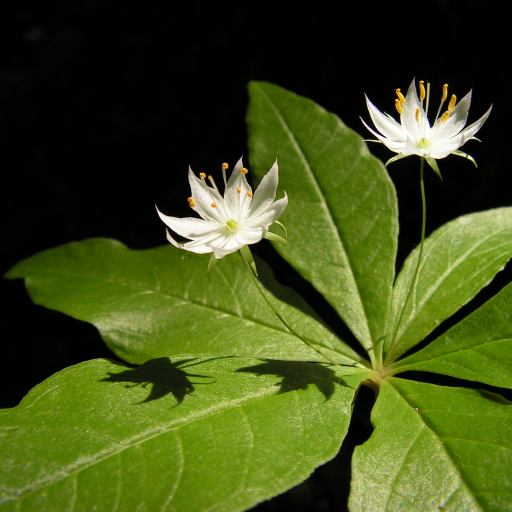
Plant Overview
Commonly known as the Starflower or American Starflower, this delicate woodland perennial looks like a celestial spark resting against the forest floor. Often found dancing under the shade of ancient pines and birches, its symmetrical beauty has earned it a reputation as one of the most "perfectly" geometric wildflowers in North America. It is a true spring ephemeral that disappears once the summer heat sets in.
🔍 How to Identify
- ⭐ The Bloom: Look for one or two dainty, white, star-shaped flowers. Unusually for plants, they typically have seven petals, though they can range from five to nine.
- 🍃 The Whorl: The leaves are lance-shaped and arranged in a single, elegant whorl (a circle) at the very top of a slender, reddish stem.
- 📐 Symmetry: The plant is a master of symmetry; the number of petals usually matches the number of sepals and stamens, creating a crisp, geometric appearance.
🏡 In Your Garden
- 🌲 Natural Habitat: This plant thrives in the "duff" (the decomposing needles and leaves) of cool, moist, acidic woodlands. If you are trying to grow it, mimic a coniferous forest floor with plenty of leaf mold.
- 💤 Summer Dormancy: Don't panic if it vanishes! The Starflower is a spring ephemeral. Once the canopy fills in and the soil warms up, the plant goes dormant and retreats into its tiny, thread-like rhizomes until the following spring.
- 🐌 Gentle Spreader: It spreads slowly through underground runners. It isn't aggressive, making it a perfect, non-invasive groundcover for deep-shade "wild corners" where other plants struggle.
⚠️ Safety & Toxicity
- 🟢 Status: Generally non-toxic.
- 🐾 Details: There are no widely reported cases of toxicity toward dogs, cats, or horses. However, like most wild woodland plants, it is not meant for human consumption and can cause mild stomach upset if ingested in large quantities by curious children or pets.
✨ Fun Fact
The Starflower is a rebel in the botanical world because of the number seven. While most flowers follow patterns of threes or fives, Lysimachia borealis frequently produces seven petals, seven sepals, and seven stamens—a mathematical rarity in nature!

Detailed Care Instructions
To grow Lysimachia Borealis, also known as Boreal Loosestrife, follow these steps:
- Select a suitable planting location: Choose a spot that receives partial shade to full sun. Ensure the soil is well-draining and fertile.
- Prepare the planting area: Remove any weeds or grass from the planting area. Loosen the soil with a garden fork or tiller, and amend it with organic matter like compost or well-rotted manure to improve fertility and drainage.
- Planting: Dig a hole slightly larger than the root ball of the plant. Place the Lysimachia Borealis in the hole, ensuring the top of the root ball is level with the soil surface. Fill in the hole with soil, gently firming it around the plant.
- Watering: After planting, water the plant thoroughly to settle the soil around the roots. For the first few weeks, keep the soil evenly moist, but avoid waterlogging.
- Mulching: Apply a layer of organic mulch around the plant to help retain soil moisture, suppress weed growth, and regulate soil temperature.
- Maintenance: Regularly water the plant during dry periods, providing about 1 inch of water per week. Keep an eye out for pests or diseases, and treat accordingly. Prune the plant as needed to maintain its shape and remove any dead or damaged growth.
- Fertilization: Feed the plant with a balanced, slow-release fertilizer once in early spring and again in early summer. Follow the package instructions for the appropriate dosage.
- Division: Lysimachia Borealis tends to spread and form clumps over time. To propagate or control its spread, divide the plant every 2-3 years in early spring or late summer. Dig up the clump, split it into smaller sections, and replant the divisions.
By following these steps, you can successfully grow Lysimachia Borealis in your garden.

Place in a window with dappled sun or a spot in the middle of a room. Or directly in a window facing west or east.

To ensure adequate hydration for the Lysimachia Borealis plant, it is important to follow these watering guidelines:
1. Assess the soil moisture: Before watering, check the moisture level of the plant's soil. Insert your finger about an inch into the soil, and if it feels dry at this depth, it is time for watering.
2. Watering frequency: Lysimachia Borealis plants generally require regular watering. Aim to water them once or twice a week, depending on the weather conditions and the moisture retention capacity of the planting site. Be careful not to overwater, as excessive moisture can lead to root rot and other problems.
3. Watering amount: Provide a generous amount of water to allow it to penetrate the root zone effectively. Water until you see the soil becoming evenly moist, but not oversaturated. Avoid letting the water accumulate on the surface or creating waterlogged conditions.
4. Watering method: It is recommended to water Lysimachia Borealis at the base of the plant rather than overhead watering. Directing the water to the soil minimizes the risk of fungal diseases and enables effective absorption by the roots.
5. Mulching: Apply a layer of organic mulch, such as bark chips or straw, around the base of the plant. Mulching helps retain moisture in the soil, reducing water evaporation and the need for frequent watering.
6. Adjusting watering based on weather and season: During hot and dry periods, you may need to increase the frequency of watering to meet the plant's needs. Conversely, in cooler or rainy seasons, you may need to reduce the watering frequency to prevent waterlogging.
7. Monitor plant response: Observe the plant's response to watering. If the leaves appear droopy or yellowing, it may indicate under or overwatering. Adjust your watering practices accordingly to maintain the plant's health.
Remember that watering requirements can vary depending on factors such as climate, soil type, and plant age. Regularly monitor the plant's condition and adjust the watering regimen as needed to provide optimal growing conditions for your Lysimachia Borealis.
To effectively fertilize the Lysimachia Borealis plant, follow these instructions:
- Choose a balanced, water-soluble fertilizer with a ratio of 10-10-10 or 20-20-20.
- Dilute the fertilizer according to the package instructions to avoid over-fertilization. Generally, a ratio of 1 tablespoon of fertilizer per gallon of water is suitable.
- Water the plant thoroughly before applying the fertilizer. This helps prevent root burn.
- Apply the diluted fertilizer to the soil around the base of the plant, avoiding direct contact with the leaves or stems.
- For optimal growth, feed the Lysimachia Borealis plant every four to six weeks during the growing season (spring and summer).
- Adjust the frequency and dosage based on the plant's response. If you notice signs of over-fertilization, such as yellowing leaves or stunted growth, reduce the frequency or strength of the fertilizer solution.
- In winter, when the plant is dormant, avoid fertilizing as it may cause unnecessary stress to the plant.
- Regularly monitor the plant's overall health and adjust the fertilization routine accordingly, providing additional nutrition only when necessary.
Remember, following proper fertilization practices, including not exceeding recommended dosage and timing, is essential to prevent fertilizer burn and promote the health and vitality of your Lysimachia Borealis plant.
Lysimachia borealis is a plant that prefers a specific type of soil to thrive. It requires a well-draining soil mix that retains some moisture but does not become waterlogged. The ideal soil composition for this plant consists of a balanced combination of organic matter and inorganic materials.
Organic matter, such as compost or well-rotted manure, helps improve the soil's structure, retain moisture, and enhance nutrient availability. It also promotes beneficial microbial activity in the soil. Adding leaf mold or peat moss can aid in retaining moisture, especially if you live in an area with hot and dry summers.
In terms of inorganic materials, a mixture of loam and sandy soil is preferable for Lysimachia borealis. Loam soil offers good drainage and moisture retention qualities, while sandy soil prevents waterlogging and promotes aeration. Avoid heavy clay soils or waterlogged areas as they may lead to root rot or other moisture-related issues.
To further enhance the soil, you may consider incorporating perlite or vermiculite, which improve drainage and prevent compaction. These materials facilitate root development and ensure proper air circulation within the soil.
Before planting Lysimachia borealis, prepare the soil by removing any weeds or plant debris. Loosen the soil with a garden fork or tiller to improve aeration and root penetration. Incorporate organic matter and any desired soil amendments before planting.
Regularly monitor the moisture levels in the soil to ensure it remains consistently damp, but not overly saturated. Proper watering practices are crucial for the successful cultivation of Lysimachia borealis.
Lysimachia Borealis is a perennial herbaceous plant that can be propagated through several methods. Here are details on how to propagate this plant:
- Division: One common method of propagation is through division. Wait for spring when new growth appears and the plant is actively growing. Carefully dig up the mature plant and separate the clumps into smaller sections, each containing a healthy portion of roots and shoots. Replant these divisions in suitable soil conditions, ensuring they are adequately watered.
- Stem Cuttings: Another way to propagate Lysimachia Borealis is through stem cuttings. Take cuttings from the parent plant during spring or early summer when the stems are young and healthy. Cut 4-6 inch (10-15 cm) long sections of the stem, ensuring they have 2-3 pairs of leaves. Remove the lower leaves and dip the cut end into a rooting hormone to encourage root growth. Plant the cuttings in a well-draining soil mix, keep them moist, and place them in a warm and bright location.
- Seed Propagation: Lysimachia Borealis can also be propagated from seeds. Collect mature seeds from the plant when they have turned brown and are fully matured. Sow the seeds in a seed tray or pots filled with a well-draining soil mix. Cover the seeds lightly with soil and keep them moist but not waterlogged. Place the tray or pots in a warm location with indirect sunlight. Germination usually takes several weeks. Once the seedlings have developed a few sets of leaves, they can be transplanted into individual pots.
Regardless of the propagation method you choose, it is important to provide the young plants with adequate care. Ensure they are placed in suitable light conditions, watered appropriately, and protected from extreme temperatures or harsh conditions. With proper care, Lysimachia Borealis will establish and thrive, providing you with beautiful foliage and flowers in your garden.








