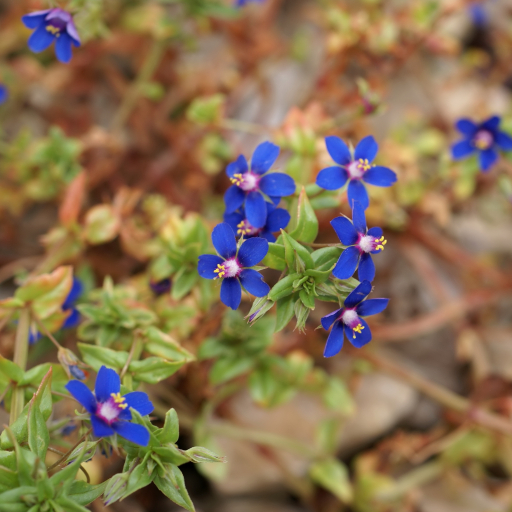
Plant Overview
Known as the Blue Pimpernel, this dainty wildflower is often called the "Poorman’s Weatherglass" because its brilliant blossoms snap shut the moment the sun disappears or rain approaches. Native to Europe and the Mediterranean, it has wandered across the globe, often appearing as a charming guest in gardens and disturbed fields. Its sapphire-colored petals are so intense they almost look painted against the green foliage.
🔍 How to Identify
- 🌸 Petal Fringe: Look closely at the five sapphire-blue petals; unlike its cousins, the edges are lined with tiny, glandular hairs that give it a delicate, fringed look.
- 🍃 Opposite Leaves: The small, stalkless, oval leaves grow in neat pairs directly across from one another along the stem.
- 📐 Square Stems: If you roll the stem between your fingers, you’ll feel its distinct four-angled, square shape, which helps it stay sturdy while trailing.
🏡 In Your Garden
- ⛅ Natural Barometer: In a garden setting, this plant acts as a living weather station; if the flowers remain closed on a summer morning, you might want to bring your umbrella.
- 🌱 Disturbance Lover: It thrives in "tired" or disturbed soil, often popping up in the cracks of paths or at the edges of vegetable patches where the earth has been turned.
- 🐜 Low-Profile Growth: It has a creeping, prostrate habit, making it an excellent, albeit wild, groundcover that doesn't compete heavily with taller perennials.
⚠️ Safety & Toxicity
- 🚫 Toxic if Ingested: The entire plant contains saponins and acrid juices which are toxic to humans, poultry, and livestock if consumed in significant amounts.
- 🧴 Skin Sensitivity: Some gardeners report mild skin irritation or "pimpernel dermatitis" after handling the stems with bare hands, so gloves are a wise choice.
- 🐶 Pet Warning: Keep an eye on grazing pets, as the bitter taste usually deters them, but ingestion can lead to digestive upset.
✨ Fun Fact
📜 Ancient Folklore: In centuries past, it was believed that carrying a sprig of Blue Pimpernel would grant the wearer the "second sight" and protect them from deceptions and "wicked charms."

Detailed Care Instructions
To grow Lysimachia foemina, also known as yellow loosestrife, you can follow these steps:
- Choose a suitable location: Lysimachia foemina prefers well-drained soil and full sunlight to partial shade. Ensure the area has enough space for the plant to spread, as it can become invasive.
- Prepare the soil: Amend the soil with compost or organic matter to improve drainage and fertility. Lysimachia foemina can tolerate a wide range of soils but prefers moist soil.
- Planting: Dig a hole slightly larger than the root ball of the plant. Place the plant in the hole, ensuring it sits at the same depth as it was in the nursery pot. Backfill the hole with soil, gently firming it to eliminate air pockets.
- Watering: Water the plant thoroughly after planting and keep the soil consistently moist but not waterlogged. Provide supplemental watering during dry periods.
- Mulching: Apply a layer of organic mulch around the base of the plant, leaving a clearance around the stem to prevent rot. Mulching helps retain moisture, regulate soil temperature, and suppress weed growth.
- Fertilizing: Lysimachia foemina generally does not require frequent fertilization if the soil is rich in organic matter. However, if your soil is lacking nutrients, you can provide a general-purpose fertilizer once or twice a year.
- Maintenance: Keep an eye out for any signs of pests or diseases, such as leaf spots or aphid infestations. Prune back any dead or damaged foliage. To control its spreading, you may need to divide the plant every few years.
- Propagation: Lysimachia foemina can be propagated through division or by collecting and sowing its seeds. Divide the plant in early spring or fall by carefully separating the root ball into sections and replanting them.
Remember to check your local regulations before planting Lysimachia foemina, as it can be considered invasive in some areas.

Place in a dark room with little light, like a dark bedroom or a spot far away from a window or directly in a north-facing window.

The best way to water this plant is by using a watering can or a hose with a gentle shower head. Water the plant thoroughly, allowing the water to soak in deep into the soil. However, avoid overwatering as it can lead to root rot and other plant diseases and problems. It is beneficial to check the soil moisture level before watering to prevent overwatering. If the top inch of soil feels dry to the touch, it is time to water the plant. Additionally, it is good to water this plant early in the morning or late in the evening to avoid water loss due to evaporation. Also, avoid watering the leaves as this can promote the growth of fungal diseases.
To fertilize this plant, apply a balanced, water-soluble fertilizer every two weeks during the growing season. Use a diluted solution of the fertilizer and make sure to water the plant before and after fertilizing. Avoid over-fertilizing as it can damage the plant.
Lysimachia Foemina plant prefers a well-draining soil that is moist but not waterlogged. It grows best in soil that is slightly acidic to neutral with a pH range of 5.5 to 7.5. The ideal soil type is loamy soil that is rich in organic matter. The plant also requires soil that is nutrient-rich and has good drainage, as it doesn't tolerate standing water. It is recommended to mix compost or well-rotted manure with the planting soil to improve soil quality and fertility. The plant also benefits from adding some sand or perlite to the soil mixture to improve drainage.
To propagate this plant, first select a healthy and established parent plant. Look for stems that are at least 6 inches long and have several leaves. Using a sharp, clean pair of cutters, make a clean cut about 1/4 inch below a node, which is where a leaf attaches to the stem.
Remove the lowermost leaves so that the remaining leaves are about 2 inches from the bottom. This will expose the nodes where roots will form. Dip the cut end of the stem into a rooting hormone powder and gently tap off any excess.
Next, fill a small pot with well-draining soil. You can make your own soil mix using equal parts perlite, vermiculite, and peat moss, or use a commercial potting mix. Make a hole in the center of the soil and insert the cut end of the stem into it, making sure the bottom node is covered with soil.
Water the plant thoroughly and place it in a warm, bright area that receives indirect sunlight. Keep the soil moist but not waterlogged, and mist the plant once or twice a day to increase humidity.
After a few weeks, you should start to see new growth and the roots should have started to form. Once the new plant has grown a few inches and has several sets of leaves, it can be transplanted into a larger pot or planted in the garden.








