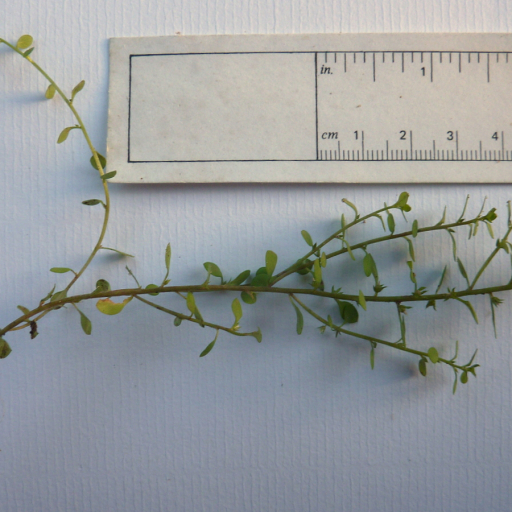
Plant Overview
Often called "Chaffweed," Lysimachia minima is a master of disguise—not through camouflage, but through its microscopic stature. This tiny member of the Primrose family is a "belly plant," meaning you usually have to get down on your hands and knees to truly appreciate it. It is a pioneer species, often found colonizing the muddy footprints of hikers or the damp margins of drying vernal pools.
🔍 How to Identify
- 🌱 Miniature Stature: This is one of the smallest flowering plants you’ll encounter, rarely exceeding 2 to 3 inches in height. It often grows prostrate, hugging the mud.
- 🍃 Egg-Shaped Leaves: The leaves are smooth, oval, and quite fleshy for their size. They are arranged alternately along the stem, which distinguishes it from some of its look-alike cousins.
- 🌸 Hidden Blooms: The flowers are almost invisible to the naked eye. They are stalkless (sessile), tucked tightly into the junctions where the leaves meet the stem, appearing as tiny white or pale pink dots.
🏡 In Your Garden
- 💧 The Pioneer Spirit: Chaffweed isn't typically sold in nurseries, but it may appear in your garden if you have damp, sandy soil or low-lying areas that collect water. It loves "disturbed" ground where larger, more aggressive plants haven't taken over yet.
- ☀️ Sun Seeker: Despite its size, it hates the shade of taller neighbors. It requires open ground and direct light to complete its rapid life cycle before the soil dries out completely in mid-summer.
⚠️ Safety & Toxicity
- 🐾 Low Risk: There is no significant record of Lysimachia minima being highly toxic. However, like many members of the Primrose family, it contains saponins.
- 👶 General Caution: While not considered "poisonous," it is best to discourage pets or children from foraging it, as concentrated amounts of saponins can cause mild stomach upset or skin irritation in sensitive individuals.
✨ Fun Fact
The common name "Chaffweed" refers to the plant's appearance when it goes to seed; it turns a brownish-tan color and looks like the discarded husks (chaff) of wheat scattered across the ground.

Detailed Care Instructions
To grow Lysimachia Minima, also known as Creeping Jenny or Moneywort, you can follow these steps:
- Choose a suitable location: Lysimachia Minima prefers partial shade to full sun. Ensure the area has well-drained soil and receives a few hours of direct sunlight each day.
- Prepare the soil: Before planting, prepare the soil by removing any weeds, rocks, or debris. Loosen the soil and amend it with compost or organic matter to improve its texture and fertility.
- Planting: Take the Lysimachia Minima plant and gently separate the individual stems. Dig small holes in the prepared soil, spaced about 8-12 inches apart. Place each stem into a hole, covering the root ball with soil. Ensure that the plant is level with the surrounding soil.
- Watering: After planting, water the Lysimachia Minima thoroughly. Keep the soil moist but not waterlogged throughout the growing season. Water deeply whenever the top inch of soil feels dry.
- Mulching: Apply a layer of organic mulch, such as straw or wood chips, around the base of the plants. This helps retain moisture, suppresses weed growth, and keeps the soil temperature consistent.
- Fertilization: Lysimachia Minima generally does not require much fertilization. However, you can apply a slow-release balanced fertilizer in early spring to promote healthy growth. Follow the package instructions for proper application rates.
- Pruning: As Lysimachia Minima is a fast-growing plant, it may benefit from regular pruning to control its spread and maintain appearance. Trim back any leggy or overgrown stems to encourage new growth.
- Propagation: Lysimachia Minima can be propagated by dividing mature plants or rooting stem cuttings. To divide, gently lift the plant from the soil, separate the rooted stems, and replant them in suitable locations. To propagate from stem cuttings, take 3-4 inch stem cuttings, remove the lower leaves, and place them in a moist potting mix until roots develop.
Remember to monitor the plant for pests or diseases and take appropriate control measures if needed. With proper care, Lysimachia Minima will spread and create a beautiful ground cover in your garden.

Place in a bright room that is sun drenched almost all day. Or directly in a south-facing window.

To properly water this particular plant, it is important to first consider the plant's natural habitat and watering needs. It is important to use well-draining soil to avoid waterlogging the plant's roots, which can lead to root rot. The plant should be kept consistently moist, and it is important to ensure that it receives adequate drainage to prevent standing water. Watering should be done thoroughly, allowing the water to soak into the soil before draining excess water. It is important to monitor the moisture levels of the soil regularly to prevent over or underwatering.
To fertilize the plant, use a balanced fertilizer with equal parts nitrogen, phosphorus, and potassium. Apply the fertilizer once a month during the growing season, starting in early spring and ending in late summer. Water the plant before and after the fertilizer application to help the nutrients penetrate the soil. Avoid over-fertilizing, as it can cause the plant to grow too quickly and become weak and susceptible to disease.
Lysimachia Minima prefers a well-draining and moderately fertile soil. It is best to use a soil mixture that contains a combination of organic matter, such as peat moss or compost, and a coarse material like perlite or sand to improve drainage. The pH level of the soil should be slightly acidic, ranging from 5.5 to 6.5. In addition, it is recommended to avoid compacted soil, as this can limit root growth and potentially cause root rot. An appropriate soil mixture will provide the Lysimachia Minima with the necessary nutrients and drainage to grow and thrive.
To propagate the plant, take a stem cutting that is approximately 3-4 inches long from a mature plant. You should make the cut at a 45-degree angle, just below a set of leaves. Remove the foliage from the bottom of the cutting and dip the end in rooting hormone powder.
Prepare a potting mix with equal parts peat moss and perlite. Moisten the mix and insert the cutting about halfway into the soil. Cover the pot with plastic wrap, and place it in a brightly lit area but out of direct sunlight. Make sure that the soil remains moist, but not wet.
After about two weeks, check to see if the cutting has taken root by gently tugging on it. If it resists, then it has formed roots. At this point, remove the plastic wrap and let the plant continue to grow in the same location for a few more weeks.
Once the new plant has reached the desired size and health, it can be transplanted into a larger pot or planted directly into the ground.








