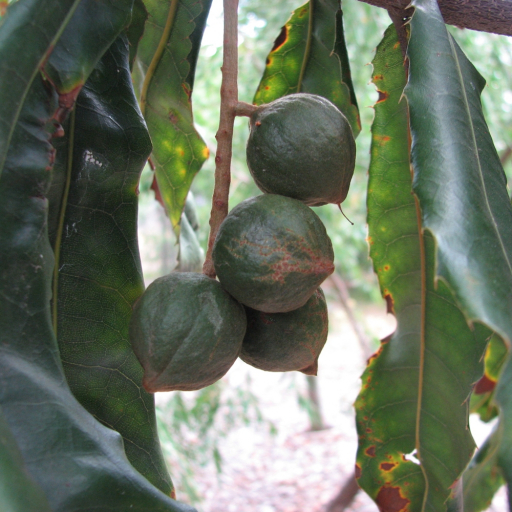
Plant Overview
Known affectionately as the Rough-shelled Macadamia or the Bush Nut, this Australian native is the wilder, more ornamental cousin of the commercial macadamia tree. While its smooth-shelled relatives dominate grocery aisles, Macadamia tetraphylla is prized by home gardeners for its stunning pink blossoms and exceptionally sweet, crunchy nuts that many enthusiasts claim have a superior flavor.
🔍 How to Identify
- 🍃 Prickly Foliage: The most striking feature is the leaves, which grow in "whorls" of four (hence the name tetraphylla). They are long, narrow, and have distinctly serrated, spiny edges that feel like a holly leaf.
- 🌸 Pendulous Blooms: In late winter and spring, the tree produces spectacular, drooping flower spikes (racemes) up to 10 inches long. These are often a beautiful pastel pink or creamy lilac color.
- 🌰 Rough Nut Shells: The fruit is a green fibrous husk that splits to reveal a woody, brown nut. Unlike the smooth macadamia, these shells have a characteristic pebbled or "rough" texture.
🏡 In Your Garden
- 🌳 The Rainforest Legacy: Coming from the subtropical rainforests of Australia, this tree loves deep, rich, and slightly acidic soil. It has a sensitive root system that dislikes being moved, so choose its permanent "forever home" carefully.
- 🐝 A Pollinator Magnet: The fragrant flowers are irresistible to honeybees and stingless native bees. If you want a garden buzzing with life, this tree is a cornerstone species.
- 🛡️ Wind Protection: While it is a sturdy evergreen, its heavy branches can be brittle. Planting it in a spot protected from harsh, drying winds will help prevent limb breakage and keep the foliage looking lush.
⚠️ Safety & Toxicity
- 🐕 STRICT PET WARNING: While the nuts are a healthy gourmet treat for humans, they are highly toxic to dogs. Ingesting even a few nuts can cause "Macadamia Nut Toxicosis," resulting in temporary hind-leg paralysis, vomiting, and tremors.
- 👶 Prickly Leaves: The serrated leaf edges are quite sharp and can cause minor scratches. It is best to plant this tree away from pathways or areas where small children frequently play.
✨ Fun Fact
The Macadamia is the only Australian native plant to be developed and traded globally as a major commercial food crop. Although it’s an Aussie local, it was actually first commercially grown on a large scale in Hawaii!

Detailed Care Instructions
To grow Macadamia Tetraphylla plants, follow these steps:
- Choose a suitable location: Macadamia Tetraphylla prefers a sheltered position with full sun or light shade. Ensure the soil is well-drained and slightly acidic (pH 5.5-6.5).
- Obtain healthy seeds or seedlings: You can purchase Macadamia Tetraphylla seeds or seedlings from a nursery or online. Use healthy and disease-free plants for best results.
- Prepare the soil: Improve the soil quality by adding organic matter such as compost or well-rotted manure. This will improve drainage, nutrient content, and moisture retention.
- Dig a hole: Dig a hole that is slightly larger than the root ball of the seedling. Ensure the hole is deep enough that the top of the root ball is level with the soil surface or slightly above it.
- Plant the seedling or seeds: Gently place the seedling into the hole and backfill with soil, ensuring the plant is upright and the roots are spread out. If using a seed, plant it directly into the soil at a depth of 1-2 inches.
- Water thoroughly: After planting, water the newly planted Macadamia Tetraphylla thoroughly to settle the soil and remove any air pockets. Maintain moist conditions for the first few weeks, but avoid overwatering, as Macadamia trees are sensitive to waterlogged conditions.
- Mulch and weed control: Apply a layer of organic mulch around the base of the plant to help retain moisture, suppress weeds, and protect the roots from temperature extremes.
- Prune and train the plant: As the plant grows, prune out any dead, damaged, or crossing branches. Shape the tree by selectively removing excessive growth to maintain form and encourage healthy branching.
- Fertilize: Use a slow-release fertilizer specifically formulated for macadamia trees to provide essential nutrients. Follow the manufacturer's instructions for dosage and frequency.
- Protect against pests and diseases: Monitor the plant regularly for signs of pests or diseases. Apply appropriate organic or chemical treatments if necessary, following the instructions carefully.
- Harvest: Depending on the variety and growing conditions, Macadamia Tetraphylla trees generally start producing nuts within 4-5 years. Harvest the nuts when the husks split open and the kernels are well-developed.
Remember to research specific cultivar requirements and adapt the care accordingly. Regular monitoring, proper care, and patience are key to successfully growing Macadamia Tetraphylla plants.

Place in a bright room that is sun drenched almost all day. Or directly in a south-facing window.

To properly water this plant, you should first determine the soil moisture level by inserting your finger into the soil up to the second knuckle. If the soil feels dry at this depth, it is time to water.
When watering, make sure to thoroughly saturate the soil, allowing water to reach the roots deep within the soil. It is important to not overwater as this can lead to root rot.
Watering frequency will depend on factors such as the climate, humidity, and soil drainage. It is recommended to water deeply about once a week, adjusting as necessary based on the specific needs of the plant.
To fertilize this plant, use a balanced fertilizer with equal amounts of nitrogen, phosphorus, and potassium. Apply the fertilizer during the growing season, which is typically from spring to fall. A slow-release fertilizer is preferred, as it will release nutrients over a longer period of time. Be sure to follow the instructions on the fertilizer packaging for application rates and frequency. Avoid fertilizing during the dormant season, which is typically in the winter.
The ideal soil for this particular plant is well-draining and has a pH between 5.5 to 6.5. It should also be rich in organic matter, such as compost or other natural fertilizers. The soil should not be compacted and should be loose and airy to allow for proper root growth and water absorption. It is important to avoid soil that is prone to waterlogging, as this can cause root rot and other problems for the plant. Additionally, the soil should be able to retain moisture but not become waterlogged, as this can lead to root rot as well.
Macadamia Tetraphylla can be propagated through different methods like air layering, grafting, stem cuttings or seed propagation. In order to propagate through stem cuttings, it is important to collect healthy sections of young wood from the plant. Using a sharp and clean tool, cut sections of about 6 inches long and make sure to remove any leaves or flowers from the lower part of the stem.
Prepare a pot with well-draining soil mixed with perlite and vermiculite to provide good moisture retention. Dip the lower end of the stem cutting into the rooting hormone powder and place it in the soil, burying at least two thirds of the stem. Water the cutting and cover it with a plastic bag or a clear plastic container to keep the humidity level high and to protect it from direct sunlight.
Place the pot in a warm and shaded area and maintain the moisture level by watering it as necessary. After a few weeks, the cutting should start producing new growth and roots should form. Once it has developed a strong root system, it can be transplanted into a larger pot or in the location where it will eventually grow.
Propagation through stem cuttings is an effective way to multiply a desirable cultivar of Macadamia Tetraphylla as it ensures that the new plant will have the same genetics and characteristics of the original plant. It is important to note that not all stem cuttings will root, so it's important to take multiple cuttings and provide good care and attention to ensure success.








