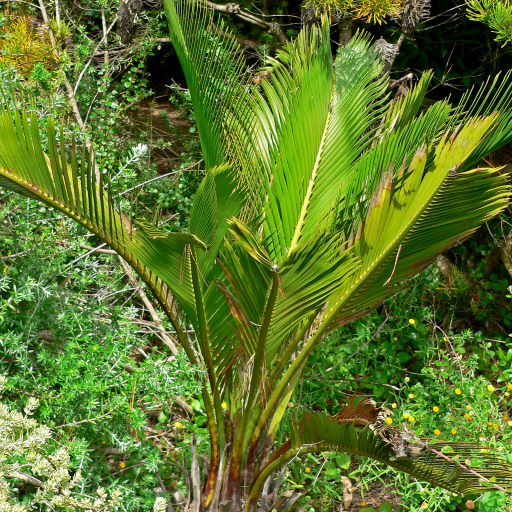
Plant Overview
Often called the Zamia Palm or Riedle's Macrozamia, this Australian native is a true "living fossil." Despite its palm-like appearance, it is actually a cycad—a lineage of plants that thrived during the era of the dinosaurs, long before flowering plants even existed. It is a symbol of ancient resilience, found gracing the sandy landscapes of Southwest Australia.
🔍 How to Identify
- 🌿 The Fronds: Stiff, leathery, and arching fronds that can reach up to 2 meters in length. The leaflets are a deep, glossy green and lack a midrib, distinguishing them from true palms.
- 🍍 The Cones: As a gymnosperm, it produces large, woody cones instead of flowers. Female cones are particularly striking, becoming heavy and breaking open to reveal bright red or orange seeds.
- 🪵 The Trunk: The trunk is thick and woody, but in younger plants or specific environments, it often remains mostly underground, making the fronds appear to sprout directly from the earth.
🏡 In Your Garden
- 🏜️ Drainage is Vital: This plant has evolved to thrive in the sandy, nutrient-poor soils of Western Australia. It is highly susceptible to root rot, so ensure your soil is gritty and fast-draining.
- 🐢 Extreme Patience: The Zamia is an incredibly slow grower. It may only produce one new "flush" of leaves per year. This makes it a low-maintenance choice, but don't expect it to fill a large space quickly.
- ☀️ Light Flexibility: While it loves bright, dappled sunlight, it is surprisingly adaptable and can handle full sun once established, provided it isn't scorched by extreme heat waves without some protection.
⚠️ Safety & Toxicity
- 🚫 Highly Toxic: Every part of this plant is poisonous, but the seeds are particularly dangerous due to high concentrations of cycasin.
- 🐾 Pets & Children: Ingestion can cause severe liver failure and neurological damage in dogs, cats, and humans. The bright red color of the seeds can unfortunately be attractive to children and pets, so it is best planted in restricted areas of the garden.
✨ Fun Fact
Indigenous Australians, particularly the Noongar people, developed a complex method of processing the toxic seeds to make them edible. By washing the seeds in running water or burying them in anaerobic pits for many weeks, they neutralized the toxins to create a starch-rich food source!

Detailed Care Instructions
To grow Macrozamia Riedlei plants, also known as zamia palm or zamia plant, follow these steps:
- Choose the right location: Macrozamia Riedlei plants thrive in warm, subtropical or tropical climates. They prefer well-draining soil and can tolerate full sun to partial shade.
- Planting: Dig a hole that is slightly wider and deeper than the root ball of your Macrozamia Riedlei plant. Place the plant in the hole and backfill with soil, ensuring the top of the root ball is level with the ground.
- Watering: Keep the soil evenly moist, but avoid overwatering, as these plants can be sensitive to excessive moisture. During hotter months or dry periods, water deeply about once a week. Reduce watering in cooler months.
- Fertilizing: Apply a slow-release fertilizer specifically formulated for palms in spring and early summer to promote healthy growth. Follow the instructions on the fertilizer packaging for application rates.
- Mulching: Apply a layer of organic mulch around the base of the plant to help retain moisture, suppress weeds, and provide nutrients as it decomposes. Keep the mulch away from direct contact with the plant's trunk.
- Pruning: Regularly inspect your Macrozamia Riedlei plant for any dead or damaged fronds (leaves). Trim them off at the base using clean pruning shears to maintain a neat appearance.
- Protection from frost: If you live in an area prone to frost, provide protection by covering the plant with a frost cloth or moving it indoors during frosty weather. Macrozamia Riedlei plants are generally frost tolerant but can be damaged by severe cold.
- Pest and disease control: Watch for signs of common pests like mealybugs or scale insects, and treat them promptly with an appropriate insecticide. Additionally, ensure good airflow around the plant to prevent fungal or bacterial infections.
It's important to note that Macrozamia Riedlei plants are classified as cycads—the oldest group of seed plants on Earth, known for their slow growth rate. Therefore, be patient with your plant's growth and give it time to establish itself.

Place in a bright room that is sun drenched almost all day. Or directly in a south-facing window.

To properly water this plant, you should first assess the moisture level of the soil by sticking your finger an inch or two into the soil. If the soil feels dry, it is time to water. When watering, it is important to do so deeply enough that the water reaches the root zone, but without saturating the soil. Allow the water to fully soak in before adding any more. During the summer months, this plant may require more frequent watering than during the cooler months. Be sure to avoid getting water on the leaves or crowns of the plant, as this can lead to rot.
To fertilize this species, use a slow-release fertilizer with a balanced NPK ratio of 10-10-10 or 14-14-14. Apply the fertilizer evenly around the base of the plant, taking care not to get it on the leaves or stem. Fertilize every three months during the growing season, and avoid fertilizing during the winter months when the plant is dormant. Water the plant thoroughly after fertilizing to help distribute the nutrients evenly into the soil.
The Macrozamia Riedlei plant requires well-draining soil with good aeration. It is important to use a soil mix that is free of heavy clay and is preferably neutral to acidic in pH. A mix of sandy loam with some peat moss or perlite mixed in can provide the ideal growing conditions for this plant. It is also recommended to add some slow-release fertilizer to the soil mix to provide essential nutrients to the plant. Additionally, it is important to ensure that the soil is not too wet as the plant is susceptible to root rot in overly moist conditions.
Propagation of this plant can be achieved through both seed and vegetative means. The most common method is through seed propagation, which involves collecting mature seeds from the plant and planting them in well-draining soil. The seeds should be soaked in water for a few hours before planting to encourage germination. It is best to plant the seeds at a depth of approximately twice their size and keep the soil moist until they sprout.
Vegetative propagation can be achieved through division or offsets, where smaller plantlets are removed from the parent plant and planted in their own individual containers. This method should only be used on mature plants that have produced multiple stems or offsets, as it can be detrimental to the health of the plant if done too frequently or on younger plants. The plantlets should be removed from the parent plant using a clean, sharp tool and planted in a well-draining soil mix. It is important to keep the soil and plantlets moist but not waterlogged to prevent damping off.
Both methods of propagation can be successful with proper care and attention given to the plant and its growing conditions. It is important to note that this plant is slow-growing and may take several years to reach maturity.








