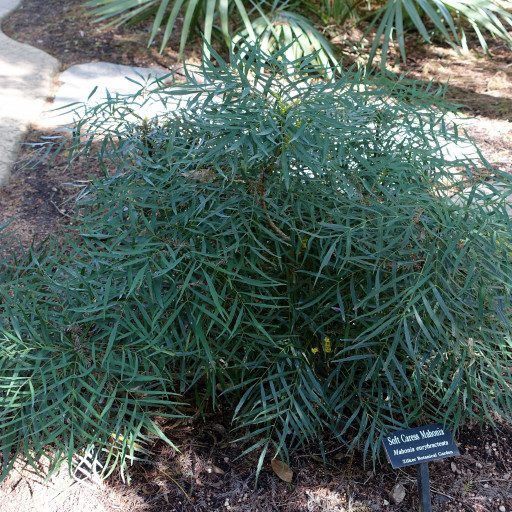
Plant Overview
Often called the "Soft Caress" Mahonia, this elegant evergreen breaks all the rules of its genus. While most Mahonias are known for their prickly, holly-like leaves that can draw blood, this Chinese native is famous for being completely spine-free and touchably soft. It brings a sophisticated, Asian-inspired aesthetic to shaded corners, looking more like a delicate fern or a miniature bamboo than a traditional woodland shrub.
🔍 How to Identify
- 🌿 The Foliage: Unlike the jagged edges of its cousins, the leaves are exceptionally narrow, slender, and smooth to the touch. They grow in a whorled pattern, creating a feathery, palm-like texture.
- 🟡 The Blooms: In late fall and early winter, the plant produces upright "candles" of tiny, lemon-yellow flowers that brighten the garden when most other plants are dormant.
- 🍇 The Fruit: Following the flowers, clusters of small, spherical berries appear, maturing into a dusty, frosted blue-black color that persists through the winter.
🏡 In Your Garden
- ☁️ Woodland Comfort: This plant is a shade-lover through and through. It excels in "bright shade" where it can avoid the harsh afternoon sun, which can bleach its deep green fronds.
- 🌱 Low Maintenance Roots: It is remarkably slow-growing and compact, meaning you won't need to reach for the pruning shears often. It prefers "cool feet"—meaning a thick layer of mulch helps keep the soil moisture consistent and the roots happy.
⚠️ Safety & Toxicity
- 🐾 Pet & Child Safety: Mahonia eurybracteata is generally considered non-toxic to humans and pets. However, like many Mahonias, it contains berberine, which can cause mild stomach upset if large quantities of the leaves or berries are ingested.
- 🫐 Edibility Note: While the blue berries are technically edible and high in Vitamin C, they are extremely tart and acidic. They are best left for the birds, who rely on them as a vital winter food source.
✨ Fun Fact
The 'Soft Caress' cultivar of this species was so revolutionary in the gardening world that it won the prestigious Plant of the Year award at the RHS Chelsea Flower Show in 2013—the first time a woody shrub had taken the top prize in years!

Detailed Care Instructions
To grow Mahonia Eurybracteata, also known as Soft Caress Mahonia, you can follow these steps:
- Select a suitable location: Mahonia Eurybracteata prefers partial shade to full sun. It can tolerate a wide range of soil types, including sandy, loamy, and clay soils. Choose a spot with well-drained soil.
- Dig a hole: Dig a hole that is twice the width and depth of the plant's container.
- Amend the soil: If your soil is heavy clay or poor in quality, mix in organic matter such as compost or aged manure to improve drainage and enrich the soil.
- Planting: Gently remove the Mahonia Eurybracteata plant from its container, being careful not to damage the roots. Place the plant in the hole, ensuring that the top of the root ball is level with or slightly higher than the soil surface. Backfill the hole with soil, firming it gently around the roots.
- Watering: After planting, water the Mahonia Eurybracteata thoroughly to help settle the soil and establish the roots. Water regularly to keep the soil evenly moist, especially during dry periods.
- Mulching: Apply a layer of organic mulch around the base of the plant to help retain moisture, suppress weeds, and regulate soil temperature. Leave a gap between the mulch and the stem to prevent rot.
- Pruning: Mahonia Eurybracteata generally requires minimal pruning. Remove any dead, damaged, or diseased branches as needed. You can also shape the plant by selectively pruning branches to maintain its desired form and size.
- Fertilizing: Apply a balanced, slow-release fertilizer in early spring to promote healthy growth. Follow the package instructions for the recommended amount and method of application.
- Maintenance: Keep an eye out for pests such as aphids or scale insects. If infestations occur, treat them with appropriate organic or chemical control methods.
- Propagation: Mahonia Eurybracteata can be propagated through stem cuttings taken in late spring to early summer or by dividing mature plants in spring or fall. Follow standard propagation techniques for the best success.
Remember to check the specific care needs of your Mahonia Eurybracteata plant as they may vary slightly based on your climate and growing conditions.

Place in a window with dappled sun or a spot in the middle of a room. Or directly in a window facing west or east.

Water the plant deeply and thoroughly, making sure that the soil is moist but not soaking wet. Avoid getting water on the leaves or flowers to prevent damage or disease. Allow the top inch of soil to dry out before watering again, as this plant prefers slightly dry conditions. Use room-temperature water to avoid shock to the roots. Adjust watering frequency based on seasonal changes in temperature and humidity.
To fertilize this plant, apply a balanced, slow-release fertilizer in the spring and again in early summer. Avoid applying fertilizer late in the growing season, as this can encourage new growth that may not harden off before winter. Also, avoid over-fertilization, as this can lead to excessive growth and reduced flowering. Finally, be sure to water the plant well before and after applying fertilizer to prevent burning.
Mahonia Eurybracteata prefers a well-draining and nutrient-rich soil. It is better to choose a soil with a pH level that is slightly acidic to neutral, and the soil should also be able to hold moisture well. The plant requires adequate watering but does not tolerate waterlogging, so it is essential to choose soil that is porous and able to drain excess water. A mixture of organic compost, peat moss, and sand can serve as a good growth medium for this plant. Organic compost enriches the soil with nutrients, while peat moss retains moisture and improves drainage, and sand improves the soil's structure by helping to loosen compact soil. Avoid using heavy, clay-rich soil, as it can hinder the plant's growth and development.
There are several ways to propagate this plant species. One method is by taking stem cuttings in the spring or autumn. Select a healthy stem with several nodes and cut it to a length of 6-8 inches. Remove the lower leaves and dip the end of the cutting in rooting hormone. Plant the cutting in a container filled with moist soil and cover it with a plastic bag to increase humidity. Place the container in a warm, bright area, but away from direct sunlight. Keep the soil moist and mist the cutting daily. The cutting should root in 4-6 weeks.
Another method is through division. In the spring, dig up an established plant and carefully separate the root system into smaller sections, with each section having a healthy stem and roots. Replant the sections into individual pots or directly into the garden, making sure the soil is moist and the plant receives partial shade until established.
Lastly, this plant can also be propagated by seeds. Collect the ripe berries in the fall and extract the seeds. Sow the seeds in a container filled with a moist, well-draining soil mix and cover them lightly with soil. Keep the container in a warm, bright area, but away from direct sunlight. Keep the soil moist and the seedlings will emerge within 2-4 weeks. Transplant the seedlings into individual pots or directly into the garden once they have developed their second set of leaves.








