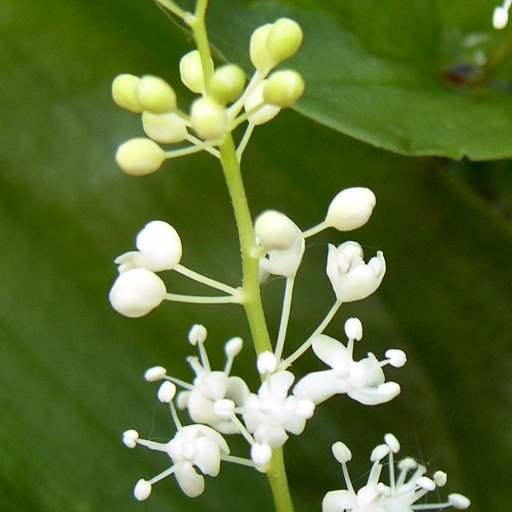
Plant Overview
Often called the May Lily or False Lily of the Valley, this delicate woodland treasure paints forest floors with emerald green, heart-shaped leaves. Despite its name, it is a distinct cousin to the common Lily of the Valley, offering a more subtle and wild aesthetic. Native to the cool, shady woodlands of Europe and Northern Asia, it is the perfect "fairy-tale" groundcover for the deepest corners of a garden.
🔍 How to Identify
- 🍃 The Twin Leaves: True to its species name bifolium (meaning two leaves), flowering stems almost always produce exactly two glossy, heart-shaped leaves that alternate up the stalk.
- ❄️ Starry Blooms: In late spring, it produces a frothy upright spike of tiny, white, four-petaled flowers. They lack the "bell" shape of true Lily of the Valley, appearing more like miniature stars.
- 🍒 Speckled Berries: After flowering, small green berries appear with reddish spots, eventually ripening into a solid, translucent ruby-red by late summer.
🏡 In Your Garden
- 🌲 Shadow Dweller: This plant is a specialist in deep shade. It thrives in the "dry shade" found under large deciduous trees where other plants often wither, making it an excellent solution for difficult North-facing spots.
- 🍂 Leaf Mold Lover: It performs best in acidic, humus-rich soil. Instead of heavy chemical fertilizers, it prefers a thick mulch of fallen leaves or compost to mimic the natural forest floor it calls home.
- 🐌 Slow Weaver: While it spreads via underground runners (rhizomes) to form a carpet, it is rarely invasive. It takes its time to establish, so avoid moving it once planted, as it dislikes root disturbance.
⚠️ Safety & Toxicity
- 🚫 Status: Toxic if Ingested.
- 🐾 Details: All parts of the plant, especially the tempting red berries, contain saponins and other compounds that are toxic to humans, dogs, and cats. Ingestion can cause blurred vision, nausea, and heart palpitations. It is best planted away from areas where curious toddlers or pets play.
✨ Fun Fact
Most members of the broad Lily family have flower parts in multiples of three (3 or 6 petals). Maianthemum bifolium is a rebel in the botanical world—it is one of the very few species in its group that follows a "rule of two," featuring four petals and four stamens.

Detailed Care Instructions
To grow Maianthemum bifolium, also known as false lily of the valley or two-leaved Solomon's seal, follow these steps:
- Choose a suitable location: Select a site with partial shade to full shade. The plant prefers moist, well-draining soil but can tolerate a wide range of soil types.
- Prepare the soil: Loosen the soil in the planting area using a garden fork or tiller. Remove any weeds or rocks and amend the soil with organic matter like compost or well-rotted manure to improve its fertility and drainage if needed.
- Planting: Dig a hole that is slightly larger than the root ball of the plant. Place the plant in the hole with the roots spread out. Backfill the hole with soil, ensuring that the crown of the plant is level with or slightly above the soil surface. Gently firm the soil around the roots.
- Watering: Give the newly planted Maianthemum bifolium a thorough watering immediately after planting to settle the soil around the roots. Afterward, water regularly, keeping the soil consistently moist but not waterlogged. During particularly dry periods, ensure the plant receives enough water to prevent dehydration.
- Mulching: Apply a layer of organic mulch around the plant to help retain soil moisture and suppress weed growth. Keep the mulch a few inches away from the stem to prevent rot.
- Feeding: Fertilization is not typically necessary for Maianthemum bifolium. However, if the plant appears weak or lacks vigor, a balanced, slow-release fertilizer can be applied according to package instructions.
- Maintenance: Remove any weeds that may emerge around the plant, being careful not to disturb the shallow roots. Additionally, remove any dead or yellowing foliage to keep the plant looking tidy and prevent disease.
- Propagation: Maianthemum bifolium can be propagated by division. After a few years, lift the plant in early spring or fall, separate the rhizomes, and replant them at the same depth as the parent plant.
- Protection: Monitor the plant for pests and diseases such as slugs, snails, or fungal infections. Take appropriate measures, such as using organic pest control methods or fungicides, to manage any issues.
By following these steps, you should be able to successfully grow Maianthemum bifolium in your garden or landscape.

Place in a window with dappled sun or a spot in the middle of a room. Or directly in a window facing west or east.

When providing water to this plant, it is important to ensure that the soil remains consistently moist throughout the growing season. This may involve regular watering, especially during periods of drought or when the weather is particularly warm. It is important to avoid over-watering the plant, as this can lead to root rot and other problems. To ensure that the plant receives enough water, it is important to water deeply, allowing the water to penetrate into the soil around the roots. Additionally, planting the plant in a location with good drainage can help to prevent waterlogged soil and other problems. Overall, providing regular, consistent watering is key to keeping Maianthemum bifolium healthy and thriving.
To fertilize this plant, use a balanced fertilizer with equal amounts of nitrogen, phosphorus, and potassium. Apply the fertilizer around the base of the plant in early spring before new growth appears. Water thoroughly after fertilizing. Avoid over-fertilizing as it can burn the roots and damage the plant.
Maianthemum bifolium prefers to grow in a well-draining soil that is slightly acidic to neutral in pH. The soil should be moist but not waterlogged, and rich in organic matter. A soil mix that is high in organic matter such as compost, leaf mold, and peat moss, mixed with sand or perlite for better drainage is recommended. Fertilizing the soil with a slow-release, balanced fertilizer can also be beneficial for maintaining the plant's health and vigor. It is important to avoid using heavy clay soils or soils that are too sandy as they can lead to problems with drainage and nutrient uptake.
Maianthemum bifolium is a plant that can be propagated in two ways: by seeds or by rhizomes.
To propagate by seeds, collect ripe berries from a mature plant, usually in late summer or early fall. Remove the fleshy pulp around the seeds and plant them in a well-draining soil in a shady area. Cover the seeds with a thin layer of soil and keep them moist but not wet. The seeds will germinate in the spring.
To propagate by rhizomes, dig up the plant in the fall or early spring. Carefully separate the rhizomes, making sure each section has at least one bud. Replant the rhizomes in a well-draining soil in a shady area and keep them moist but not wet. The new plants will emerge in the spring.
It is important to note that Maianthemum bifolium is a slow-growing plant and may take several years to mature. Additionally, it is important to preserve the natural habitat of this plant, as it is an important part of the ecosystem.








