Plant Overview
The quintessential "Forbidden Fruit" and a staple of folklore from the Garden of Eden to Newton’s orchard, Malus pumila is the ancestor of the modern dessert apple. Native to the rugged mountains of Central Asia, this deciduous tree has traveled the Silk Road to become the most widely cultivated fruit tree in the world. Whether you call it the Orchard Apple or the Common Apple, it remains the ultimate symbol of health, knowledge, and autumn harvests.
🔍 How to Identify
- 🍃 The Foliage: Look for simple, oval leaves with finely serrated edges. The undersides are often covered in a soft, silvery "down" or fuzz, which distinguishes them from many other fruit trees.
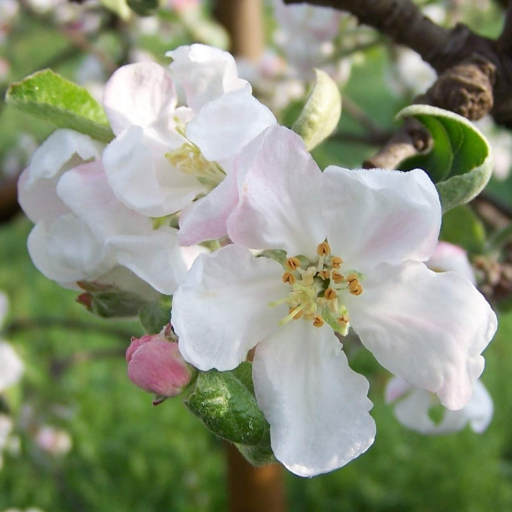
- 🌸 The Blossoms: In spring, the tree is smothered in clusters of five-petaled flowers. They are typically snowy white with a delicate blush of pink, carrying a sweet, honey-like fragrance.
- 🍎 The Fruit: The classic "pome" fruit varies wildly in color from lime green to deep crimson. Unlike crabapples, these are generally larger than two inches in diameter and possess a distinct "core" containing the seeds.
🏡 In Your Garden
- ✂️ The Art of Pruning: Apple trees require an "open center" or "central leader" pruning style. This isn't just for looks; it ensures sunlight reaches the inner branches and prevents moisture from trapped air, which can lead to fungal issues like Apple Scab.
- 🐝 The Need for a Partner: Most Malus pumila varieties are not self-fertile. To get a harvest, you usually need a second, different apple variety nearby to act as a pollen donor. It’s a social tree that relies heavily on local bee populations to do the heavy lifting.
- 🌱 Rootstock Matters: When buying one, remember that the tree's ultimate size is determined by its rootstock. "Dwarf" varieties are perfect for small patios, while "Standard" trees can reach heights of 30 feet, becoming a permanent legacy in your landscape.
⚠️ Safety & Toxicity
- 🍏 The Fruit: The fleshy part of the apple is perfectly safe and nutritious for humans, dogs, and horses.
- 🚫 The Seeds: Caution is required with the seeds. Apple seeds contain amygdalin, which releases cyanide when digested. While a human would need to chew and swallow a massive amount to be at risk, they should be kept away from small pets and curious toddlers.
- 🐾 Pet Safety: The leaves and stems contain low levels of cyanogenic glycosides. If your dog or cat enjoys "grazing" on fallen branches, it can lead to stomach upset or more serious respiratory issues in large quantities.
✨ Fun Fact
If you plant a seed from a delicious Honeycrisp apple, the tree that grows will not produce Honeycrisp apples. Apples are "extreme heterozygotes," meaning their offspring are genetically wild and unpredictable. To get a specific type of apple, humans must "clone" the tree through grafting!

Detailed Care Instructions
To grow a Malus pumila plant (commonly known as an apple tree), follow these steps:
- Location: Choose a sunny spot in your garden that receives at least 6-8 hours of direct sunlight per day. The soil should be well-draining and fertile.
- Soil preparation: Clear the area of any weeds or grass. Dig a hole that is twice as wide and deep as the root ball of the apple tree. Mix compost or well-rotted manure into the excavated soil to improve fertility and drainage.
- Planting: Place the apple tree in the center of the hole, making sure that the bud union (swollen area where the apple tree is grafted onto the rootstock) is above the soil level. Backfill the hole with the amended soil, gently firming it around the roots.
- Watering: After planting, water the apple tree thoroughly. Keep the soil consistently moist but not waterlogged. Providing 1-2 inches of water per week should be sufficient, allowing for rainwater.
- Pruning: Prune the apple tree during its dormant season. Remove any dead or diseased branches. Thin out overcrowded areas to improve air circulation and light penetration. Pruning will help shape the tree and promote better fruit production.
- Fertilizing: Feed the apple tree with a balanced fertilizer in spring and summer according to the package instructions. Avoid over-fertilizing, as it can lead to excessive vegetative growth with reduced fruit production.
- Mulching: Apply a layer of mulch around the base of the tree, leaving a few inches of space around the trunk to avoid rot. Mulch helps retain soil moisture, suppresses weeds, and improves soil quality over time.
- Pest and disease control: Regularly inspect the apple tree for signs of pests or diseases, such as aphids, apple maggots, and fungal infections. Apply appropriate organic or chemical treatments as needed, following the instructions and recommended dosage.
- Harvesting: Depending on the variety, apples are typically ready for harvest in late summer or early fall. Harvest apples when they are firm, fully colored, and easily detach from the tree. Twist or gently lift the apple upwards, twisting slightly until it releases from the branch. Handle the fruit carefully to avoid bruising or damage.
By following these steps, you can successfully grow and enjoy your Malus pumila plant. Remember to be patient, as it might take a few years for the apple tree to start producing a significant harvest.

Place in a bright room that is sun drenched almost all day. Or directly in a south-facing window.

To properly water this type of plant, you should first make sure to check the soil moisture level by sticking your finger about 1-2 inches into the soil. If the soil feels dry, it’s time for watering. Use a watering can or hose to gently water the base of the plant until the soil is evenly moist but not saturated. Be careful not to water the foliage or flowers as this can lead to fungal diseases. Avoid letting the soil dry out completely between watering, but also make sure it’s not constantly wet. In general, this plant prefers consistently moist soil. The frequency of watering will depend on factors such as temperature, humidity, and the type of soil used.
To fertilize this plant, use a balanced fertilizer with equal parts nitrogen, phosphorus, and potassium. Apply the fertilizer in early spring before new growth begins, and again in early summer. Use a granular fertilizer and spread it evenly around the base of the plant, avoiding direct contact with the trunk. Water thoroughly after fertilizing. Avoid over-fertilizing, as it can lead to excessive vegetative growth and reduced fruit production.
The recommended soil for Malus Pumila plants should be well-draining and rich in nutrients. It should have a pH level of 6.0-7.0 and a good mixture of organic matter such as compost, perlite, or vermiculite. The soil should also be able to retain moisture without becoming waterlogged. The ideal texture of the soil should be smooth and crumbly, allowing the roots to penetrate easily and secure the plant firmly. Heavy clay soils should be avoided as they tend to hold water and can lead to root rot. As this plant requires good drainage, it is recommended to plant it in raised soil beds or containers with drainage holes.
Malus Pumila is widely propagated by cutting and/or grafting techniques. To propagate this plant, first, select healthy and disease-free young shoots from a mature plant. Make sure the shoots are at least six inches long and have several leaves on them. Cut the shoots at a forty-five-degree angle using a disinfected and sharp pair of pruning shears.
For cuttings, remove all leaves except for the top two and dip the cut end into rooting hormone. Then, plant the cuttings in a well-draining potting mix, keeping the soil uniformly moist. Place the pot of cuttings in a bright but indirect light and keep it warm and humid. Cuttings will root within a few weeks if kept consistently moist and warm.
For grafting, select a healthy rootstock of a compatible species to act as the foundation to graft the Malus Pumila onto. Cut the rootstock at a forty-five-degree angle and then cut the Malus Pumila scion to fit closely onto the cut surface of the rootstock. Secure with grafting tape and seal with grafting wax to prevent moisture loss.
Regardless of which propagation method is used, provide the new plant with consistent watering, adequate sunlight or artificial lighting, and sufficient nutrients. It may take several months or even a year to establish a new, self-sustaining plant.








