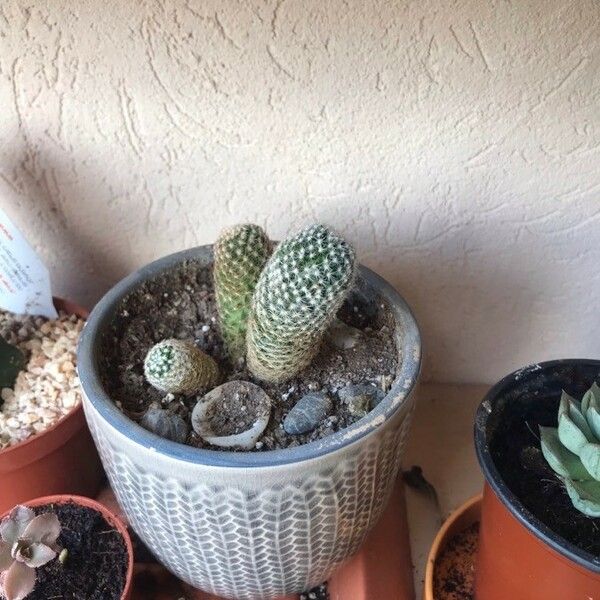
Plant Overview
Hailing from the rugged, sun-drenched islands of Baja California, Mammillaria albicans is often called the "White Pincushion" for its strikingly snowy appearance. This cactus looks like it has been dusted with powdered sugar or wrapped in a delicate white lace, a natural defense mechanism against the harsh Mexican sun. It’s a favorite among desert enthusiasts for its symmetrical growth and its ability to turn a simple windowsill into a miniature desert landscape.
🔍 How to Identify
- 🌵 The Body: Typically grows in cylindrical stems that cluster over time, creating a dense "colony" of white towers.
- ❄️ The Spines: Covered in a thick coat of short, chalky-white spines. Unlike some "hairy" cacti, these are stiff and provide a frosted, geometric texture.
- 🌸 The Bloom: In late spring, a crown of delicate, funnel-shaped flowers emerges near the top. They are usually pale pink or creamy white with a darker stripe down each petal.
🏡 In Your Garden
- ☀️ Sun-Shielding Spines: The dense white spines aren't just for show; they act as a natural parasol. To keep this plant looking its whitest and most compact, it needs very bright, direct light.
- 🪨 Mineral-Rich Diet: This species is sensitive to "wet feet." It thrives in a gritty, inorganic substrate (like pumice or lava rock) that mimics the rocky cliffs of its island home, preventing root rot.
⚠️ Safety & Toxicity
- 🟢 Status: Non-toxic to humans and pets.
- 🌵 Physical Hazard: While it won't poison your cat or dog, the spines are very sharp and can easily lodge in skin or fur. It’s best kept on a high shelf away from curious noses and wagging tails.
✨ Fun Fact
The name albicans comes from the Latin word for "whitening." In the wild, this cactus has evolved to be so white that it reflects a significant portion of UV radiation, essentially wearing its own permanent SPF 100!

Detailed Care Instructions
Mammillaria Albicans is a type of cactus that needs specific care in order to thrive. Here are some tips on how to grow Mammillaria Albicans plant successfully:
- Light: Mammillaria Albicans requires bright, indirect sunlight to grow. Place the plant near a south or west facing window where it can receive at least 6-8 hours of sunlight per day.
- Soil: Use a well-draining cactus or succulent potting mix for Mammillaria Albicans. Avoid using regular potting soil as it retains too much moisture, which can cause root rot.
- Watering: Water your Mammillaria Albicans sparingly, allowing the soil to dry out completely between waterings. During the growing season (spring and summer), water the plant only when the top inch of soil is dry. Decrease watering in the winter months when the plant is dormant.
- Humidity: Mammillaria Albicans prefers low humidity levels. Provide good airflow around the plant to prevent rot and fungal diseases.
- Temperature: Mammillaria Albicans thrives in warm temperatures between 70-80°F (21-27°C). Protect the plant from drafts and cold temperatures, as it is sensitive to cold.
- Fertilizer: Feed your Mammillaria Albicans with a diluted cactus or succulent fertilizer during the growing season, following the instructions on the product label. Avoid fertilizing in the winter months.
- Pests and diseases: Keep an eye out for common cactus pests such as spider mites, mealybugs, and scale insects. Treat any infestations promptly with insecticidal soap or neem oil. Avoid overwatering to prevent root rot and fungal diseases.
By providing the right conditions of light, soil, water, and temperature, you can successfully grow and care for your Mammillaria Albicans plant.

Place in a bright room that is sun drenched almost all day. Or directly in a south-facing window.

To water this plant, gently pour room temperature water over the soil until it is thoroughly moistened. Allow any excess water to drain out of the bottom of the pot. Wait until the soil has completely dried out before watering again, as this plant is susceptible to root rot from overwatering. It is recommended to water this plant sparingly during the winter months when it is in its dormant phase.
To fertilize the Mammillaria Albicans plant, apply a balanced liquid fertilizer diluted to half strength during the growing season (spring and summer). Fertilize every 4-6 weeks during this time. Do not fertilize during the winter months when the plant is dormant. Water the plant thoroughly after fertilizing to ensure the nutrients are absorbed properly.
The Mammillaria Albicans plant prefers a well-draining soil with a neutral to slightly alkaline pH level. A mix of coarse sand, perlite, and a well-draining succulent soil mix is recommended. Additionally, adding small amounts of limestone and bone meal to the soil can help provide essential nutrients for the plant's growth and health. It is important to avoid using soil mixes that retain moisture as this can lead to root rot in the plant.
Propagation of Mammillaria Albicans can be done easily through seed or offsets.
To propagate through seeds, collect ripe seeds from the plant and sow them in a well-draining soil mixture. Keep the soil evenly moist and place the seeds in a warm, bright location. Germination can take a few weeks to a few months.
To propagate through offsets, carefully separate the offsets from the parent plant using a sharp, sterile knife. Allow the offsets to callus for a few days before planting them in a well-draining soil mixture. Keep the soil lightly moist and place the offsets in a warm, bright location. Roots should develop within a few weeks, at which point the plant can be treated like a mature Mammillaria Albicans.
Common pests of the mammillaria albicans include Scale insect, mealybugs, spider mites, thrips. Make a habit of checking your mammillaria albicans frequently for pests so that any infestations can be caught and managed early.








