Plant Overview
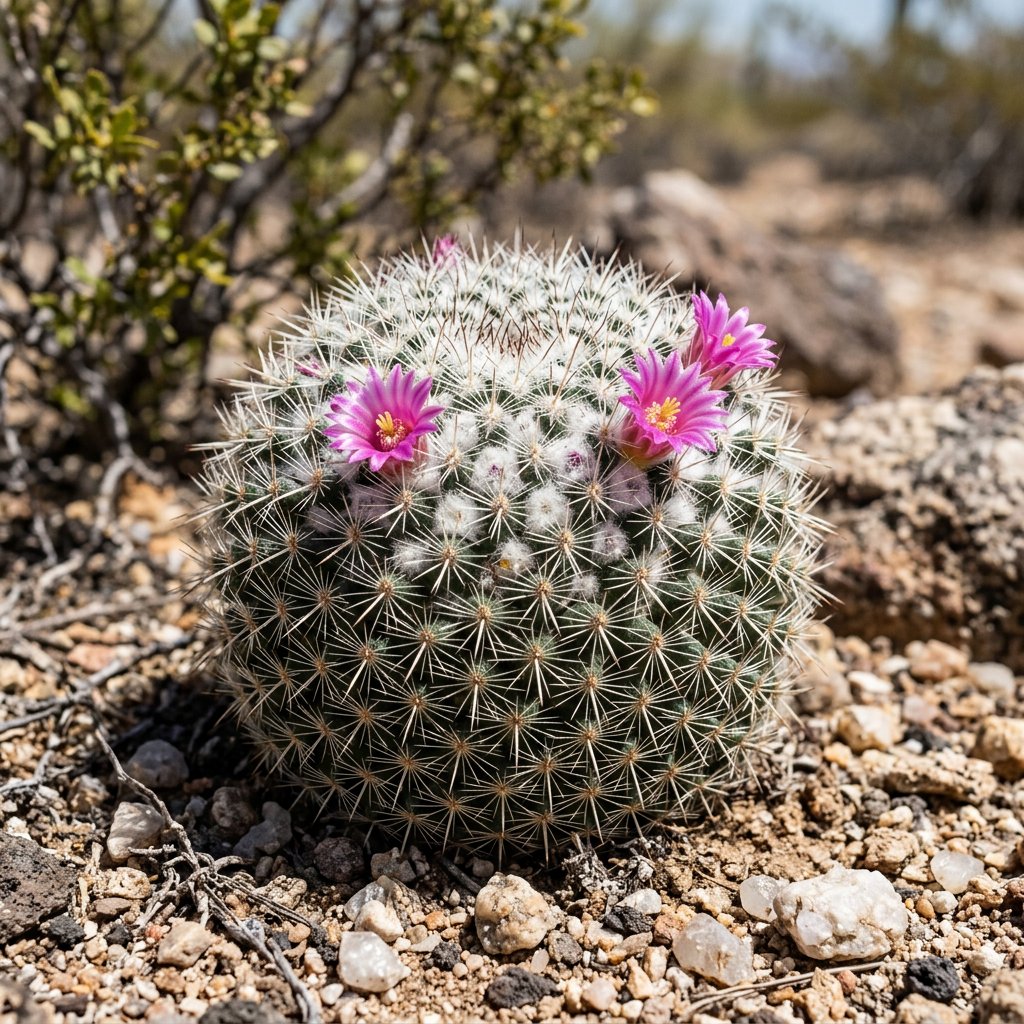
Often referred to as the Sonoran Pincushion, Mammillaria bocensis is a rugged beauty native to the coastal deserts of Sonora, Mexico. This cactus is a master of adaptation, often found clinging to rocky hillsides overlooking the Sea of Cortez. It is beloved by collectors for its geometric precision and its ability to blush a deep, moody purple when kissed by the desert sun.
🔍 How to Identify
- 🌵 The Body: A solitary, globular plant that may become slightly cylindrical with age. Its skin is a matte, dark bluish-green, often turning reddish or purplish under high light.
- 🧶 Woolly Axils: The spaces between its "nipples" (tubercles) are filled with a soft, white wool, giving the plant a slightly frosted appearance between the spines.
- 🌸 Halo of Blooms: It produces a "crown" of funnel-shaped flowers near the top. These are usually a delicate pale pink or cream with darker brownish-pink mid-stripes on the petals.
🏡 In Your Garden
- ☀️ The Sun-Blush: This cactus thrives on neglect but demands light. If kept in a shaded spot, it stays green; however, providing intense, direct sunlight encourages its signature purple "tan" and tighter spine growth.
- 💧 The "Drought First" Rule: Because it is adapted to rocky, well-draining coastal cliffs, its roots are highly susceptible to rot. It is better to skip a watering than to overdo it. Use a highly mineral "gritty mix" rather than standard potting soil to mimic its Mexican home.
⚠️ Safety & Toxicity
- 🌵 Physical Hazard: While not chemically toxic to humans or pets, the spines are very sharp and can easily puncture the skin.
- 🐾 Pet Safety: It is considered non-toxic if accidentally nibbled, but the spines serve as a natural deterrent that can cause mouth injuries to curious dogs or cats. Place it on a high shelf or in a dedicated "cactus zone."
✨ Fun Fact
The name Mammillaria comes from the Latin word mammilla, meaning "nipple" or "teat." This refers to the characteristic tubercles that cover the plant’s surface, a unique evolutionary trait that helps the cactus dissipate heat and conserve water more efficiently than ribbed cacti!

Detailed Care Instructions

Place in a bright room that is sun drenched almost all day. Or directly in a south-facing window.

To water this plant, it is important to first check the soil moisture level by sticking your finger about one inch deep into the soil. If the soil feels dry, it is time to water. When watering, pour water directly onto the soil rather than on the leaves or stem. Allow the soil to drain completely and do not leave standing water in the saucer. This plant prefers well-draining soil and should not be overwatered, as this can lead to root rot. Watering should be done sparingly during the winter months when the plant is dormant.
These plants can thrive without taking help from any fertilizer. However, if the medium of growth is something other than soil for instance sand then you may need to add little fertilizer. The best way to know if your plants need fertilizer or not is to check for yellowing of leaves. If the leaves start to turn yellow it’s fertilizing time.
You may use Cactus Fertilizer for your Mammillaria Bocensis
Mammillaria Bocensis plant requires a well-draining soil with a pH level of 6 to 7.5. The soil used can be a combination of peat moss, coarse sand, perlite, and gravel. The plant prefers soil that is slightly acidic and allows excess water to drain quickly. The soil used should be low in nutrients as the plant does not require a lot of fertilizers. It is recommended to avoid compacted or heavy soil as it can hinder the plant's growth. Regular watering is necessary, but the plant should never be allowed to sit in waterlogged soil as it can lead to root rot. Providing adequate drainage and nutrient-rich soil will help the plant thrive.
Common pests of the mammillaria bocensis include Scale insect, mealybugs, spider mites, thrips. Make a habit of checking your mammillaria bocensis frequently for pests so that any infestations can be caught and managed early.








