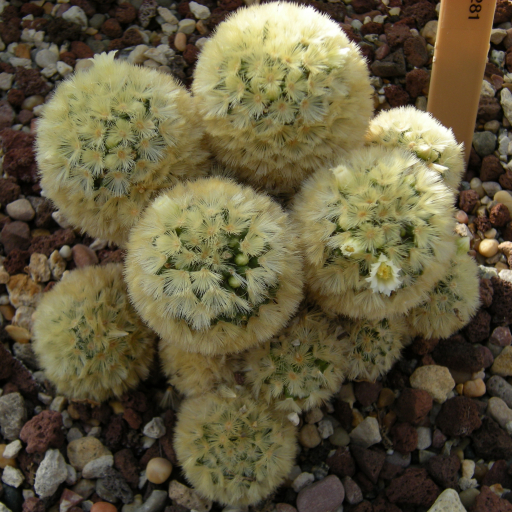
Plant Overview
Often called the Isla Carmen Pincushion, this Mexican native is a favorite among succulent collectors for its incredibly dense, fuzzy appearance. Unlike the sharp, intimidating needles of many desert cousins, this cactus looks like it’s wrapped in a cozy sweater of golden or white bristles. It hails from the rocky mountain crevices of Tamaulipas, where it thrives in the thin, mineral-rich air.
🔍 How to Identify
- 🌵 Body Shape: It begins its life as a small, perfect globe but gradually stretches into a short cylinder as it matures, often clustering into "families" of multiple heads.
- ☁️ Spine Texture: Each tubercle (the small bumps on the cactus) is packed with up to 100 hair-like radial spines. They are so dense that the green skin of the cactus is often completely hidden from view.
- 🌸 The Flower Crown: During late winter or early spring, it produces a charming "halo" or ring of small, bell-shaped flowers near the top, typically in shades of creamy white, pale pink, or soft yellow.
🏡 In Your Garden
- ☀️ Light & Spine Color: To keep its "fur" thick and brightly colored, this cactus craves intense, bright light. If kept in a dim corner, the new growth will be thin and the spines will look sparse and "balding."
- 💧 The Moisture Trap: Because the spines are so dense, they can trap water against the plant's body like a wet sponge. Always water at the soil level; getting the "fuzz" wet in cool weather can quickly lead to fungal rot or unsightly orange spotting.
⚠️ Safety & Toxicity
- 🛡️ Safe Status: Mammillaria carmenae is considered non-toxic to humans, cats, and dogs. It does not contain the toxic alkaloids found in some other cactus families.
- 🌵 Mechanical Irritant: While the spines are "soft" compared to a Saguaro, they are still needles. They can easily lodge in skin or curious paws, causing minor irritation and itchiness. It’s best handled with gloves or a folded piece of newspaper.
✨ Fun Fact
For nearly 50 years after its initial discovery in the 1930s, this plant was considered "lost" to science. No one could find it in the wild again until 1977, when a small population was finally rediscovered clinging to a single mountain ridge!

Detailed Care Instructions

Place in a bright room that is sun drenched almost all day. Or directly in a south-facing window.

Some plants prefer to be dry and thrive in a low-water environment. Allow your plant soil to completely dry for a few inches before watering again. However, a constant water supply is recommended in early years of plant growth. Watering these plants on a regular basis will help them establish a strong foundation. Excessive or everyday watering will cause the soil to become oversaturated, resulting in root rot and other fungal infections.
These plants can thrive without taking help from any fertilizer. However, if the medium of growth is something other than soil for instance sand then you may need to add little fertilizer. The best way to know if your plants need fertilizer or not is to check for yellowing of leaves. If the leaves start to turn yellow it’s fertilizing time.
You may use Cactus Fertilizer for your Mammillaria Carmeniae
Common pests of the mammillaria carmeniae include Scale insect, mealybugs, spider mites, thrips. Make a habit of checking your mammillaria carmeniae frequently for pests so that any infestations can be caught and managed early.







