Plant Overview
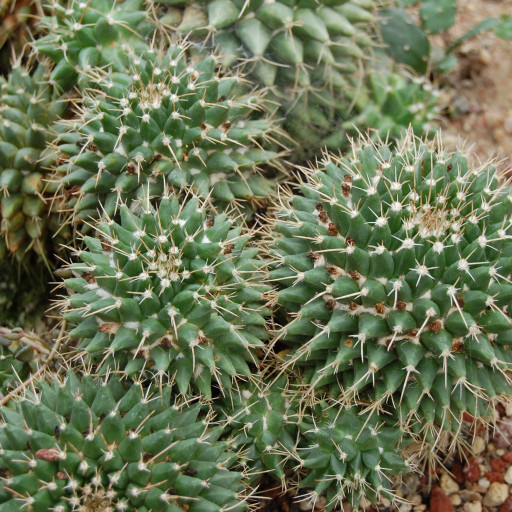
Often called the Mustache Cactus, Mammillaria mystax is a striking desert gem hailing from the high-altitude regions of Mexico. This cactus is beloved for its geometric precision, with its body covered in mathematical patterns of "tubercles" and long, wiry spines that give it a slightly wild, unkempt appearance. In late spring, it rewards its owner with a perfectly circular "crown" of vibrant pink flowers that pop against its grey-green skin.
🔍 How to Identify
- 🌵 Body Shape: It begins as a perfect globe but slowly elongates into a short cylinder as it matures, reaching about 6 to 12 inches in height.
- 📐 Tubercles: Unlike many cacti with ribs, this one has distinct, pyramid-shaped bumps (tubercles) arranged in tight spirals.
- 🧶 The "Mustache" Spines: Each tubercle cluster features several short radial spines and one to four central spines that are much longer, darker, and often curve slightly—resembling stiff whiskers.
- 🌸 Floral Crown: It produces a ring of small, bell-shaped flowers, usually in shades of deep rose or magenta, encircling the top of the plant.
🏡 In Your Garden
- ☀️ Light & Color: This cactus craves bright, direct sunlight. High light levels are essential not just for growth, but to ensure the spines develop their deep color and the plant remains compact rather than "stretching" toward the light.
- 💧 The "Drought" Logic: Like most Mammillaria, it has a sensitive root system that cannot tolerate "wet feet." It prefers a very gritty, porous soil mix because its roots are designed to drink quickly and then dry out completely to prevent fungal rot.
- 🌡️ Winter Dormancy: To encourage those beautiful spring flowers, it appreciates a cool, dry "nap" during the winter months. Reducing water almost to zero in winter mimics its natural high-desert environment.
⚠️ Safety & Toxicity
- 🌵 Physical Hazard: While not chemically toxic, the spines are incredibly sharp and can be difficult to remove if they hook into the skin.
- 🐾 Pets & Children: It is generally considered non-toxic if accidentally nibbled, but the mechanical danger of the spines makes it a plant that should be kept on high shelves away from curious paws and hands.
✨ Fun Fact
The species name mystax comes from the Greek word for "mustache," referring to the long, twisting central spines that look like a Victorian gentleman’s facial hair!

Detailed Care Instructions
| Soil Ph | Acidic |
| Humidity | Dry |
| Lighting | Full Sun |
| Toxicity | Non-Toxic |
| Soil Type | Sandy, Well-Drained |
| Bloom Time | Summer |
| Difficulty | Easy |
| Plant Type | Cactus |
| Mature Size | Up To 6, Even 8" In Height |
| Native Area | Mexico |
| Sun Exposure | Full Sun |
| Hardiness Zones | 9-11 |
To grow Mammillaria mystax plants, you can follow these steps:
- Select a suitable pot: Choose a small to medium-sized pot with drainage holes. Mammillaria mystax prefers a slightly cramped pot, so avoid using a container that is too large.
- Soil: Use a well-draining cactus/succulent soil mix. It should consist of a mixture of regular potting soil, perlite, and coarse sand to provide good drainage.
- Planting: Place the plant in the pot, making sure the roots are covered with soil. Gently press the soil around the base of the plant to anchor it securely. Avoid burying the plant too deep; the top of the root ball should be level with or slightly above the soil surface.
- Sunlight: Mammillaria mystax plants need bright, indirect sunlight. Place them near a south-facing window or provide them with about 4-6 hours of sunlight per day. Be cautious of intense, direct sunlight, especially during hot summer months, as it can scorch the plant.
- Temperature: These plants thrive in average room temperatures between 65-80°F (18-27°C). Protect them from extreme cold or frost during winter months.
- Watering: Allow the soil to dry out completely between waterings. Water enough to moisten the entire root ball, and then let the excess water drain through the pot's drainage holes. Overwatering can lead to root rot, so be cautious not to keep the soil constantly wet.
- Humidity: Mammillaria mystax can tolerate normal household humidity levels, but it does appreciate slightly higher humidity. You can increase humidity by placing a tray filled with water near the plant or using a humidifier.
- Fertilizer: Feed the plant with a diluted, balanced cactus/succulent fertilizer once a month during the growing season (spring and summer). Follow the instructions on the fertilizer package for proper dilution ratios.
- Pruning: Prune off any dead or damaged parts, or use clean scissors to remove offsets (baby plants) once they reach a reasonable size to encourage the main plant's growth.
- Repotting: Mammillaria mystax plants generally need to be repotted every 2-3 years. Repot in early spring, using fresh cactus/succulent soil.
By providing the right conditions of light, water, and temperature, your Mammillaria mystax plant should thrive and grow successfully.

Place in a bright room that is sun drenched almost all day. Or directly in a south-facing window.

To properly water this specific type of cactus, it is important to allow the soil to dry out completely between waterings. This might mean only watering once every 1-2 weeks, depending on the environment it is in. When it is time to water, gently pour water onto the soil, making sure to thoroughly soak it. Be careful not to get water on the body of the cactus itself. After watering, allow any excess water to drain out of the pot before placing it back in its spot.
For optimal growth, fertilize this plant during the spring and summer months using a cactus fertilizer diluted to half strength. Only fertilize after watering the plant, and avoid fertilizing during the dormant winter period. Be sure not to over-fertilize and follow the instructions on the fertilizer package for dosage and application.
The recommended soil for the Mammillaria Mystax plant should be well-draining and composed of a mixture of perlite, coarse sand, and peat moss or coconut coir. This type of soil will allow for good airflow and moisture regulation, which are both essential for the proper growth and health of this plant. Additionally, the soil should be slightly acidic to neutral, with a pH range of around 6.0 to 7.0. Adding a slow-release fertilizer to the soil once or twice a year can also provide the plant with the necessary nutrients for healthy growth. It is important to avoid using soil that is heavy or compacted, as this can lead to problems such as root rot or suffocation of the plant's roots.
Propagation of this plant can be achieved through several methods, including seed propagation and vegetative propagation. For seed propagation, the seeds should be collected from mature fruit and then allowed to dry for several days. Once dried, the seeds can be sown in a well-draining soil mix and kept in a warm and humid environment until they germinate.
Vegetative propagation involves taking cuttings from the plant and rooting them in soil or water. The cuttings should be taken from healthy, mature stems and allowed to callus over for several days. Once callused, the cuttings can be planted in a well-draining soil mix or placed in water until they develop roots.
Propagation should be done during the plant's active growth period, which is typically in the spring and summer months. The newly propagated plants should be kept in a warm and humid environment until they become established and begin to show signs of new growth.
Common pests of the mammillaria mystax include Scale insect, mealybugs, spider mites, thrips. Make a habit of checking your mammillaria mystax frequently for pests so that any infestations can be caught and managed early.








