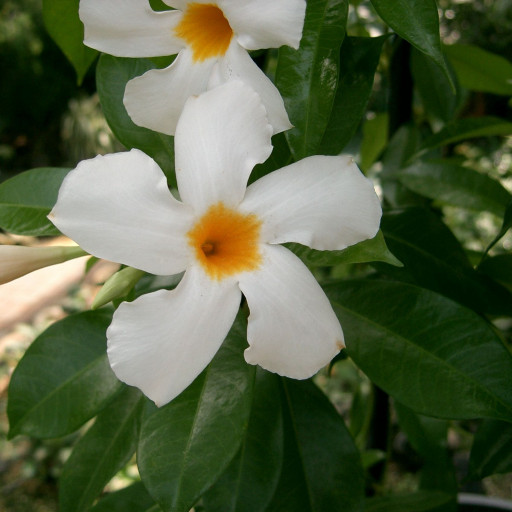
Plant Overview
Often called the White Dipladenia or Bolivian Jasmine, this elegant climber is the monochromatic queen of the tropical patio. While it isn’t a true jasmine, its pristine white blooms and lush, waxy foliage evoke a Mediterranean dreamscape, even when grown in a simple container. It is beloved by gardeners for being slightly more compact and manageable than its more aggressive pink cousins.
🔍 How to Identify
- 🌼 The Blooms: Large, trumpet-shaped flowers that are pure snowy white, featuring a distinct, sunny-yellow "throat" at the center.
- 🍃 The Foliage: Elongated, lance-shaped leaves that are deep green with a high-gloss finish, looking almost as if they’ve been polished with wax.
- 🎢 Growth Habit: A vigorous twining vine that seeks out vertical structures, wrapping its stems tightly around anything it can reach to climb toward the sun.
🏡 In Your Garden
- 🧗 Vertical Ambition: This plant is not a ground-hugger; it requires a trellis, obelisk, or fence to show off its best side. Because it twines its stems rather than using "suckers," it won't damage your masonry or siding like ivy would.
- 💧 Thirst vs. Drainage: While it craves a tropical drink, it is highly prone to root rot if left in standing water. It thrives when the top inch of soil dries out between waterings—think "moist but never soggy."
- ☀️ Light Logic: To produce a heavy flush of flowers, it needs at least 6 hours of sun. However, in extremely hot climates, it appreciates a little "siesta" in the afternoon shade to prevent its delicate petals from scorching.
⚠️ Safety & Toxicity
- 🧪 Irritant Sap: Like many members of the Dogbane family, the stems and leaves contain a milky white latex sap. This can cause skin redness or itching, so it's wise to wear gloves when pruning.
- 🐾 Pet & Child Safety: It is considered mildly toxic if ingested. While rarely fatal, it can cause nausea, vomiting, and mouth irritation in curious cats, dogs, or toddlers.
✨ Fun Fact
Despite its delicate appearance, the Mandevilla is a marathon runner of the plant world. In the right conditions, a single vine can grow up to 10 feet in a single season, and it has been known to bloom continuously from late spring until the very first frost of autumn!

Detailed Care Instructions
To successfully grow a Mandevilla Boliviensis plant, you can follow these steps:
- Choose the right location: Mandevilla Boliviensis plants thrive in full sun to partial shade. Select a spot in your garden that receives at least six hours of direct sunlight per day. Ensure that the area has well-draining soil and provides sufficient space for the vine to spread out.
- Planting: Dig a hole that is twice the width of the root ball of the plant. Place the Mandevilla Boliviensis in the hole and backfill it with soil, gently firming it around the base of the plant. Water thoroughly after planting to settle the soil.
- Watering: Provide regular watering to the Mandevilla Boliviensis, especially during dry spells. The soil should be kept evenly moist but avoid overwatering, as this can lead to root rot. Mulching the base of the plant can help retain moisture and prohibit weed growth.
- Fertilizer: Apply a balanced, slow-release fertilizer to the soil in spring and mid-summer. This will provide the necessary nutrients to support healthy growth and blooming. Follow the package instructions for the appropriate amount to use.
- Pruning: Mandevilla Boliviensis plants benefit from regular pruning to encourage bushier growth and more flowers. Pluck off any spent blooms to encourage new flower production. Cut back any long, straggly vines in early spring to maintain a compact shape.
- Support: Mandevilla Boliviensis is a climbing vine that requires support as it grows. Install a trellis, arbor, or stake near the plant to provide it with something to climb on. As the plant grows, gently guide the vines around the support structure.
- Winter care: Mandevilla Boliviensis is sensitive to colder temperatures and is typically grown as an annual in regions with frosty winters. Before the first frost, bring the plant indoors and place it in a cool, bright location. Reduce watering during winter dormancy, and when spring arrives, resume regular care and gradually reintroduce it to outdoor conditions.
By following these tips, you can successfully grow a beautiful and vibrant Mandevilla Boliviensis plant.

Place in a window with dappled sun or a spot in the middle of a room. Or directly in a window facing west or east.

To water this plant, you should first ensure that the soil is dry to the touch before watering. Use a watering can or hose to slowly and evenly water the soil around the base of the plant. Avoid getting water on the leaves, as this can lead to fungal growth and damage to the plant. Water deeply, but do not allow the soil to become excessively saturated, as this can cause root rot. Watering frequency will vary based on factors such as temperature, humidity, and the size of the plant, so it's important to monitor the soil moisture regularly and adjust your watering accordingly.
To fertilize this plant, you should use a balanced fertilizer with equal amounts of nitrogen, phosphorus, and potassium. You can mix the fertilizer into the soil around the base of the plant once a month during the growing season. Follow the fertilizer instructions for the appropriate amount to use for the size of your plant. Be careful not to over-fertilize, as this can damage the roots and harm the plant. Water the plant immediately after fertilizing to help the nutrients enter the soil. Avoid fertilizing during the dormant season.
The ideal soil for Mandevilla Boliviensis is a well-draining soil with a slightly acidic pH of around 6 to 6.5. The soil should be rich in organic matter and have good water retention properties. It is recommended to use a mixture of peat moss and coarse sand or perlite to create a lightweight and airy soil. Avoid using heavy soils that may become waterlogged and cause root rot. Additionally, regular fertilization every 2-3 weeks during the growing season with a balanced fertilizer will help promote healthy growth and blooming.
There are several ways to propagate this plant. One method is by taking stem cuttings. To do this, choose a healthy stem that is about 5-6 inches long and cut it at a 45-degree angle, just below a node. Remove any leaves from the bottom half of the stem. Dip the cut end of the stem in rooting hormone and plant it in a well-draining potting mix. Water the cutting and place a clear plastic bag over it to create a mini greenhouse. Keep the soil moist and the cutting in indirect light until it roots, which usually takes about 2-3 weeks.
Another method of propagation is by layering. Choose a stem that is close to the ground and partially bury it in the soil. Use a small stick or wire to hold the stem in place. Over time, roots will develop from the buried section of the stem. Once the plant has established roots, it can be cut from the parent plant and transplanted.
Mandevilla Boliviensis can also be propagated by dividing the plant. This is best done in the spring when the plant is actively growing. Carefully remove the plant from its pot and separate the root ball into smaller sections. Replant each section in its own pot or in the garden.
Common pests of the white dipladenia include Mealybugs, spider mites, aphids, whiteflies. Make a habit of checking your white dipladenia frequently for pests so that any infestations can be caught and managed early.








