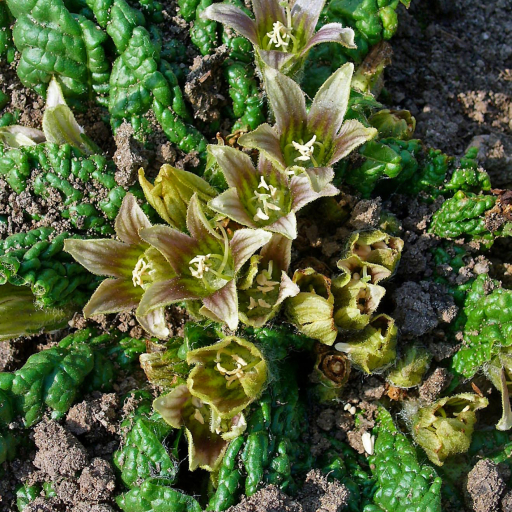
Plant Overview
Known widely as the legendary Mandrake, this plant is steeped in centuries of folklore, witchcraft, and even modern pop culture (as seen in Harry Potter). Originating from the Mediterranean, its most famous feature is its thick, forked taproot that often takes on a strangely human-like shape. While it looks like a simple, low-growing leafy rosette on the surface, its history is one of the most mystical in the botanical world.
🔍 How to Identify
- 🍃 The Foliage: Large, wrinkled, and crinkled dark green leaves that grow in a flat rosette close to the ground, appearing somewhat like a cross between a primrose and a tobacco leaf.
- 🌸 The Blooms: Small, bell-shaped flowers that emerge from the center of the rosette. They typically range in color from a ghostly pale green to a deep, moody violet-blue.
- 🥕 The Root: A long, thick, brownish taproot that can reach up to three feet deep. It is famous for its "legs"—forks in the root that frequently resemble the human torso and limbs.
🏡 In Your Garden
- 🏜️ Deep Soil Needs: Because of its massive taproot, Mandrake requires very deep, well-draining, and somewhat sandy soil. It hates "wet feet," which can cause the precious root to rot quickly.
- 💤 Summer Dormancy: Don’t be alarmed if the plant seems to die off in mid-summer. Mandrake often goes dormant during high heat to conserve moisture, with its leaves yellowing and disappearing entirely until the cooler weather returns.
- 🛑 The "Forever" Spot: This plant is notorious for hating relocation. Due to its sensitive and deep-reaching taproot, transplanting a mature Mandrake is almost always fatal to the plant. Choose its permanent home with care.
⚠️ Safety & Toxicity
- 🚫 Extreme Hazard: Mandrake is highly poisonous if ingested. It contains potent tropane alkaloids, including atropine and scopolamine, which affect the nervous system.
- 🐕 Pets & Kids: Every part of this plant—especially the root and the small, yellow, tomato-like berries—is toxic. Ingestion can cause hallucinations, rapid heart rate, and respiratory failure. It is best grown in a restricted area or a "curiosity garden" away from curious pets.
✨ Fun Fact
According to medieval legend, the Mandrake would emit a piercing shriek when pulled from the earth that was loud enough to kill anyone who heard it. To harvest it safely, ancient herbalists would tie a dog to the plant and lure the dog away with food, allowing the dog to pull the root while the humans plugged their ears with wax!

Detailed Care Instructions
| Humidity | Normal |
| Lighting | Part Sun |
| Toxicity | Poisonous |
| Difficulty | Easy |
| Hibernation | Cold Period |
| Temperature | 18°C - 21°C |
| Hardiness Zones | 6 - 9 |
To grow Mandragora officinarum plants, also known as Mandrake, follow these steps:
- Obtain seeds or young Mandragora officinarum plants from a reputable source. Note that this plant is not commonly available for purchase as it is considered a rare and protected species in many places. Make sure it is legal to grow and possess in your area.
- Choose a suitable location for planting. Mandragora officinarum prefers a well-drained soil with a neutral to slightly acidic pH. It does well in partial shade to full sun but can also tolerate shade.
- Prepare the soil by removing any weeds, rocks, or debris. Loosen the soil to a depth of about 8-12 inches (20-30 cm) and mix in organic matter like compost or well-rotted manure to improve fertility.
- If starting from seeds, scarify them by gently rubbing them against sandpaper or nicking them with a knife. This helps improve germination rates. Soak the scarified seeds in warm water for 24 hours before planting.
- Plant the seeds in the prepared soil about 1/4 to 1/2 inch (0.5-1 cm) deep. Space the seeds or young plants about 12-18 inches (30-45 cm) apart to allow for proper growth.
- Water the planted seeds or young plants well after planting and keep the soil consistently moist, but not waterlogged. Avoid letting the soil dry out completely.
- Provide regular care and maintenance. Ensure the plants receive adequate sunlight, water them regularly, and provide organic fertilizers or compost during the growing season. Mulching around the plants can help retain moisture in the soil.
- Mandragora officinarum can be sensitive to extreme temperatures. Protect young plants from frost or extreme heat by using mulch or providing shade if necessary.
- Be patient, as Mandrake plants can take several years to reach maturity. During this time, they will develop a long taproot and sprout dark green leaves. Typically, it takes around 2-3 years before the first flowers may appear.
- Harvest the Mandragora officinarum roots when the plant is mature, usually after several years. This should be done with caution, as the plant is toxic and can cause harm if not handled properly. Use gloves and carefully dig around the roots to avoid damaging them.
Note: It is essential to check the legality of growing Mandragora officinarum plants in your area as they are considered a protected species in many regions and harvesting them from the wild may be illegal.

Place in a window with dappled sun or a spot in the middle of a room. Or directly in a window facing west or east.

To water the plant, ensure that the soil is evenly moist but not waterlogged. Water the plant deeply and ensure that the water reaches the roots. Allow the top layer of soil to dry slightly before watering again. Be careful not to let the soil dry out completely, as this can cause stress to the plant. Use room temperature water to avoid shocking the roots. It is recommended to water the plant regularly, but reduce watering during periods of dormancy.
To fertilize this plant, use an all-purpose, balanced fertilizer with equal amounts of nitrogen, phosphorus, and potassium. Apply the fertilizer every four to six weeks during the growing season. Use a ratio of 10-10-10 or 20-20-20 and follow the instructions on the fertilizer package for the application rate. Water the plant thoroughly after applying the fertilizer. Avoid applying fertilizer during the dormant season.
The best soil for Mandragora Officinarum plant is one that is well-draining, loamy, and rich in nutrients. A mixture of sand, peat moss, and perlite is ideal for growing this plant, as it provides good drainage while retaining moisture and nutrients. It is also important to maintain a slightly acidic pH level, which can be achieved with the addition of organic matter such as compost or leaf mold. Avoid using heavy clay soils or soils that are too compact, as this can hinder root growth and lead to rotting. Additionally, ensure that the soil is not too alkaline, as this can affect the plant's ability to absorb nutrients. It is recommended to amend the soil regularly with organic matter and to fertilize the plant during the growing season to ensure healthy growth.
Mandragora Officinarum plants can be propagated through various means. One method is by collecting the seeds when they are ripe and sowing them immediately in well-draining soil. The seeds should be sown at a depth of 1-2 cm and kept moist until germination occurs, which can take up to several months.
Another method of propagation is through root cuttings. This involves cutting a small section of the root (approximately 5-10 cm in length) and planting it in a pot with well-draining soil. The cutting should be kept moist and warm until new growth appears.
It is important to note that Mandragora Officinarum is a toxic plant and should be handled with care. Gloves should be worn when handling the plant and its seeds. Additionally, the plant should be kept out of reach of children and pets.








