Plant Overview
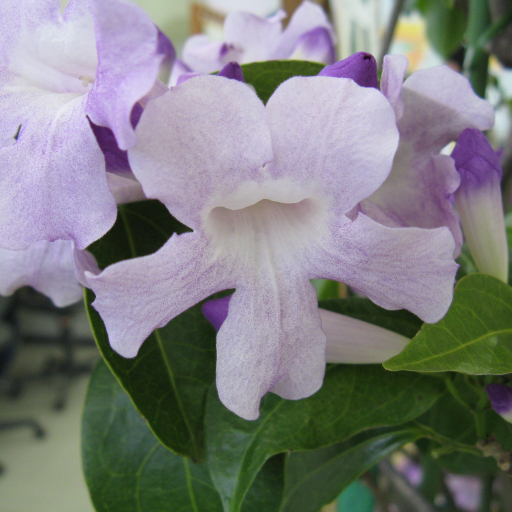
Often called the Garlic Vine or Ajos Sacha, Mansoa alliacea is a breathtaking tropical climber that plays a trick on the senses. While its clusters of lavender, trumpet-shaped flowers look like something out of a fairy tale, its crushed leaves release a pungent aroma indistinguishable from fresh kitchen garlic. Native to the Amazon rainforest, it is cherished both as an ornamental powerhouse and a traditional medicinal plant.
🔍 How to Identify
- 🌸 The Color-Changing Bloom: The flowers emerge in heavy clusters. They start as a deep violet-purple, fade to a soft lavender, and eventually turn almost white before falling, often showing all three colors on the vine at once.
- 🍃 Garlic-Scented Foliage: The bright green, leathery leaves are oval-shaped. If you gently bruise or crush a leaf, it emits a strong, unmistakable smell of garlic or onions.
- 🧗 Woody Climbing Habit: This is a vigorous evergreen vine that uses small tendrils to pull itself upward. Over time, the lower stems become thick and woody, making it ideal for covering heavy fences or pergolas.
🏡 In Your Garden
- 🧱 The Need for Support: Because this vine grows rapidly and can become quite heavy, it requires a sturdy structure like a trellis or a stone wall. It "hates" being moved once established because its root system is sensitive, so choose its forever home carefully.
- ☀️ Sun for Scent and Sight: To get those massive "bouquets" of purple flowers, it needs full sun. In shadier spots, the plant will focus on green leaf production but will rarely bloom, and the garlic scent of the leaves may be less intense.
- 💧 Tropical Humidity: Coming from the Amazon, it thrives in high humidity and well-draining soil. It is not frost-tolerant; even a light freeze can cause it to drop its leaves, so it is best grown in containers in cooler climates.
⚠️ Safety & Toxicity
- 🐾 Pet Safety: While the plant is used in traditional human medicine in South America, it is generally considered non-toxic. However, the high concentration of sulfur compounds (which cause the garlic smell) can cause stomach upset in cats or dogs if consumed in large quantities.
- 👶 Kid-Friendly: It is safe to touch and smell, making it a great "sensory plant" for children, though the taste is quite bitter and unpleasant.
✨ Fun Fact
In many Amazonian cultures, Mansoa alliacea is considered a "magical" plant used to drive away bad luck or "evil spirits." It is often planted near the entrance of a home to act as a spiritual protector—and a natural mosquito repellent!

Detailed Care Instructions
| Lighting | Full Sun |
| Hardiness Zones | Min 9B |
To grow Mansoa alliacea plant, also known as garlic vine or wild garlic, follow these steps:
- Choose a suitable location: Garlic vine thrives in full sun or partial shade. Select a spot where the plant can receive at least 4-6 hours of direct sunlight per day. The soil should be well-draining and rich in organic matter.
- Propagation: Garlic vine can be propagated from stem cuttings or seeds. For stem cuttings, take a 4-6 inch long cutting from a healthy, mature plant. Remove the lower leaves and dip the cut end in a rooting hormone powder. Plant the cutting in a small pot filled with well-draining soil mix and keep it in a warm, humid location. Water the cutting regularly, keeping the soil slightly moist but not overly wet. Roots should form within a few weeks.
- Planting: If you prefer to grow garlic vine from seeds, sow them in small containers or trays filled with seed starting mix. Cover the seeds lightly with soil and keep the medium evenly moist. Once the seedlings have grown a few inches tall and developed several sets of leaves, they can be transplanted to their final location.
- Watering: Garlic vine requires regular watering to keep the soil consistently moist but not waterlogged. During dry periods, increase the frequency of watering. However, avoid overwatering, as excessive moisture can lead to root rot.
- Fertilization: Apply a balanced, slow-release fertilizer during the growing season to promote healthy growth and flowering. Follow the manufacturer's instructions for the dosage and frequency.
- Pruning: To encourage bushier growth and maintain its shape, you can prune garlic vine in early spring or after flowering. Remove any dead or diseased branches, and trim back long, leggy branches. This will help promote better flowering and a more compact form.
- Support: Garlic vine is a vine plant that climbs using its twining stems. Provide some form of support like a trellis, fence, or arbor for the plant to climb on. Secure the stems gently and regularly to prevent them from causing any damage.
- Protection: Garlic vine is generally resistant to pests and diseases. However, keep an eye out for common issues such as spider mites or whiteflies. If infestation occurs, you can use insecticidal soap or horticultural oil to control them.
By following these steps, you should be able to successfully grow and care for a Mansoa alliacea plant.

Place in a window with dappled sun or a spot in the middle of a room. Or directly in a window facing west or east.

1. Observe the soil moisture level: Check the soil moisture by inserting a finger or an instrument into the soil. If the soil is still moist, do not water the plant. Only water the plant when the top 2-3 inches of soil feels dry to the touch.
2. Use room temperature water: The water used to water the plant should be at room temperature. This helps avoid any shock to the plant from cold water.
3. Water at the base of the plant: When watering the plant, water directly at the base of the plant. Avoid watering the foliage as this can lead to fungal diseases.
4. Water deeply: It is important to water the plant deeply, so the water reaches the roots. Shallow watering can cause the roots to grow towards the surface, making the plant more vulnerable to dry conditions.
5. Allow excess water to drain: After watering, allow excess water to drain out of the pot or container. This prevents water from accumulating in the soil, which can lead to root rot.
6. Water consistently: Mansoa Alliacea requires consistent moisture, so it is important to water the plant regularly. Inconsistent watering can cause stress on the plant and impact its growth and development.
Fertilize the plant every two weeks during the growing season with a balanced fertilizer. Ensure that you dilute the fertilizer according to the instructions on the package. Avoid over-fertilizing the plant as it can result in excessive growth and weak stems. Water the plant well before fertilizing and avoid fertilizing when the soil is dry.
The suitable type of soil for Mansoa Alliacea plant should have a loamy texture with good drainage capacity. It should hold enough moisture for the plant's roots to absorb, but not too much that it can lead to root rot. The ideal pH range is slightly acidic to neutral (6.0 to 7.0). The soil should be rich in organic matter to provide essential nutrients for the plant's growth and development. The use of a well-balanced fertilizer can also help enhance soil fertility. It is recommended to avoid soil with high salt content or heavy clay soils as they can limit root growth. Regular watering and proper soil maintenance can ensure the healthy growth and longevity of this plant.
To propagate this plant, you can take stem cuttings or layering.
For stem cuttings:
- Choose a healthy stem that is about 4-6 inches long and has at least 2-3 leaves attached.
- Cut the stem at a 45-degree angle with a clean, sharp knife.
- Remove all the leaves from the lower half of the stem.
- Dip the cut end of the stem in rooting hormone to encourage root growth.
- Plant the stem cutting in a pot with well-draining soil mix.
- Water the soil lightly and cover the pot with a plastic bag to create a humid environment.
- Place the pot in a warm, bright spot, but not in direct sunlight.
- Monitor the soil moisture and mist the leaves regularly.
- After a few weeks, new growth should appear, indicating that roots have developed.
- You can then transplant the young plant into a larger pot or directly into the ground.
For layering:
- Choose a healthy stem that is touching the ground or can be bent down to the soil.
- Make a small wound on the stem where it will touch the soil.
- Apply rooting hormone to the wounded area.
- Bury the wounded area of the stem in soil, leaving the top portion of the stem exposed.
- Water the soil lightly and cover the stem with plastic to create a humid environment.
- In a few weeks, roots should form at the wounded area of the stem.
- Cut the stem below the roots and transplant the new plant into a pot or directly into the ground.








