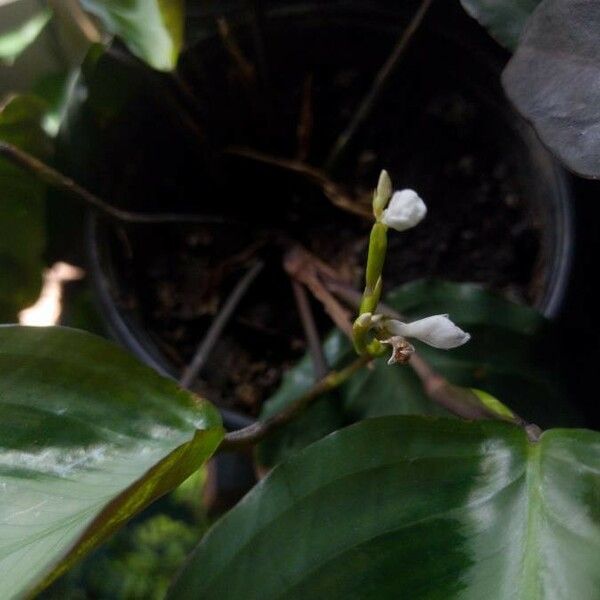
Plant Overview
Commonly known as the "Rabbit’s Foot" or "Prayer Plant," Maranta cristata is a botanical marvel of rhythm and color. Hailing from the humid tropical forest floors of Brazil, this plant is famous for its "nyctinastic" movement—folding its leaves upward at night like hands in prayer. It is a favorite for those seeking a "living" plant that visibly reacts to the cycle of the sun.
🔍 How to Identify
- 🍃 The "Rabbit Tracks": The leaves are broad and oval, featuring a bright emerald green background decorated with dark, brownish-green splotches between the veins that resemble animal footprints.
- 🤲 The Prayer Pose: The most distinct feature isn't just visual, but behavioral; as evening approaches, the leaves tilt upward vertically, revealing their lighter undersides.
- 🌱 Low Profile: This plant maintains a spreading, prostrate growth habit, rarely reaching more than a foot in height, making it an excellent choice for tabletops or hanging baskets.
🏡 In Your Garden
- ☁️ Humidity is Life: Because it evolved on the damp rainforest floor, this plant breathes through its leaves. If your indoor air is too dry, the leaf edges will quickly turn "crunchy" and brown. It loves a pebble tray or a nearby humidifier.
- 💧 Water Sensitivity: It is a bit of a "diva" regarding water quality. It is sensitive to fluoride and chlorine found in city tap water, which can cause leaf spotting. Using distilled or rainwater keeps the foliage pristine.
- 🌘 Shadow Dweller: Unlike many tropicals that crave bright sun, Maranta cristata is easily "sunburned." It prefers the soft, dappled light of a north-facing window or a cozy spot a few feet away from a bright light source.
⚠️ Safety & Toxicity
- 🐾 Pet Friendly: Excellent news for pet owners—the Maranta genus is non-toxic to cats and dogs, making it a worry-free addition to a busy household.
- 👶 Safe for Humans: It is entirely non-toxic to children, though the leaves are quite delicate and can be easily damaged by curious little hands.
✨ Fun Fact
The movement of the leaves is powered by a specialized "joint" called the pulvinus located at the base of the leaf. By shifting water pressure within this joint, the plant can change the angle of its leaves to catch the most light during the day and protect itself from heavy tropical rains at night!

Detailed Care Instructions
To grow Maranta Cristata plants, also known as prayer plants, follow these steps:
- Choose the right location: Prayer plants prefer bright, indirect sunlight. Avoid exposing them to direct sunlight, as it can scorch their leaves. They also thrive in warm temperatures ranging from 60-80°F (15-27°C).
- Provide the appropriate humidity: Prayer plants prefer high humidity levels. You can increase humidity by placing a humidifier nearby or by using a water-filled tray with pebbles beneath the plant.
- Watering: Keep the soil evenly moist but not soggy. Prayer plants are susceptible to root rot if they are overwatered or if their roots sit in standing water. They may need more frequent watering during warm weather and less during cooler months.
- Soil and container: Plant your Maranta Cristata in well-draining soil that is rich in organic matter. The container should have drainage holes to prevent waterlogging. You can use a mixture of peat moss, perlite, and potting soil to create an ideal growing medium.
- Fertilization: Feed your prayer plant with a balanced, water-soluble fertilizer diluted to half-strength every two to four weeks during the growing season (spring to summer). Avoid fertilizing during the dormant period (fall and winter).
- Propagation: Maranta Cristata plants can be propagated through division. Carefully separate the plant into smaller clumps, ensuring that each division has enough roots. Plant the divisions in separate pots and water them thoroughly.
- Pruning: Prayer plants can become leggy over time. Prune them in spring or summer by cutting back the overgrown stems to encourage bushier growth.
- Watch for pests: Keep an eye out for common houseplant pests like spider mites, mealybugs, or aphids. If you notice any pests, treat them promptly with an appropriate insecticidal soap or another organic solution.
Remember to provide regular care and keep an eye on the plant's health. With proper maintenance and conditions, your Maranta Cristata plant should thrive and grow.

Place in a window with dappled sun or a spot in the middle of a room. Or directly in a window facing west or east.

To water this plant, first ensure that the soil is slightly dry to the touch before watering. Fill a watering can with room temperature water and slowly pour the water around the base of the plant, avoiding the leaves if possible. Allow the excess water to drain out from the drainage holes at the bottom of the pot. Avoid over-watering or letting the plant sit in water, as this can cause root rot. Watering once a week is generally sufficient, but frequency may need to be adjusted based on temperature, humidity, and light conditions.
To fertilize this plant, mix a balanced, water-soluble fertilizer with water according to package instructions. Apply the fertilizer solution to the soil once a month during the growing season, which is typically spring and summer. Make sure to wet the entire root ball and avoid getting fertilizer on the leaves. Reduce fertilizing in the fall and winter when the plant is not actively growing.
For Maranta Cristata plants, it is recommended to use a well-draining soil mixture that is rich in organic matter. A good soil mix can include a combination of peat moss, perlite, vermiculite, and sand. It is important to ensure good drainage so that the soil does not become waterlogged. Additionally, regular fertilization with a balanced fertilizer can help to maintain healthy growth. It is also important to water the plant regularly, but avoid overwatering as this can cause root rot. Overall, a lightweight and well-draining soil mix works best for Maranta Cristata plants.
To propagate the Maranta Cristata plant, you first need to locate a healthy and mature plant that has several stems and plenty of foliage. You must then select a compact and well-established stem that is at least 3-4 inches in size and has some leaves attached to it.
Next, you need to take a sharp and sterilized pair of shears or pruning scissors and snip the stem off from the main plant, ensuring that you cut just below a node or where the leaves originate from the stem. You can then remove any excess leaves or stems from the cutting, leaving only a few healthy leaves at the top.
After this, fill a small pot with potting mix or a combination of peat moss and perlite, and moisten it well. Then, make a small hole in the center of the soil with a small stick or your finger and insert the cutting into it, making sure that the soil is firm around the stem.
Finally, place the pot in a warm and bright area but avoid direct sunlight, as this can damage the sensitive leaves. You should also mist the cutting with water daily or cover it with a plastic bag to increase humidity levels.
Over time, the cutting will begin to develop roots and new growth, indicating that it has successfully propagated into a new plant. You can then transplant it into a larger pot or into your garden.
Common pests of the mukulanukkumatti include Spider mites, fungus gnats, thrips. Make a habit of checking your mukulanukkumatti frequently for pests so that any infestations can be caught and managed early.








