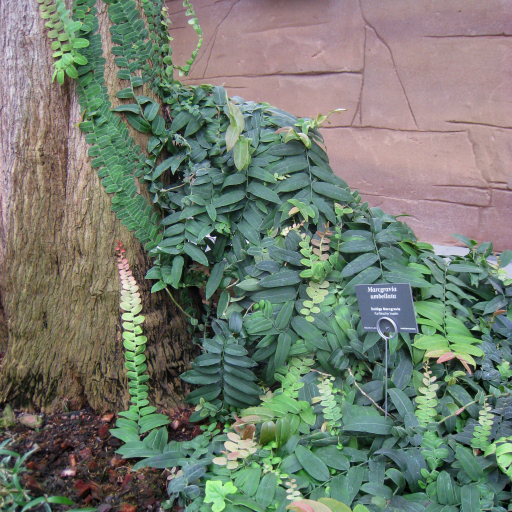
Plant Overview
Known as the "Caribbean Shingle Plant," Marcgravia umbellata is a botanical acrobat that transforms as it climbs. In its youth, it hugs tree trunks so tightly it looks like a coat of green scales, but as it reaches the canopy, it undergoes a dramatic "metamorphosis," growing large, swaying branches. This rare beauty is the ultimate prize for terrarium collectors looking to recreate a lush, prehistoric rainforest floor.
🔍 How to Identify
- 🍃 The Shingle Leaf: In its juvenile stage, the leaves are small, heart-shaped, and overlap one another perfectly, pressing flat against any surface like shingles on a roof.
- 🧗 Aerial Anchors: It features tiny, root-like structures along the stem that act like biological glue, allowing it to scale moist wood or stone without any external support.
- 🌳 Adult Metamorphosis: Once the plant reaches a certain height or light level, it stops "shingling" and begins producing larger, lance-shaped leaves that hang freely in the air.
🏡 In Your Garden
- 💧 The Humidity Requirement: This plant is a true rainforest native; it thrives in high humidity (ideally above 70%) and will quickly crisp up if the air is too dry. This makes it a star for glass enclosures or humid "plant rooms" rather than standard bookshelves.
- 🪵 The Need to Climb: Without a vertical surface like a cork pole, a damp wooden plank, or a moss wall to "shingle" against, the plant may lose its characteristic flat-leaf look and become a messy, trailing vine.
- 🚿 Airy Substrate: It hates "wet feet." Use a substrate like long-fiber sphagnum moss or an airy aroid mix to ensure the roots stay moist but oxygenated, preventing the dreaded root rot.
⚠️ Safety & Toxicity
- 🛡️ Low Risk: Marcgravia umbellata is not widely documented as a high-risk toxic plant, but it should still be handled with some care.
- 🐱 Pet Caution: Like many plants in the Marcgraviaceae family, the sap may contain calcium oxalate crystals. If chewed by pets or children, it can cause mild mouth irritation, drooling, or stomach upset. It is best placed in a secure terrarium.
✨ Fun Fact
🦜 Nectar Pitchers: When this plant matures and blooms in the wild, it produces bizarre, pitcher-shaped flowers that hang in a circular formation. These aren't for catching bugs—they are "nectar cups" designed specifically to feed hummingbirds and bats, who act as the plant's primary pollinators!

Detailed Care Instructions
To grow Marcgravia Umbellata, also known as the Shingle Plant or the Marcgravia Gold Vine, follow these steps:
- Prepare the soil: This plant prefers well-draining and fertile soil. Mix equal parts of potting soil, peat moss, perlite, and orchid bark.
- Choose a suitable container: Select a hanging basket or a container with good drainage holes. Make sure it is large enough to accommodate the plant's growth.
- Provide bright, indirect light: Marcgravia Umbellata thrives in bright, indirect sunlight. Place the plant near a window with filtered light or provide artificial grow lights.
- Maintain temperature and humidity: This plant prefers warm temperatures between 60-85°F (15-29°C). Keep it away from cold drafts or extreme temperature fluctuations. Maintain a humidity level of 50-60% by placing a humidifier nearby or using a pebble tray with water.
- Water properly: Ensure that the plant's soil is moist but not soggy. Water the plant when the top inch of soil feels dry. Avoid overwatering as it can lead to root rot. Mist the foliage regularly to increase humidity.
- Fertilize regularly: During the growing season (spring and summer), fertilize the plant every two weeks with a diluted balanced liquid fertilizer. This will provide the necessary nutrients for healthy growth.
- Prune when needed: Trim back leggy or unruly growth to help maintain the plant's shape. Pruning also stimulates new growth and encourages a bushier appearance.
- Maintain aerial roots: Marcgravia Umbellata produces aerial roots that attach themselves to surfaces. You can provide a trellis, moss-covered board, or other vertical structures for the roots to cling to as the plant grows.
- Propagate and share: This plant can be propagated through stem cuttings. Take a cutting of about 3-4 inches (7-10 cm) long from a healthy, established plant, and place it in a moist, well-draining potting mix. Keep the soil consistently moist until the cutting roots, usually within a couple of weeks.
By following these steps, you can successfully grow and care for a Marcgravia Umbellata plant.

Place in a window with dappled sun or a spot in the middle of a room. Or directly in a window facing west or east.

1. Determine the soil type: Marcgravia Umbellata plant requires well-draining soil, so it's essential to choose the right type of soil mix. You can use a combination of peat moss, perlite, and sand to ensure good drainage.
2. Watering frequency: The frequency of watering depends on several factors such as the weather, humidity, and the plant's growth stage. As a rule of thumb, water the plant when the top inch of soil is dry to the touch. Overwatering can lead to root rot, so make sure not to let the soil stay waterlogged.
3. Watering method: To water the Marcgravia Umbellata plant, gently pour water into the soil until it drains through the bottom of the pot. You can also place the pot in a tray filled with water, allowing the plant to soak up the water from the drainage holes.
4. Humidity: This plant thrives in high humidity levels, so it's essential to keep the air around it moist. You can mist the plant regularly or use a humidifier to maintain the ideal humidity levels.
5. Avoid wetting the leaves: This plant is susceptible to leaf spot disease, which can be caused by wetting the leaves. Therefore, it's essential to direct the water towards the soil and avoid getting it on the leaves.
6. Monitor the plant: Keep an eye on the plant's growth and health to detect any signs of overwatering or underwatering. If the leaves start to turn yellow or become droopy, it could be a sign of over or underwatering. Adjust the watering frequency accordingly.
7. Water quality: The quality of water used to water the plant can also affect its health. Avoid using hard water or water that contains high levels of salts, as it can damage the plant's roots. You can use distilled or rainwater for optimal growth.
To fertilize this plant, use a balanced liquid fertilizer with an N-P-K ratio of 10-10-10. Dilute the fertilizer to half strength and apply it to the soil once a month in the growing season. Avoid getting the fertilizer on the leaves and stems as it may cause burning. Water the plant well before and after fertilizing to prevent root burn.
The optimal soil for Marcgravia Umbellata should be nutrient-rich and well-draining. A mixture of organic matter such as peat moss or compost, with perlite or coarse sand to improve drainage, is recommended. The soil should have a slightly acidic pH level between 5.5-6.5. The roots of the plant should be allowed enough space to grow, and the soil should be moist but not waterlogged. It is also recommended to provide some form of support for the plant, such as a trellis or moss pole, as it will naturally climb and attach itself to surfaces.
There are a few methods to propagate this plant. One way is through stem cuttings. Select a healthy, mature stem and cut it just below a node (point where a leaf grows). Remove any leaves from the lower half of the cutting. Dip the cut end in rooting hormone and plant it in a well-draining soil mix. Keep the soil moist and place the cutting in a bright, indirect light. After a few weeks, roots should start to develop and new leaves will form.
Another method is by layering. Select a limb that is close to the ground and slightly flexible. Gently scrape off a small area of bark on the underside of the limb where it touches the ground. Dust the scraped area with rooting hormone and cover it with soil. Water the area well and cover it with plastic to keep it moist. After a few weeks, roots should form and the plant can be separated from the parent plant.
Propagation can also be done through seeds. However, this method can be more difficult as the seeds have a low germination rate and require specific conditions to grow. The seeds should be soaked overnight in water before planting in a well-draining soil mix. Keep the soil moist and in a warm, humid environment until the seeds germinate.
Common pests of the monkey paws include Mealybugs, spider mites. Make a habit of checking your monkey paws frequently for pests so that any infestations can be caught and managed early.








