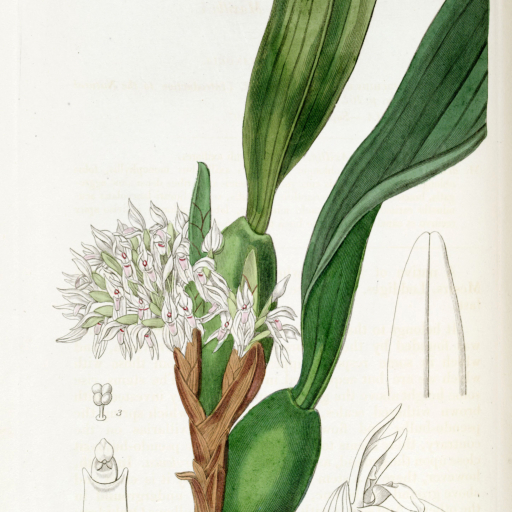
Plant Overview
Often called the Dense-Flowered Maxillaria, this orchid is a charming "creeper" originating from the humid cloud forests of Mexico and Central America. Unlike the tall, showy Phalaenopsis found in grocery stores, this species is prized for its prolific, jewel-like clusters of tiny flowers that emerge from the base of its leaves. It is a resilient survivor that brings a touch of the misty highlands into the modern home.
🔍 How to Identify
- 🌿 Growth Habit: It features flattened, oval-shaped pseudobulbs that grow along a creeping rhizome, often forming dense, grassy mats over time.
- 🍃 Foliage: Each pseudobulub produces a single, long, strap-like leaf that is thin and flexible, resembling decorative forest grass.
- 🌸 Clustered Blooms: The flowers are tiny—rarely exceeding an inch—and vary in color from creamy white to a deep, wine-red. They grow in "dense" bunches (hence the name) tucked close to the stems.
🏡 In Your Garden
- ☁️ Humidity is Key: Because this plant is an epiphyte (a "tree-dweller"), it lacks traditional soil roots. It thrives when mounted on cork bark or tucked into a slatted basket with sphagnum moss to mimic its misty mountain home.
- 💧 The "Plumpness" Test: Its pseudobulbs act as water reservoirs. If you notice them beginning to shrivel or wrinkle, it’s a sign the plant is thirsty and needs a boost in ambient humidity or a thorough misting.
⚠️ Safety & Toxicity
- ✅ Status: Non-toxic and safe.
- 🐾 Details: Like the vast majority of the Orchidaceae family, Maxillaria densa is considered non-toxic to cats, dogs, and humans. It is a "pet-friendly" choice for indoor collectors, though its grass-like leaves might be tempting for curious cats to nibble on.
✨ Fun Fact
While many orchids are famous for their sweet perfumes, Maxillaria densa is often described as having a nostalgic, waxy scent that reminds collectors of old-fashioned honey or even light coconut, especially during the brightest part of the day!

Detailed Care Instructions

Place in a window with dappled sun or a spot in the middle of a room. Or directly in a window facing west or east.

Water-loving plants flourish in wet or sloppy soil and near ponds. The extensive root system enables these plants to absorb plenty of water. The surface of the soil should be kept moist at all times. Place your pot in a container filled with water to guarantee that plants get enough water. If the ground becomes dry, it is recommended that you water it well. Plants in smaller pots will need to be watered more frequently. Water the soil in which the plant is standing thoroughly using a watering can.








