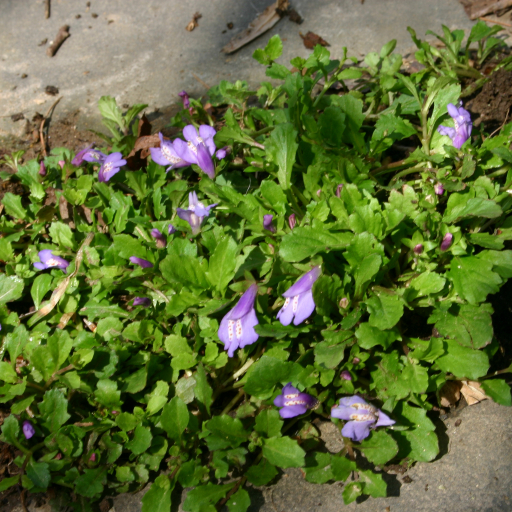
Plant Overview
Often called the "Creeping Mazus" or the "Miniature Carpet," Mazus reptans is a tiny powerhouse from the craggy slopes of the Himalayas. This resilient perennial is a favorite for fairy gardens and stone pathways because it creates a lush, emerald rug that stays remarkably low to the ground. While it looks delicate, it is surprisingly tough, often used as a "living grout" to fill the gaps between pavers.
🔍 How to Identify
- 🌿 Folliage Texture: The leaves are tiny, lance-shaped, and bright green with slightly "toothed" or wavy edges, forming a dense, interlocking mat.
- 🌸 Snapdragon-like Blooms: In late spring and summer, it produces miniature, tubular flowers that are typically purplish-blue with distinct white and yellow spots in the center.
- 🏃 Growth Habit: It spreads via "creeping" stems (stolons) that root as they touch the ground, allowing it to rapidly colonize empty spaces without becoming invasive.
🏡 In Your Garden
- 🛤️ The Steppable Secret: Unlike many ground covers, Mazus can handle moderate foot traffic. It’s the perfect choice for planting between stepping stones where its soft texture cushions every step.
- 💧 Thirsty Foundations: This plant is a moisture-lover. While it can tolerate some sun, it truly thrives in damp soil. It’s an excellent choice for those "soggy spots" in the yard or near the edges of a garden pond.
- 🧱 Rooting Nuance: Because it roots at every node along its stem, it is excellent for erosion control on small slopes, as it "knits" the soil together.
⚠️ Safety & Toxicity
- ✅ Safe Status: Mazus reptans is generally considered non-toxic to humans, dogs, and cats.
- 🐾 Pet-Friendly: Since it is often used in areas where pets might roam or lounge, it is a fantastic, worry-free alternative to chemically treated lawns or more sensitive ornamental plants.
✨ Fun Fact
Despite its tiny size, Mazus is a member of the Mazaceae family and was once grouped with the Snapdragons. If you look closely at the flower, you’ll see it has a "lip" designed perfectly for small pollinators to land on, much like its larger snapdragon cousins!

Detailed Care Instructions
To grow Mazus Reptans, you can follow these steps:
- Choose a suitable location: Mazus Reptans prefers partial shade to full sun, so select a location that provides some shade during the hottest part of the day.
- Prepare the soil: The plant prefers moist, well-draining soil. Amend the soil with organic matter, such as compost, to improve its fertility and drainage.
- Planting: Mazus Reptans can be propagated from seeds, plugs, or division. If using seeds, sow them directly into the prepared soil, keeping them moist until they germinate. For plugs or division, dig a hole slightly larger than the root ball and place the plant at the same depth as it was in the previous container or location.
- Watering: Keep the soil consistently moist but not waterlogged. Water deeply whenever the top inch of soil feels dry. Adjust the frequency of watering as per the weather conditions.
- Mulching: Apply a layer of organic mulch around the plants to help retain moisture, suppress weeds, and regulate soil temperature.
- Fertilizing: Apply a balanced, slow-release fertilizer in spring to promote healthy growth. Follow the recommended dosage as per the packaging instructions.
- Pruning: Trim back any dead or yellowing foliage as needed. This will help maintain a neat appearance and encourage new growth.
- Pests and diseases: Mazus Reptans is relatively resistant to pests and diseases. However, keep an eye out for common garden pests like aphids or slugs. If detected, use appropriate organic pest control methods to address the issue.
- Propagation: Mazus Reptans can be propagated by division. Dig up the plant, carefully separate the root clump into smaller sections, and replant them in their own areas.
- Overwintering: In colder climates, Mazus Reptans may die back in winter. However, it usually regrows in the spring. Consider covering the plants with mulch or protective layers to insulate them during the colder months.
Remember to regularly monitor the plant's watering needs, adjust as necessary, and provide proper care. With these guidelines, you should be able to successfully grow Mazus Reptans.

Place in a bright room that is sun drenched almost all day. Or directly in a south-facing window.

To water this particular plant, it is important to keep the soil consistently moist. Do not let the soil dry out completely, but also avoid overwatering as it can lead to root rot. It is best to water early in the morning or late in the evening to prevent evaporation. Use a watering can or a hose with a gentle spray nozzle to water the soil around the plant base, avoiding getting water on the leaves. Watering should be done regularly, especially during the hot and dry summer months.
To fertilize this plant, use a balanced fertilizer with an N-P-K ratio of 10-10-10. Apply the fertilizer once a month during the growing season, which is typically spring to fall. Be sure to follow the instructions on the fertilizer packaging for application rates. Alternatively, you can use an organic fertilizer, such as compost or aged manure, applied at a rate of one to two inches around the base of the plant. Water the plant well after applying fertilizer.
Mazus Reptans plant requires a well-draining soil that is rich in organic matter. The soil should be slightly acidic with a pH level between 5.5 and 6.5. It should be moist but not waterlogged, as the plant is susceptible to root rot. The ideal soil texture should be sandy and loamy, allowing for sufficient drainage. It is also recommended to mix perlite or sand with the soil to improve drainage. The plant can tolerate some soils with poor drainage, but it is not recommended for long-term growth. Furthermore, heavy clay soils can make it challenging for the plant to establish a healthy root system. Finally, the soil should have good aeration to allow for proper breathing of the roots.
To propagate this plant, you can take stem cuttings from healthy, mature plants. Select a stem that has several leaves and is at least several inches long. Using a sharp, clean pair of scissors or pruners, make a clean cut just below a node (where a leaf attaches to the stem). Remove any lower leaves, leaving only a few leaves at the top of the cutting. Dip the cut end into rooting hormone powder if desired, then plant the cutting in a well-draining potting mix. Keep the soil moist but not waterlogged, and place the pot in a warm, bright location out of direct sunlight. Over the next few weeks, the cutting should develop roots and begin to grow new leaves. Once it has rooted, you can transplant it into a larger pot or directly into the ground.
Common pests of the miquel's mazus include Spider mites, larvae. Make a habit of checking your miquel's mazus frequently for pests so that any infestations can be caught and managed early.








